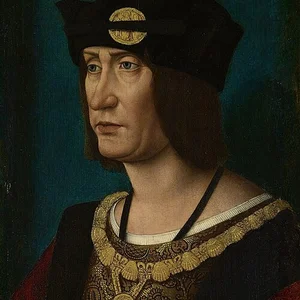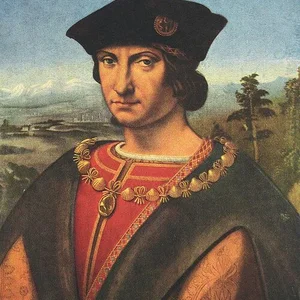

Lord of Chaumont and governor of the Duchy of Milan on behalf of Louis XII, Charles d'Amboise (1473–1511) was one of the leading French military commanders during the Italian Wars. He is particularly known for having been Leonardo da Vinci's patron in Milan.
Charles d'Amboise
Charles d'Amboise
6 min read
Frequently asked questions
Key Facts
- 1473: born into the powerful d'Amboise family, closely connected to the kings of France
- 1499: takes part in Louis XII's conquest of the Duchy of Milan
- 1503: appointed Governor-General of Milan, a post he held until his death
- 1506–1507: protects and supports Leonardo da Vinci in Milan, commissioning several works from him
- 1511: dies at Correggio during the Italian campaign
Works & Achievements
Charles d'Amboise administered the Duchy of Milan for nearly eight years on behalf of Louis XII, maintaining order and managing the complex relations between Italian powers and the French crown.
Following the Genoese uprising against French rule, Charles d'Amboise led the army that retook the city, restoring Louis XII's authority over this important Mediterranean port.
Commanding the French forces in this decisive battle, Charles d'Amboise crushed the Venetian army and paved the way for French hegemony in northern Italy.
Charles d'Amboise was Leonardo da Vinci's principal patron in Milan, commissioning works from him and interceding with the Florentine authorities to extend his stay in Lombardy.
Anecdotes
Charles d'Amboise was a fervent admirer of Leonardo da Vinci. When Florentine authorities demanded the master's return in 1506, he personally wrote a letter to the gonfalonier of Florence to secure an extension of his stay in Milan, arguing that Leonardo was “infinitely dear” to him. This unusual diplomatic gesture testifies to the exceptional prestige the artist enjoyed among the powerful figures of his era.
In May 1509, Charles d'Amboise led the French forces at the Battle of Agnadello, one of the greatest French military victories of the Renaissance. In a single day, the French army crushed the forces of the Republic of Venice, paving the way for French dominance in northern Italy. Machiavelli himself cited this battle as an example of the fragility of states built on mercenary troops.
Governor of Milan for nearly eight years, Charles d'Amboise had to manage a wealthy but difficult city to administer. He strove to balance the interests of the Milanese elites with the demands of the French crown, effectively serving as a viceroy. His policy of equilibrium earned him a degree of acceptance from the Lombard population — no small feat for a foreign conqueror.
Charles d'Amboise died in Milan on January 11, 1511, at only 38 years old, carried off by illness in the midst of the Italian campaigns. His death came at a critical moment for France, just as Pope Julius II had formed the Holy League against it. Leonardo da Vinci, whom he had protected and supported, found himself without his main patron in Milan and was forced to seek new protectors.
Primary Sources
«We have experienced the excellence of Master Leonardo da Vinci in several things we have asked of him, both in architecture and in other areas of his art, and we are satisfied in the highest degree.»
Jean d'Auton, official chronicler of Louis XII, recounts the military exploits of Charles d'Amboise in Italy and his role as governor of Milan, attesting to his loyalty to the king and his remarkable military and administrative abilities.
The letters between the king and his governor bear witness to the royal trust placed in Charles d'Amboise, who was tasked with maintaining French dominion over Lombardy and managing relations with the Italian powers.
Key Places
Family château of the lords of Amboise in the Loire Valley. This was the estate from which Charles d'Amboise took his title of lord of Chaumont, an inheritance from his powerful family.
Official residence and seat of French government in Lombardy. Charles d'Amboise administered the Duchy of Milan from there from 1503 until his death in 1511, wielding the powers of a true viceroy.
Village in Lombardy where the decisive battle of 14 May 1509 took place, in which Charles d'Amboise crushed the Venetian forces — one of the greatest French victories of the Italian Wars.
Strategic Mediterranean port where Charles d'Amboise led military operations in 1507 to restore French authority after the city revolted against the rule of Louis XII.
Favourite residence of Louis XII and heart of the French royal court. Charles d'Amboise received his orders from the king there and reported on the situation in Italy during his returns to France.
Liens externes & ressources
Références
Œuvres
Gouvernement du duché de Milan
1503-1511
Reprise de Gênes révoltée
1507
Victoire d'Agnadello
1509
Mécénat de Léonard de Vinci à Milan
1506-1511