
A Hausa warrior queen of the kingdom of Zazzau (present-day Zaria, Nigeria), Amina reigned around the 16th century according to Hausa oral traditions. She greatly expanded her kingdom's territory through military conquest and is celebrated as a symbol of female power in Hausa collective memory.
Frequently asked questions
Famous Quotes
« "A woman who deserves a throne must first deserve the battlefield." (words attributed to Amina by Hausa oral tradition, unverified)»
Key Facts
- Amina is known primarily through Hausa oral traditions and the oral chronicles of Kano and Katsina — few contemporary written sources exist.
- She is said to have reigned during the second half of the 16th century over the kingdom of Zazzau (present-day Zaria, in Kaduna State, Nigeria).
- According to tradition, she led numerous military campaigns and extended Zazzau's control over trans-Saharan trade routes.
- Oral tradition credits her with building defensive earthen ramparts around conquered cities, still referred to as 'Amina's walls' in some regions.
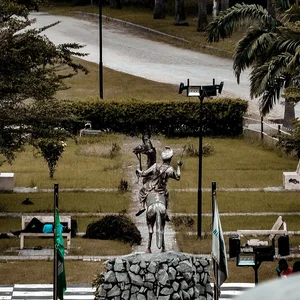
- Amina is today a national figure in Nigeria: a statue in her honor stands in Abuja and her image has appeared on banknotes.
Works & Achievements
Amina is credited with building earthen walls around dozens of conquered cities. Some of these remains are still visible in northern Nigeria and represent her principal material legacy, confirmed through archaeological evidence.
Through her military campaigns, Amina extended Zazzau's territory to its greatest reach, covering a vast area of what is now northern Nigeria. This expansion made Zazzau the dominant power among the southern Hausa kingdoms.
By conquering the Nupe and Kwararafa lands as far as the Niger River, Amina opened new trade corridors linking the northern Hausa cities to the coastal markets of the Gulf of Guinea, bringing lasting prosperity to Zazzau.
The cycle of stories, epic songs, and poetic praises devoted to Amina forms a collective work of the Hausa oral tradition. Passed down by griots, it has kept her memory alive to the present day.
Amina established a system for administering vassal territories based on the regular payment of tribute — including kola nuts, enslaved people, and livestock — which funded Zazzau's military power and foreshadowed forms of regional political organization.
Anecdotes
According to Hausa oral tradition, Amina is said to have refused to marry so she would never have to share her power. It is told that after each victory, she would take a warrior as a temporary companion, dismissing him by morning — a symbol of her absolute dominion over men as much as over armies.
Oral traditions credit Amina with building earthen fortifications around every city she conquered. These ramparts, known as 'ganuwar Amina' (the walls of Amina), are still visible in parts of northern Nigeria today and have become one of her most enduring architectural legacies.
Tradition holds that Amina personally led her troops into battle on horseback, clad in war armor, at the head of a feared cavalry. She is said to have commanded more than thirty battles in fewer than thirty years, pushing the borders of Zazzau all the way to the banks of the Niger River and toward Kano.
Hausa griots sing that Amina mastered the art of war from childhood, observing military strategies at the court of her mother Bakwa Turunku, herself queen of Zazzau. She is said to have never known defeat in her lifetime, earning her the title 'Lioness of Zazzau.'
According to some versions of oral tradition, Amina died while on military campaign, faithful to the end to her warrior calling. Her death far from home, on enemy soil, is presented as the fitting death of a warrior-queen who never stopped fighting for her people.
Primary Sources
The oral annals later compiled in writing mention Zazzau as an expansionist power under the reign of a warrior queen, whose conquests extended the Hausa trade routes southward into Nupe territory and westward to the banks of the Niger River.
Amina, daughter of Bakwa Turunku, ruled Zazzau after her brother Karama. She opened roads and compelled all neighboring kings to pay her tribute. None challenged her authority during her reign.
The praise songs (kirari) dedicated to Amina describe her as 'daughter of Bakwa with armor sharp as steel', riding at the head of her warriors, merciless in battle and just in her governance of her subjects.
The traditions of the neighboring peoples subjugated by Zazzau preserve the memory of a Hausa queen who demanded tribute in kola nuts and enslaved people, and whose armies built earthen palisades around conquered towns before withdrawing.
Key Places
Capital of the Zazzau kingdom and the heart of Amina's power. The city preserves remnants of earthen ramparts attributed to the queen, and its emirate keeps her memory very much alive.
An archaeological site near Zaria identified as the location of the ancient capital of Bakwa Turunku, Amina's mother. Excavations there have confirmed the presence of defensive structures dating to the presumed period of Amina's reign.
The southern limit of Amina's conquests according to Hausa oral tradition. By reaching the Niger, she opened Zazzau's access to trade routes leading to the Gulf of Guinea.
A major Hausa city-state neighboring Zazzau, with which Amina maintained complex relations combining commercial rivalry and occasional alliances. The Kano Chronicles indirectly refer to the power of Zazzau during this era.
A region subjugated by Amina's armies during her campaigns southward. Nupe traditions preserve the memory of the tribute demands imposed by the warrior queen of Zazzau.
Typical Objects

According to oral traditions, Amina wore reinforced leather armor and a metal helmet in battle. This equipment, reserved for the warrior elite, symbolized her exceptional status as a warrior-queen.

The long lance was the primary weapon of the Hausa cavalry that Amina commanded. Epic songs describe her brandishing her lance at the head of her troops during decisive charges.

Hausa rulers used horses imported from North Africa via trans-Saharan trade routes. Amina is invariably depicted on horseback in oral traditions, a sign of her military command.

The kola nut was the main currency of exchange and tribute in the Hausa kingdoms. The peoples conquered by Amina are said to have paid her tribute in kola nuts, a prized commodity along trade routes.

The tambari is the great war drum reserved for Hausa rulers, a symbol of royal authority. Its beat announced Amina's military campaigns and her victories.

Elite Hausa warriors used shields made of tanned buffalo hide, resistant to arrows and lance strikes. This type of shield appears in oral descriptions of Amina's equipment.

As queen of Zazzau, Amina wore the insignia of Hausa power: a royal turban, ceremonial sandals, and gold-embroidered garments, marking her dual status as sovereign and war leader.
School Curriculum
Vocabulary & Tags
Key Vocabulary
Tags
Daily Life
Morning
Amina began her day before dawn with prayer (though the Islamization of Zazzau was still partial in the 16th century, the court had already come into contact with Islam). She would then review her troops with her generals, receiving scouts' reports on enemy movements and the state of the trade routes.
Afternoon
Afternoons were devoted to governing the kingdom: receiving vassal chiefs who came to pay tribute, arbitrating trade disputes, and inspecting the fortification works around newly conquered towns. Amina personally oversaw the defensive constructions that still bear her name today.
Evening
In the evenings at court, griots sang of the deeds of royal ancestors and Amina's recent victories. Senior officers and wealthy merchants shared a meal with the queen, during which upcoming campaigns were planned. Nights of the full moon could give rise to propitiatory ritual ceremonies held before departures to war.
Food
The diet at the court of Zazzau was built around millet and sorghum, prepared as porridge (fura) or flatbread (tuwo), served with spiced soups made with okra and groundnuts. Mutton and beef were reserved for festive meals and ritual offerings. Kola nuts, a symbol of status, were chewed during important meetings.
Clothing
In peacetime, Amina wore finely woven cotton garments dyed with indigo, with gold embroidery on the sleeves and collar — marks of Hausa royal rank. On campaign, she donned reinforced leather armor, a metal helmet, and protective leg guards, an appearance that struck enemies as remarkable for a woman.
Housing
The royal palace of Zazzau (gidan sarki) was a vast complex of adobe (banco) buildings, with shaded inner courtyards, separate apartments for the women of the court, and stables for the warhorses. The thick walls kept the interior relatively cool despite the savanna heat. Watchtowers allowed guards to survey the surroundings of the capital.
Historical Timeline
Period Vocabulary
Visual Style
Style épique et chaleureux aux teintes ocre, terre et indigo, mêlant iconographie guerrière haoussa et grandeur des savanes du Sahel nigérian.
Sound Ambience
Ambiance guerrière et royale des savanes du nord Nigeria au XVIe siècle : tambours de guerre, cavalerie au galop, chants épiques des griots haoussa et rumeur des caravanes commerciales.
Liens externes & ressources
Références
Œuvres
Réseau de fortifications 'Ganuwar Amina'
vers 1576–1610
Extension territoriale du royaume de Zazzau
vers 1576–1610
Ouverture des routes commerciales haoussa vers le Sud
vers 1580
Épopée orale d'Amina (kirari et chants de louange)
XVIe siècle et postérieur
Système de tributs et gouvernance des territoires conquis
vers 1577–1610