
Yinka Shonibare is a British visual artist of Nigerian descent, born in 1962. He is famous for his installations and sculptures using wax fabric — that colorful cloth associated with Africa but with complex colonial origins — to question identity, colonialism, and cultural hybridity.
Yinka Shonibare(1962 — ?)
Yinka Shonibare
Royaume-Uni, Nigeria
6 min read
Frequently asked questions
Key Facts
- Born in 1962 in London, he grew up in Nigeria before returning to study art in London
- Nominated for the Turner Prize in 2004
- Created the installation “Nelson's Ship in a Bottle” on the fourth plinth of Trafalgar Square (2010-2012)
- Member of the Royal Academy of Arts (Royal Academician)
- Appointed Commander of the Order of the British Empire (CBE) in 2019 for his contributions to art
Works & Achievements
A series of photographs in which Shonibare casts himself as a Black dandy at the heart of Victorian high society, overturning racial and social hierarchies.
An installation shown at Documenta 11, featuring wax-clad mannequins in scandalous poses, evoking the travels of the European Grand Tour.
Fourteen headless mannequins gathered around a table re-enact the 1884 Berlin Conference, where the European powers divided Africa among themselves.
A giant replica of HMS Victory with sails made of wax fabric, installed on the Fourth Plinth in Trafalgar Square, among his most famous works.
An installation of thousands of wax-covered books bearing the names of immigrants who shaped British culture, a celebration of diversity.
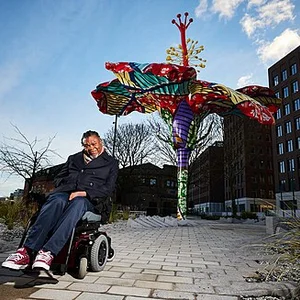
A series of large fibreglass sculptures imitating wax fabric lifted by the wind, installed in public spaces around the world.
Anecdotes
At the age of 18, Yinka Shonibare contracted transverse myelitis, an inflammation of the spinal cord that left him partially paralysed. Since then, he has used a wheelchair and works with a team of assistants who create his works according to his precise instructions.
The colourful wax fabric that Shonibare uses throughout his work is not really African: these printed cottons were invented by the Dutch in the 19th century, imitating Indonesian batik, before being sold in West Africa. The artist uses them precisely to show that identities are mixed and manufactured.
In 2010, Shonibare installed a giant replica of Admiral Nelson's ship, HMS Victory, sealed inside a bottle, on the fourth plinth of Trafalgar Square in London. The ship's 37 sails were made of wax with vibrant patterns, transforming a symbol of the British Empire into a tribute to London's diversity.
Shonibare likes to describe himself as a “hybrid Briton”: born in London, he grew up in Lagos, Nigeria, then returned to study art in England. When a teacher once asked him to produce “authentically African” art, he decided instead to explore what authenticity really means.
In 2019, the artist was honoured by the Queen and could henceforth add the letters “MBE”, and later “CBE”, to his name. With humour, he officially incorporated these titles into his artist name, signing “Yinka Shonibare CBE”, because they are part of his questioning of social class and the British establishment.
Primary Sources
African fabric isn't really African. That's what interests me: this idea that authenticity itself is a construction.
The ship celebrates the diversity and multicultural richness of London, a city shaped by its imperial and migratory history.
My work questions the meaning of cultural and national identities through the lens of colonialism and postcolonialism.
Key Places
Shonibare's birthplace and the centre of his artistic career, where he still lives and works.
City where Shonibare spent his childhood in a Yoruba family, the source of his hybrid identity. He founded his artists' residency G.A.S. there.
Art school where he earned his master's degree in 1991, alongside the generation of Young British Artists.
Iconic square where his "Nelson's Ship in a Bottle" occupied the Fourth Plinth from 2010 to 2012.
Prestigious institution of which he became a member (Royal Academician) in 2013.
Typical Objects

Cotton printed with vivid patterns, associated with Africa but invented by Europeans for the colonial trade. It is Shonibare's signature material.

Life-size figures dressed in Victorian costumes made of wax fabric, often decapitated in reference to the French Revolution. They populate his installations.

A 19th-century aristocrat's garment reproduced in colorful African fabric, blending the imperial era with a postcolonial imagination.

A replica of a great historic sailing ship enclosed in a glass bottle, its sails cut from wax fabric. A symbol of exploration and Empire.

A sphere, or a mannequin's head replaced by a globe, appearing in several works to evoke globalization and the ties between continents.

The tool with which Shonibare stages self-portraits, notably his series inspired by the Victorian dandy Oscar Wilde.
School Curriculum
Vocabulary & Tags
Key Vocabulary
Tags
Daily Life
Morning
Shonibare's morning often begins in his East London studio, where he welcomes his team of assistants. Since he cannot paint or sculpt himself because of his disability, he devotes this time to conceiving, drawing, and giving detailed instructions.
Afternoon
The afternoon is dedicated to steering production: choosing wax fabrics, supervising the sewing of costumes, approving the models. He converses with gallery owners, curators, and exhibition organizers from all over the world.
Evening
In the evening, the artist attends openings, lectures, or art-world dinners. He also devotes time to his philanthropic projects, such as the G.A.S. foundation in Nigeria.
Food
Living between London and Lagos, Shonibare enjoys a blended cuisine that mirrors his art, from British dishes to Yoruba specialties like jollof rice. His diet reflects his identity as a British-born Nigerian.
Clothing
Elegant and well-groomed, he loves refined clothing and gladly plays with the figure of the dandy that he stages in his works. The suit, a symbol of social class, holds a central place in his thinking as well as in his wardrobe.
Housing
He lives and works in London, in an environment adapted to his wheelchair. He also owns a farm in Nigeria that has been turned into a residence for artists, extending his connection to his two cultures.
Historical Timeline
Period Vocabulary
Liens externes & ressources
Références
Œuvres
Diary of a Victorian Dandy
1998
Gallantry and Criminal Conversation
2002
Scramble for Africa
2003
Nelson's Ship in a Bottle
2010
The British Library
2014