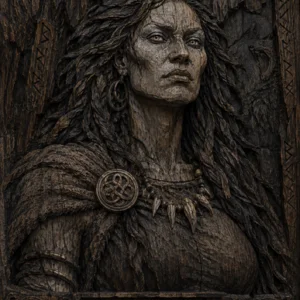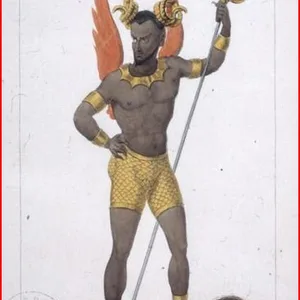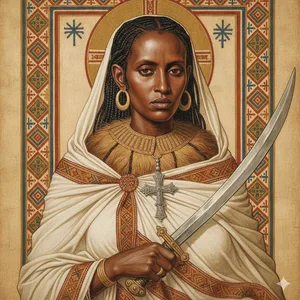

Semi-legendary warrior queen of Ethiopia (10th century), whose name means "Judith." She is said to have overthrown the Kingdom of Aksum, burned its churches, and ruled for several decades over the Ethiopian highlands.
Yodit
Yodit
8 min read
Frequently asked questions
Key Facts
- Around 960 AD: Yodit (Gudit) is said to have overthrown the last Aksumite dynasty
- She allegedly set fire to Ethiopia's main Christian churches and monasteries
- Her reign is said to have lasted around 40 years according to Ethiopian chronicles
- Her origins are debated: she may have been Jewish (Beta Israel) or from a non-Christian ethnic group
- Her downfall marks the emergence of the Zagwe dynasty in the 11th century
Works & Achievements
The founding act attributed to Yodit in Ethiopian tradition: the military conquest and destruction of the last Aksumite power, bringing an end to a millennium of dominance by this Christian dynasty.
The central legendary narrative surrounding Yodit: the burning of the great basilicas of Aksum and the dispersal of their clergy — an event that left a lasting mark on Ethiopian Christian memory as a foundational trauma.
A period of rule lasting one to several decades, depending on the sources, during which Yodit is said to have imposed her authority over the regions of Tigray and Amhara, in the dynastic vacuum that followed the fall of Aksum.
While Ethiopian Christian sources cast Yodit as a destroyer, some contemporary historians see in her actions an attempt to assert the rights of non-Aksumite populations — Beta Israel and Agaw communities — who had been marginalized by Christian power.
Beyond history, Yodit has become in Ethiopian oral and literary tradition the prototype of the warrior queen, inspiring tales, poetry, and debates about Ethiopia's multicultural identity.
Anecdotes
According to Ethiopian tradition, Yodit is said to have set fire to the cathedral of Maryam Tsion in Aksum, one of the most sacred shrines of Ethiopian Christianity. Chronicles report that she had sacred books thrown out and altars destroyed. For the faithful, this act was felt as the end of an era: the very symbol of the Christian kingdom of Aksum was collapsing in flames.
Her name “Yodit” is the Ethiopian form of the Hebrew name “Judith,” the famous biblical heroine who beheaded the enemy general Holofernes. This parallel may not be a coincidence: some traditions make Yodit a descendant of the Falashas (Beta Israel, the Jewish community of Ethiopia) or of a people who rejected Aksumite Christian domination. Like the biblical Judith, she symbolizes a woman who overthrows the powerful.
Oral tradition holds that Yodit defeated the last king of Aksum in single combat or through military cunning. This king is said to have died without a recognized heir, leaving a power vacuum that lasted several decades. This troubled period is sometimes called “the time of Yodit” in Ethiopian chronicles, which depict her in turns as a conquering queen and as a scourge sent to punish the sins of the people.
For nearly forty years according to some sources, Yodit is said to have ruled the Ethiopian highlands from her own fortresses in the Tigray and Amhara regions. Ethiopian hagiographic texts preserve the memory of monks and priests who fled carrying precious relics to keep them from her troops. These accounts of heroic flight are among the rare indirect testimonies of her passage.
Primary Sources
The chronicles of the sanctuary of Aksum mention the destruction of churches by a hostile queen from the south, who burned its treasures and toppled the royal stelae. The memory of this catastrophe is preserved in the liturgical traditions of the holy site.
The Arab geographer notes that the caravan routes between Arabia and the Ethiopian interior were disrupted toward the end of the 10th century, and that the Christian power of Tigray was weakened by internal revolts. He mentions the instability of the mountainous regions of Ethiopia.
This hagiographic text alludes, through retrospective reference, to a period of devastation of churches in northern Ethiopia: monks are said to have hidden relics and manuscripts to protect them from persecutors. The figure of Yodit is implicitly associated with this era of destruction.
The Coptic patriarchs of Alexandria, on whom the Ethiopian Church depended, mention difficulties in maintaining contact with the Christian community of Ethiopia in the 10th century, and refer to persecutions of Christians in the mountainous regions.
Key Places
The ancient capital of the Kingdom of Aksum and spiritual heart of Ethiopian Christianity, the city was the main stage of the legendary destruction carried out by Yodit. Its stelae and ruined churches still bear, according to some local traditions, the memory of these events.
A monastery perched atop an inaccessible rocky pinnacle, where monks are said to have sheltered manuscripts and relics during Yodit's conquest. Its impregnable position makes it a symbol of spiritual resistance in the face of devastation.
The geographical heart of Aksumite power and the main theater of Yodit's revolt, these high-altitude plateaus form the region of the "cold lands" where the great battles of Ethiopian legend are said to have unfolded.
The islands of Lake Tana are home to ancient monasteries said to have sheltered refugees during Yodit's reign. Some hagiographic texts mention relics transported to the island sanctuaries to keep them safe from persecution.
A remote mountainous region in northern Ethiopia and the future cradle of the Zagwe dynasty. It was in these highlands that post-Aksumite power was reconstituted after the period of Yodit, eventually leading to the construction of the rock-hewn churches of Lalibela.
Typical Objects

The central symbolic attribute associated with Yodit in Ethiopian tradition, the torch embodies her destructive mission against the Aksumite churches. It has become the emblem of her passage in hagiographic chronicles.

A traditional weapon of Ethiopian highland warriors, Yodit's sword represents her military authority and her ability to overthrow a kingdom that no one had managed to bring down before her.

These bronze or gold crosses, emblems of Ethiopian Christianity, are precisely what Yodit is said to have destroyed or melted down, symbolizing in tradition the overturning of an entire religious order.

In the oral traditions of the highlands, legendary queens and warrior women wore lion skins to signify their power and connection to wild natural forces. Yodit is often depicted adorned with them in these accounts.

A large double-headed drum used in Ethiopian rituals and battles, the kebero is the instrument of military command. Legendary chronicles associate it with a sound that heralded her advancing armies.

In Beta Israel traditions and Ethiopian folklore, amulets bearing inscriptions in Ge'ez or Ethiopian Hebrew confer protection and power. Yodit, an ambivalent figure, is imagined wearing such protective objects.
School Curriculum
Vocabulary & Tags
Key Vocabulary
Tags
Daily Life
Morning
According to legendary tradition, Yodit begins her days before dawn, receiving reports from her captains on enemy positions and news from the roads. In oral accounts, she personally inspects her troops at sunrise on the windswept plateaus of Tigray, asserting her physical presence among her soldiers.
Afternoon
Afternoons are devoted to military councils and political decisions in her fortified camp. Legendary traditions credit her with a keen strategic sense: she carefully chooses her battlegrounds at altitude, exploiting the knowledge of mountain passes that her local warriors possess far better than the Aksumite armies.
Evening
In the evening, around the campfire, Yodit receives emissaries and passes judgment on prisoners. In Ethiopian Christian hagiographies — which portray her as a dark figure — she is imagined presiding over non-Christian rituals, burning incense to the spirits of the highlands and receiving the chiefs of allied clans.
Food
Ethiopian highland warriors in the 10th century subsisted on *injera* (fermented teff flatbread), legume stews, and dried meat during military campaigns. Yodit, in legendary accounts, shares her soldiers' food — a sign of her charismatic authority over her troops.
Clothing
Tradition credits her with warrior garments: lion skins over her shoulders, dark red-dyed cotton fabric (the color of war in the highlands), and metal ornaments on her arms. Like Ethiopian queens, she likely wore the *shammas* (white cotton shawl) in peacetime, adorned with embroidery in her clan's colors.
Housing
Yodit does not reign from a fixed palace: chronicles depict her as a nomadic queen of military campaigns, lodging in fortified camps on mountain passes or in the ancient rock fortresses of Tigray. After her victory, tradition credits her with a throne in one of the remote fortresses of the Amhara highlands.
Historical Timeline
Period Vocabulary
Visual Style
Style épique et sombre inspiré de l'enluminure éthiopienne et de l'art aksumite : Yodit en reine-guerrière légendaire, dans un paysage de flammes et de stèles brisées.
Sound Ambience
Sons de guerre et de destruction sur les hauts plateaux éthiopiens : tambours kebero, feu, vent des montagnes du Tigré, voix de guerriers et chants liturgiques étouffés par la bataille.
Liens externes & ressources
Références
Œuvres
Renversement du royaume d'Aksoum
vers 960-970
Destruction des églises aksumites
vers 970
Règne sur les hauts plateaux éthiopiens
vers 960-1010
Préservation paradoxale des traditions non chrétiennes
Xe siècle
Figure matricielle de la résistance légendaire
Xe siècle – aujourd'hui