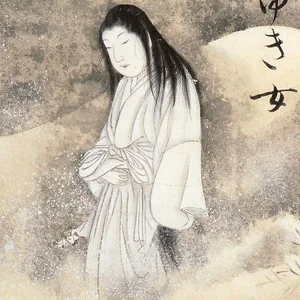

Yuki-onna is a supernatural figure from Japanese folklore, appearing as a woman of glacial and terrifying beauty. She emerges during blizzards and condemns lost travelers to death by freezing cold. Her character embodies both the beauty and the cruelty of winter nature.
Yuki-onna
Yuki-onna
8 min read
Frequently asked questions
Key Facts
- Yuki-onna appears in Japanese tales as early as the 15th century, most notably in Lafcadio Hearn's Kwaidan (1904)
- She belongs to the category of yōkai, supernatural beings from Japanese folklore
- She appears as a woman with black hair, skin as pale as snow, and blue lips
- She is associated with the mountainous regions of Japan, particularly during harsh winters
- Some versions of the myth portray her as capable of love and compassion, especially toward young men
Works & Achievements
A collection of Japanese ghost stories containing the foundational Western-language account of Yuki-onna. This text introduced the character to the world at large and established the version that remains most widely known.
An illustrated encyclopedia of Japanese yōkai featuring one of the earliest codified visual depictions of Yuki-onna. The work has profoundly shaped the iconography of Japanese spirits right up to the present day.
An illustrated collection of one hundred Japanese ghost and monster stories, including Yuki-onna. It stands as a major primary source for folklorists studying the visual and narrative evolution of the character during the Edo period.
A cinematic adaptation of Hearn's collection, with the Yuki-onna episode among its most celebrated segments. Award-winning at Cannes, the film definitively established the character's visual aesthetic for world cinema.
A landmark work that established Japanese folklore as an academic discipline, this book collects and analyzes oral legends from the mountainous regions of Tōhoku, contributing to the preservation and scholarly study of Yuki-onna tales.
Anecdotes
In the most famous version of the myth, recorded by Lafcadio Hearn in his work Kwaidan (1904), a young woodcutter named Mosaku encounters Yuki-onna during a blizzard. She spares his life on the condition that he never speaks of their meeting. He later finds a beautiful woman and marries her, not knowing she is the very same spirit.
Yuki-onna is typically described as a woman with long black hair, skin as white as snow, and lips of an icy blue. She glides above the ground without leaving footprints in the snow — a mark of her supernatural nature. This absence of tracks is a recurring motif in Japanese yōkai folklore.
In certain regions of Japan, particularly in mountainous prefectures such as Niigata, Yuki-onna was associated with the deaths of travelers and hunters from hypothermia. Local communities attributed the corpses found in the snow each spring to her, seeking a supernatural explanation for these winter tragedies.
Yuki-onna is not universally portrayed as malevolent across all regional traditions. Some tales from northern Japan depict her as a mother protecting her snow spirit children, or even as a winter deity to whom prayers were offered in hopes of mild seasons and safe passage through the mountains.
The Irish-born philosopher and writer Lafcadio Hearn, who became a naturalized Japanese citizen under the name Koizumi Yakumo, was the first to bring Yuki-onna to Western audiences in 1904. He had heard the story directly from his own Japanese servant, demonstrating that these tales were still very much alive in oral tradition during the Meiji era.
Primary Sources
She was bending over Mosaku, and blowing her breath upon him — and her breath was like a bright white smoke. Almost in the same moment she stood up, and came to Mosaku's side, and looked at him — then she turned, and, sliding open the door of the hut, passed out. With a great fear upon him, he lay still for a long time.
The spirits of the mountains and snow appear to those who lose their way in the passes during winter storms. These beings often take the form of women of unsettling beauty, whose icy breath steals the life from the unwary.
Yuki-onna descends from the snow clouds and walks across the surface of snowdrifts without leaving a trace. She appears as a young woman dressed in white, her eyes gleaming with a supernatural light in the darkness of the storm.
Among the hundred demons of the night stands the snow woman, a yōkai of the northern mountains, whose nature wavers between deadly beauty and compassion for those humans who acknowledge her presence with respect.
Key Places
A mountainous region on the western coast of Honshū, known for having some of the harshest winters in Japan. The earliest oral versions of the Yuki-onna legend are recorded in this region, where blizzards could isolate and kill travelers.
Japan's sacred volcano and highest mountain. Fuji's snow-covered slopes are associated with numerous yōkai sightings in classical Japanese literature, including Yuki-onna in several regional versions of the myth.
A vast mountainous region in the north of Japan's main island, studied by folklorist Yanagita Kunio in his Tōno Monogatari. It is one of the areas where the Yuki-onna legend is most richly documented and most deeply rooted in local tradition.
A high mountain pass notorious for its deadly blizzards, frequently cited in folkloric accounts as a site where Yuki-onna appears. This type of mountain pass symbolizes the dangerous boundary between the human and supernatural worlds in Japanese tradition.
Typical Objects

Yuki-onna is invariably dressed in a pure white kimono, the color of mourning in Japan. This garment causes her to blend into the snow and symbolizes her nature as a being on the boundary between the living and the dead.

In some stories, Yuki-onna carries a rice-paper lantern whose bluish glow lures lost travelers to their doom. This object appears in several iconographic depictions from the Edo period.

Associated with Yuki-onna's ability to summon a blizzard with a single gesture, the fan is an attribute of weather deities in Japanese Shinto. Its use by this figure underscores her connection to the forces of nature.

In versions where Yuki-onna marries among humans, the comb is the object she leaves behind when she vanishes — the only trace of her passage. It symbolizes feminine identity and the afterlife in Japanese folklore.

Yuki-onna's breath is sometimes described as turning the air into ice crystals that pierce the chests of her victims. This motif illustrates death by hypothermia as it was understood and imagined in the mountain regions of medieval Japan.

In some regional tales, Yuki-onna offers travelers a bowl of amazake (warm, sweet rice sake) before killing them, cruelly inverting the gesture of winter hospitality typical of Japanese mountain villages.
School Curriculum
Vocabulary & Tags
Key Vocabulary
Tags
Daily Life
Morning
Yuki-onna is a creature of night and cold: her existence awakens when temperatures drop and storms rise. At daybreak, as the sun approaches and begins melting the snow, she dissolves into icy mist or retreats to the high altitudes where snow never thaws.
Afternoon
On sunny days, Yuki-onna is absent from the world of the living, perhaps sleeping in ice caves on mountain peaks or in the space between snowflakes. Some accounts speak of a parallel existence in the kakuriyo — the spirit world of Japanese folklore — the counterpart to the visible world known as utsushiyo.
Evening
It is at dusk, when the sky clouds over and the temperature plunges, that Yuki-onna comes back to life. She materializes within snowsqualls, drawn by the lights of isolated dwellings or by the presence of travelers who have lost their way on mountain passes.
Food
Yuki-onna does not feed as humans do: she absorbs the vital warmth of her victims, drawing in their warm breath and life energy. In doing so, she leaves behind bodies frozen solid and drained of all vitality, as though the snow itself had consumed them.
Clothing
Her only adornment is an immaculate white kimono — a symbol of mourning and supernatural purity in Japanese tradition. Her black hair flows freely, unadorned, contrasting sharply with the whiteness of her skin and garments. She wears neither sandals nor socks: her feet never touch the ground.
Housing
Yuki-onna does not dwell in structures built by human hands. Her domain is the snow-covered mountain itself: wind-swept passes, cedar forests blanketed in snow, ice caves at high altitude. In the rare accounts where she lives among humans in disguise, she favors cold houses and poorly heated rooms.
Historical Timeline
Period Vocabulary
Visual Style
Esthétique d'estampe japonaise ukiyo-e de l'époque Edo, associant le noir profond de l'encre de Chine, les bleus glacés et le blanc pur de la neige dans une composition à la fois épurée et terrifiante.
Sound Ambience
Ambiance de blizzard de montagne japonais médiéval, mêlant le hurlement du vent, les craquements de la glace et un silence enveloppant, ponctué d'une voix féminine lointaine portée par la tempête.
Liens externes & ressources
Références
Œuvres
Kwaidan — Lafcadio Hearn
1904
Gazu Hyakki Yagyō — Toriyama Sekien
1776
Ehon Hyaku Monogatari — Takehara Shunsensai
1841
Tōno Monogatari — Yanagita Kunio
1910