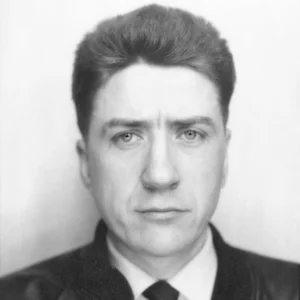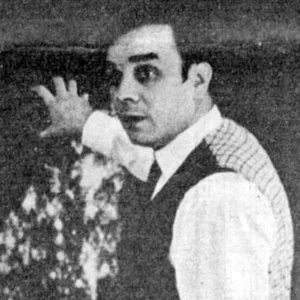

Yves Klein (1928-1962) was a French visual artist, a major figure of Nouveau Réalisme. A pioneer of the monochrome, he is famous for his patented ultramarine blue (IKB) and his anthropometries created using living models as “paintbrushes.”
Yves Klein(1928 — 1962)
Yves Klein
France
5 min read
Frequently asked questions
Famous Quotes
« My paintings are but the ashes of my art.»
Key Facts
- Born on 28 April 1928 in Nice and died on 6 June 1962 in Paris.
- Patented the International Klein Blue (IKB) in 1960, a deep ultramarine blue that became his signature.
- Created his Anthropometries from 1960 onward, in which models coated in paint pressed their bodies onto the canvas.
- Co-founded the Nouveau Réalisme movement in 1960 with the critic Pierre Restany.
- Presented the exhibition “The Void” at the Iris Clert gallery in Paris in 1958.
Works & Achievements
Series of paintings in a uniform ultramarine blue that established the monochrome as a radical artistic statement.
Exhibition of a completely empty gallery repainted in white, inviting visitors to perceive an “immaterial pictorial sensibility.”
Development and registration of a patented ultramarine blue that became the artist's trademark.
Iconic photomontage showing Klein launching himself from a wall, a visual manifesto of his quest for the void and for freedom.
Body imprints made by models coated in blue, created as a public performance accompanied by an orchestra.
Sculptures of natural sponges soaked in IKB blue and mounted on panels.
Works created with a blowtorch, where the mark left by the fire becomes the pictorial gesture.
Composition of a single sustained chord followed by a long silence, conceived to accompany his blue performances.
Anecdotes
In 1960, Yves Klein patented his signature colour, a deep ultramarine blue he named “International Klein Blue” (IKB). Together with a paint dealer he had developed a special binder that preserved the dazzling intensity of the pigment, which normally dulls when mixed.
For his “Anthropometries”, Klein coated nude models in blue paint and had them press themselves against large canvases, turning their bodies into “living brushes”. During a public session in 1960, he directed the operation in a tuxedo while an orchestra played his “Monotone-Silence Symphony”.
In 1960, a famous photograph shows him launching himself into the void from the ledge of a wall, arms outstretched. This “Leap into the Void” is in fact a carefully staged photomontage: judoka friends held a tarpaulin to break his fall, which was then erased from the image.
A passionate judoka, Klein went to Japan to study the art in 1952–1953, where he earned the 4th-dan black belt, a level then exceptional for a European. He even wrote a technical manual, “The Foundations of Judo”.
Yves Klein died of a heart attack in 1962, at only 34, shortly after seeing a screening of the film “Mondo Cane”, which mocked his anthropometries. His artistic career had lasted only about eight years.
Primary Sources
My paintings are only the ashes of my art. Blue has no dimensions, it is beyond dimension, whereas the other colors have them.
The painter now has only one work to create: freedom forever in the act of realizing itself.
Through the color blue alone, I gradually came to know the dematerialization of space.
Key Places
Yves Klein's birthplace, where he grew up in a family of artists and began his first reflections on color and the blue sky.
The center of Klein's career: the Iris Clert and Colette Allendy galleries, and the founding of Nouveau Réalisme. He died here in 1962.
Klein stayed here in 1952–1953 at the Kodokan institute to study judo, where he earned his 4th dan black belt.
German city where Klein presented a major retrospective in 1961, bringing together monochromes, sponges, and immaterial environments.
Site of the “Proposition monochrome, époque bleue” exhibition in 1957, which revealed his identical blue paintings to the public.
Typical Objects

Powdered ultramarine blue pigment bound with a special resin that preserves all its brilliance. Klein made it his visual signature and registered it under the name International Klein Blue.

Klein applied his pigment with a roller rather than a brush to achieve a uniform surface, free of any trace of personal gesture.

Soaked in IKB blue, the sponges became sculptures (the “Sponge Reliefs”) symbolizing the absorption of color, just as the viewer becomes steeped in art.

For his gilded monochromes (the “Monogold” works), Klein used thin sheets of gold, extending his blue-pink-gold trilogy of colors with their spiritual value.

Klein created “Fire Paintings” by burning the surface of panels with a blowtorch, making fire one of his tools.

The training garment of the artist, a passionate judoka and 4th-dan black belt, a discipline that fed his vision of the body and of space.
School Curriculum
Vocabulary & Tags
Key Vocabulary
Daily Life
Morning
Disciplined by judo, Klein often began his day with training and physical exercise. He placed great importance on mastery of body and mind, inherited from his martial arts practice.
Afternoon
The afternoon was spent in the studio, preparing his pigments, rolling out the blue with a roller, or supervising his models for the anthropometries. He also devoted time to writing his manifestos and conversing with the critic Pierre Restany.
Evening
Evenings were punctuated by gatherings with the other New Realists — Arman, Tinguely, César — in Parisian galleries and cafés. There Klein debated art, spirituality, and his plans for performances.
Food
Like a post-war Parisian, Klein shared meals in the bistros and cafés where artists gathered. The table was above all a place for intellectual exchange and sociability with his circle.
Clothing
In public, Klein took care with his appearance and readily appeared in a dark suit or tuxedo, notably to conduct his anthropometries like an orchestra conductor. For judo, he wore the white kimono and the black belt.
Housing
He lived and worked in Paris, dividing his time between his studio and the galleries. His living environment was that of an artist of the capital, between spaces of creation and places of exhibition.
Historical Timeline
Period Vocabulary
Liens externes & ressources
Références
Œuvres
Le Vide (La Spécialisation de la sensibilité…)
1958
International Klein Blue (IKB)
1960
Le Saut dans le vide
1960
Anthropométries de l'époque bleue
1960
Peintures de feu
1961