Imaginary dialogue between Haroun al-Rachid and Abu Nuwas
by Charactorium · Abu Nuwas (756 — 814) · Literature · 5 min read
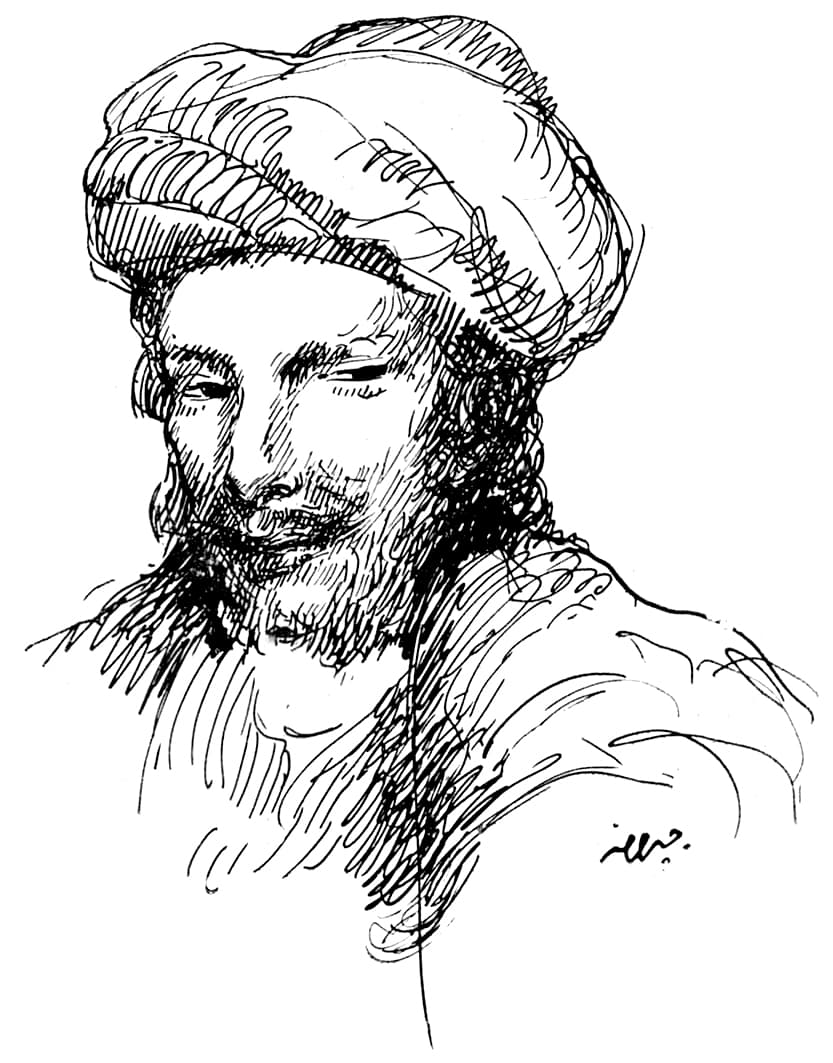
It is in the gardens of the caliphal palace, on the banks of the Tigris, that the Commander of the Faithful Harun al-Rashid summons his poet Abu Nuwas on a warm night in the year 807. A lute resounds in the distance, the moon casts silver reflections on the river, and a cup waits on a copper tray. The two men have known each other for a long time—the caliph has alternately imprisoned and pardoned this insolent man he cannot do without. Tonight, he wants neither panegyric nor buffoonery: he wants to hear him speak without a mask.
—I am told, al-Hasan, that your verses about the cup scandalize my qadis. Tell me frankly: why sing of wine when the Law forbids it?
Commander of the Faithful, I do not sing of intoxication to defy your qadis, but because the cup speaks the truth that men hide. I have composed more than four hundred bacchic pieces, my khamriyyât, and in one of them I beg that I be poured a drink and told so without allegorical veil. The Ancients wept over abandoned encampments in the desert; I sing of the tavern of Baghdad, the blown glass, the Persian amphora with its ruby gleam. There, in your reign, is life. If I scandalize, it is because I prefer admission to hypocrisy—and you, O Prince, have laughed at my verses far more often than you have punished them.
—Do you remember, al-Hasan, that night when I had you thrown into a dungeon for an insolent verse, then released at dawn? Why do you think I give in?
How could I forget it, O Prince? Your guards know me as well as their own house, so often have I frequented your prisons. One verse too many, an allusion too crude, and I am in chains; then the next day, your anger faded, I am brought back before you. I think you give in because you love me despite yourself, Commander of the Faithful—because a court deprived of my insolence would be deadly boring for you. You can imprison the man, but you do not want to silence the poet. We have both played this game for years: I provoke you, you punish me, you forgive me. Deep down, you hold on to me as one holds on to a fever that reminds one that one is alive.
You hold on to me as one holds on to a fever that reminds one that one is alive.
—You are said to be the son of an Arab soldier and a Persian mother, born over there in Ahvaz. What do you keep of that Persia in your language and your verses?
Everything, O Prince, and nothing I can disentangle. My father served in the armies, my mother was from that land of Khuzestan where I was born more than fifty years ago. From her I received the images of Persia: its gardens, its wines, its loves sung without the desert's makeup. The Bedouin poets weep over ruins and she-camels; I grew up between two languages, and I poured Persian honey into the Arabic cup. That is why my verses baffle the purists of Basra: they sense that another breath inhabits them. I deny neither the Arabic that gave me its meter, nor the Persia that gave me its intoxication—I am the bridge between the two banks.
—Before coming to my court, you spent your years in Basra and Kufa. What did you learn there that Baghdad could not teach you?
I learned rigor before audacity, Commander of the Faithful. In Basra and Kufa, the masters made me bend under grammar, lexicology, the thousand roots of our language. They say a master ordered me to memorize and then forget piles of ancient poems before daring to write a single one—one had to master the rule to have the right to break it. Kufa gave me the philological ear, Basra the science of the Ancients. Without those austere years, I would be only a tavern entertainer; thanks to them, I break conventions knowingly. A man only truly tears down the house whose every stone he knows.
—These taverns you sing of, run by Christians and Jews of my capital—tell me about those nights I do not see from my palace.
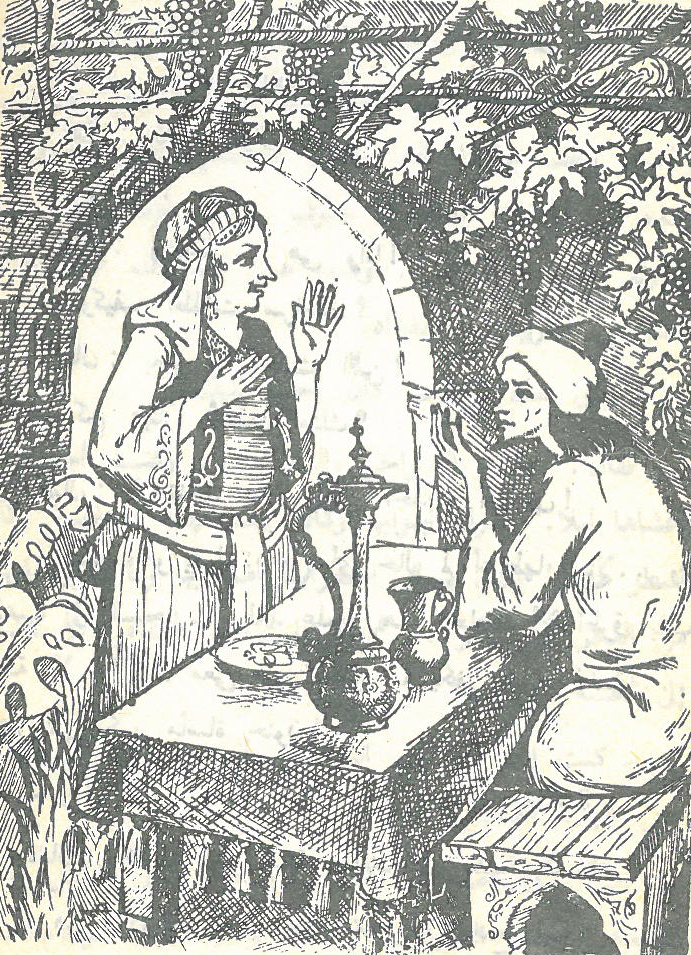
They are the most vibrant nights of your reign, O Prince, and you know them only in dreams. Past the great gates, one descends toward the river, and there a Christian tavern-keeper or a Jewish merchant opens his amphorae. I composed verses for a Christian wine seller who reserved his best jars for me—for in your city, Muslims, People of the Book, and Persians share the same cup under the same moon. The lute accompanies, people recite, they drink nabîdh and pure wine until dawn. Your Baghdad is the greatest city in the world, Commander of the Faithful, and its greatness is not only in your palaces: it is also in these taverns where peoples mingle.
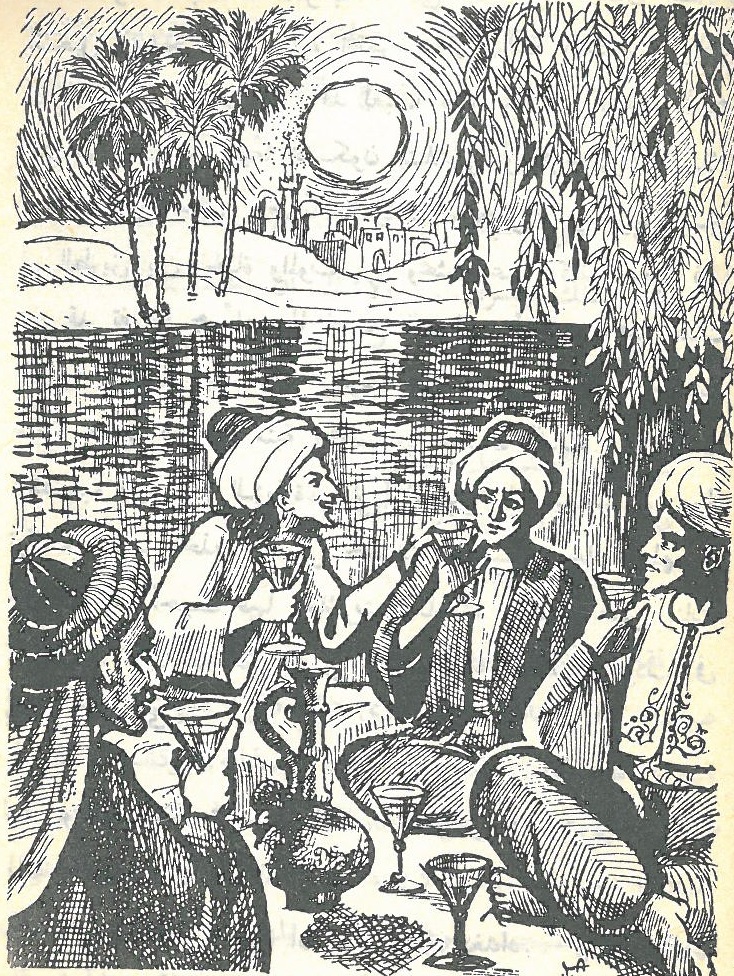
—You have dedicated panegyrics to me and to my close ones. Tell me, al-Hasan: when you praise me, is your tongue sincere or fawning?
That is a caliph's question, and I will answer you as a poet. Yes, I have praised you and the great ones of your court, for such is the duty of one who lives by the majlis. But you know me too well to believe my praises are pure honey: I sometimes slip in a barb, an irony that only sharp minds detect. When I celebrate you, I do not lie—I truly admire you, Commander of the Faithful, as the patron without whom no poet eats. But I keep my soul for the cup and for love. You, who have so often punished and then forgiven me, know well that I am only half a courtier.
Panegyric is my bread; the khamriyyât are my truth.
—At every audience I hear some trick you have played, some improvised verse to get you out of a tight spot. Where does this effrontery come from?
From necessity, O Prince, and from a nature I have never been able to correct. When a man has a quick wit and a tongue faster than prudence, he learns to make audacity his shield. How many times, dragged before you for one verse too many, did I get out of it by improvising on the spot rhymes that made you laugh despite your anger? Laughter disarms punishment better than all supplications. I play tricks, yes, on the devout as on the viziers, because solemnity bores me and Baghdad loves to laugh. But beware: beneath the jester, the poet always watches, and my lightest barbs often hide the sharpest arrow.
—It is whispered that you now compose verses of piety and repentance. You, the bard of wine? What is happening to you, al-Hasan?
Time, Commander of the Faithful. Time and the nights that weigh heavier on aging shoulders. I have sung of wine all my life, and I do not deny it; but there comes an hour when a man turns back and counts his emptied cups as so many debts. So, yes, I have begun to write a few devotional pieces, my zuhdiyyât, verses of repentance where I ask forgiveness for my excesses. Do not think, however, that the libertine is dead: he sleeps with one eye open. These serious poems are the counterpoint to my bacchic songs, the necessary shadow to so much light. A man is not made of a single block, O Prince.
—And I ask you bluntly: is this repentance true before God, or is it just one last trick from the craftiest of my poets?
You ask the question that scholars will long debate, and I have no answer that will satisfy them all. Who can fathom his own heart, Commander of the Faithful? When I write repentance, I believe it sincere at the moment the ink flows; then comes the night, the cup, and the libertine awakens. Perhaps I am sincere in both voices. Perhaps I am only playing, to the end, all the registers of language. I will only tell you this: a poet lies so well that he ends up no longer distinguishing his mask from his face. Leave the debate to the doctors of the Law—I prefer that they read my verses rather than judge my soul.
—Before the night ends and the lute falls silent, tell me: what do you hope will be remembered of you, al-Hasan?
Not the wise man, O Prince, nor the devout—others will be those better than I. Let them remember the man who dared to sing of the cup when all veiled it, who brought the tavern and laughter into a poetry that knew only the desert and ruins. I took the language of the Ancients and poured into it the wine of Baghdad. If the purists curse me, so much the better: it is a sign that I have moved something. And if I am still read when you are no longer there to pardon me, let them read me smiling, a cup in hand. That is my only wish, Commander of the Faithful: to make them smile, and to unsettle.
I took the language of the Ancients and poured into it the wine of Baghdad.

This imaginary interview was generated by artificial intelligence from sources documented in Abu Nuwas's profile. It dramatises what the figure might have said based on what we know about them, but does not constitute attested historical testimony. For primary sources and factual documentation, refer to the full profile.