Kids interview Alhazen
by Charactorium · Alhazen (965 — 1039) · Sciences · Technology · Philosophy · 5 min read
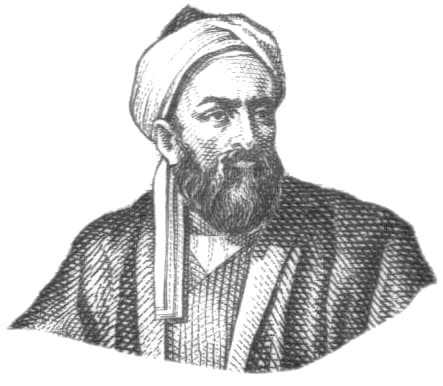
Two young visitors, on a school trip, push open the door of a room with closed shutters where a thin ray of light filters through. An old scholar greets them with a smile, a reed pen in hand. His name is Alhazen, and he has spent his life understanding how we see.
—Where were you born? What was your city like when you were little?
You know, my child, I was born in Basra, in the year 965, in what is now called Iraq. Imagine a great city of markets, by the water, where ships came from everywhere. It smelled of spices, dried fish, and ink. It was a place where books and scholars were beloved. As a child, I listened to masters discussing geometry in the squares. I dreamed only of numbers and figures. I would cut my reed, my calame, and draw circles in the dust. That's where, very young, I learned to see the world as a puzzle to be solved patiently.
I learned as a child to see the world as a puzzle to be solved.
—Why did you go so far, all the way to Cairo?
Ah, that's a beautiful story! Around the year 1000, everyone was talking about a magnificent city: Cairo, in Egypt. The caliph had founded a great house of learning there, the Dar al-Hikma — meaning the 'House of Wisdom'. They translated the books of the ancient Greeks, Persians, and Indians. Imagine a vast library where scholars from all over the world came to discuss. For a man like me, who loved learning so much, it was like a magnet. So I packed my bags, crossed deserts and rivers. I left my hometown to go where ideas were bubbling. And I never regretted that great journey.
I went where ideas were bubbling.
—Is it true you pretended to be crazy on purpose? Why?
Yes... and I'm still a little ashamed of it. I had promised the caliph Al-Hakim to tame the great river, the Nile, with dams, to prevent its floods. A huge project! But once there, I looked at the river and understood: it was impossible with our means. And that caliph, my child, was terrible when you disappointed him. I was very afraid. So I pretended to have lost my mind. For years, I played the fool so they would leave me alone. It was only at his death, in 1021, that I dared to become myself again. Sometimes, to survive, you have to make yourself very small.
Sometimes, to survive, you have to make yourself very small.
—Weren't you too sad, locked up and pretending for so long?
Sad, yes, often. But you know, this confinement gave me a strange gift. Since they thought I was mad, they left me alone. And silence, my child, is a scholar's best friend. It was precisely during those difficult years, probably under house arrest, that I began my great book, the Kitāb al-Manāẓir, my Book of Optics. I had a room, a few shutters, a little light. That was enough. I turned my prison into a workshop. When life closes a door on you, always look for the small window where light comes through. I truly did that: I watched light enter through a tiny hole.
I turned my prison into a workshop.
—What's this story about a dark room with a tiny hole?
Ah, that's my favorite experiment! I would completely close a room, in total darkness — I called it Bayt al-Zulma, the 'dark chamber'. I would pierce just a tiny hole in the shutter. And there, magic: the landscape outside would be drawn on the opposite wall, but upside down, head down! Imagine seeing trees and passersby upside down on your wall. It wasn't magic, it was proof. Light travels straight, like an arrow, and crosses as it passes through the hole. Thanks to this little room, I understood how our eyes receive the world.
Light travels straight, like an arrow.
—Before you, what did people believe about how we see things?
A strange idea, my child! The great Greek scholars, like Euclid and Ptolemy, thought that the eye sent out rays toward objects, like a lamp that illuminates. As if your eyes threw invisible threads to touch what you look at. With my dark chamber, I showed the opposite. It's not your eye that illuminates the tree: it's the sunlight that bounces off the tree and enters your eye. You are the one who receives, not the one who sends. That seems simple today, but overturning the idea of the greatest masters required a lot of courage and a lot of proof.
It's not your eye that illuminates the world: it's the world that enters your eye.
—How did you make sure you were right?
Excellent question! Many scholars in my time were content to think in their heads and copy the ancients. I believed nothing without trying. I would do the experiment, then do it again, over and over. I would change the light, the distance, the hole. And I noted everything, with my reed pen and ink. If I always got the same result, only then did I believe it. That is my method: doubt, test, measure, start over. Many centuries later, other scholars in Europe would do the same. But you know, truth is not guessed from an armchair: it is earned by getting your hands dirty.
Truth is not guessed from an armchair: it is earned by getting your hands dirty.
—Is it true you managed to measure the height of the sky?
In a way, yes! In the evening, after prayer, I observed the sky with my astrolabe, a beautiful brass instrument for measuring the height of the stars. I had noticed something: when the sun sets, there is still light for a while, the twilight. This light bounces off the air high up. By observing how long this glow lasted, I calculated that the atmosphere — the layer of air around the Earth — rises to about fifteen kilometers. Imagine measuring something you cannot even touch, just with patience and geometry! Modern measurements have proven me nearly right.
Imagine measuring the sky just with patience and geometry.
—At night, looking at the moon, what did you think?
Of a beautiful truth, my child. Many believed the moon shone by itself, like a little lamp hung in the sky. But in my Treatise on Light, I showed something else. The moon does not produce its own light: it is like a round mirror. It is the light of the sun that strikes its surface and bounces to our eyes. At night, when I looked at it, I saw a bit of hidden sun! And I also understood that everything that shines sends its light in all directions at once, like a sphere. The sky, for me, was not a magical mystery: it was a great lesson in geometry.
The moon does not produce its own light: it is a bit of hidden sun.
—In the morning, before working, what did you do? What did you eat?
I got up very early, even before sunrise, for the first prayer. Then, a very simple meal: bread and dates, sometimes a few figs. Nothing complicated. Then I would sit near the window, because I liked working in the soft morning light — I found it perfect for observing. My house in Cairo had an inner courtyard with a small fountain; you could hear the water flowing while I drew my figures. In the afternoon, I would go back to my dark room for experiments. A calm life, you see, paced by the daylight. Knowledge requires silence and well-regulated habits.
Knowledge requires silence and well-regulated habits.
—If children like us wanted to become scholars, what would you say to them?
I would say: do not believe a thing just because a great master said it. Even the wisest, like the ancient Greeks, were wrong about our eyes! Look for yourselves. Ask questions, as you do so well today. Take a tiny hole, a ray of light, and observe. Curiosity is your finest tool, far more than a golden astrolabe. I wrote over two hundred treatises, but it all started with one thing: the desire to understand. One day, my books crossed the sea to Europe, and others continued my work. Knowledge, my child, is a light passed from hand to hand.
Knowledge is a light passed from hand to hand.
This imaginary interview was generated by artificial intelligence from sources documented in Alhazen's profile. It dramatises what the figure might have said based on what we know about them, but does not constitute attested historical testimony. For primary sources and factual documentation, refer to the full profile.