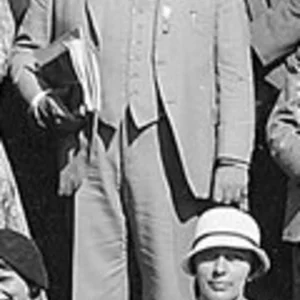

American mathematician (1894-1964), founder of cybernetics, the science of communication and control in living systems and machines. His work laid the theoretical foundations of computing, automation, and artificial intelligence.
Norbert Wiener
Norbert Wiener
9 min read
Frequently asked questions
Famous Quotes
« Society can only be understood through a study of the messages and the communication facilities which belong to it.»
« Progress imposes not only new possibilities for the future but new standards, and all too often new and superior forms of ignorance.»
Key Facts
- 1894: Born in Columbia, Missouri — child prodigy, graduated from Harvard at age 18
- 1940-1945: Work on anti-aircraft defense during World War II, development of filtering and prediction theory
- 1948: Publication of 'Cybernetics: Or Control and Communication in the Animal and the Machine', a foundational work
- 1950: Publication of 'The Human Use of Human Beings', a reflection on the social implications of automation
- 1964: Died in Stockholm, awarded the United States National Medal of Science that same year
Works & Achievements
Foundational work that invents and defines cybernetics as the science of control and communication in living systems and machines. This book directly inspired the pioneers of computing, robotics, and neuroscience.
A popular-audience version of cybernetics, in which Wiener analyzes the social consequences of automation and argues for an ethical use of machines in the service of humanity.
A once-secret military report that became famous, laying the mathematical foundations of signal filtering and statistical prediction — the theoretical bedrock of cybernetics and modern signal processing.
The first volume of his memoirs, in which Wiener recounts his childhood as a prodigy, his painful relationship with the education imposed by his father, and his early years at university.
The second autobiographical volume, covering his career at MIT and the birth of cybernetics, offering a unique portrait of American scientific life in the twentieth century.
Wiener's final work, published a few months before his death, which questions the boundaries between human creation and learning machines, and anticipates contemporary debates on artificial intelligence.
Anecdotes
Norbert Wiener was a truly extraordinary prodigy: he entered Tufts University at the age of 11 and earned his doctorate in mathematics from Harvard at just 18, in 1913. His father Leo, a professor of Slavic languages, had subjected him to intensive schooling from early childhood, which later caused deep psychological tensions that Wiener would describe in his memoirs.
During World War II, Wiener worked for the U.S. Army on the problem of anti-aircraft targeting: how to predict the trajectory of an enemy aircraft so that a gun could hit it? To solve this challenge, he developed mathematical methods for prediction and automatic correction (the concept of “feedback”), which would become the heart of cybernetics. It was by observing the similarities between a self-correcting machine and the human nervous system that his grand theory was born.
Wiener was famous throughout MIT's hallways for his legendary absent-mindedness and severe nearsightedness. The story goes that one day, after moving to a new building, he was searching for his office and stopped a female student to ask where the new mathematics department was — not realizing that the student was his own daughter, who had come specifically to help him find his way.
As early as 1949, troubled by the social consequences of automation, Wiener wrote a letter to the American automobile workers' union (UAW) warning them that machines were going to threaten millions of jobs. He was one of the first scientists to publicly raise the alarm about the ethical dangers of his own inventions, foreshadowing today's debates about artificial intelligence.
In 1948, Wiener published Cybernetics with a French scientific publisher (Hermann, Paris), having failed to find an American publisher quickly enough. The success was immediate and worldwide: the book was translated into many languages and opened up an entirely new discipline that influenced fields ranging from computer science and neurology to economics and the social sciences.
Primary Sources
We have decided to call the entire field of control and communication theory, whether in the machine or in the animal, by the name Cybernetics... The problems of control engineering and of communication engineering were inseparable.
The first industrial revolution... devalued the human arm by the competition of machinery. The modern industrial revolution is similarly bound to devalue the human brain, at least in its simpler and more routine decisions.
Mathematics is too important to be left only to mathematicians. The communication of mathematical ideas across disciplinary frontiers is not a luxury but a necessity of the scientific enterprise.
I am releasing a book which will discuss the limits of organization, and will inevitably lead to the conclusion that the present industrial revolution will create unemployment which will constitute a greater danger than the unemployment of the twenties.
It is the thesis of this book that machines can be creative... The new possibility of a self-reproducing machine leads to a new concern for the nature of life itself.
Key Places
Birthplace of Norbert Wiener, born on November 26, 1894. His father, Leo Wiener, was a professor at the University of Missouri.
Wiener taught mathematics here from 1919 until his retirement, and it was here that he developed the core of his cybernetic theory. MIT remains the foremost site of his scientific legacy.
Wiener completed his doctoral dissertation in mathematical logic here, earning his PhD at age 18 in 1913 under the supervision of Karl Schmidt. Harvard marks the beginning of his extraordinary academic journey.
In 1913–1914, Wiener spent time here studying with David Hilbert, then the world's greatest mathematician. This European experience shaped his vision of mathematics as a universal language.
From 1946 to 1953, the Macy Conferences in New York brought together around Wiener the greatest minds of the era — von Neumann, Margaret Mead, Gregory Bateson — to lay the theoretical foundations of cybernetics and cognitive science.
Norbert Wiener died in Stockholm on March 18, 1964, during a scientific visit, just weeks after receiving the United States National Medal of Science.
Typical Objects

Wiener suffered from severe myopia since childhood and wore extremely thick-lensed glasses, which became a defining part of his silhouette in the hallways of MIT.

An indispensable analog calculating instrument for mathematicians and engineers of his era, used to perform multiplications and divisions quickly before the advent of electronic calculators.

An electronic device used to visualize electrical signals varying over time, a key tool in the electronics laboratories where Wiener collaborated during the war to improve automatic targeting systems.

Wiener typed his papers and books on a typewriter; he was highly productive and corresponded extensively with scientists from around the world, including Alan Turing and John von Neumann.

Like all mathematicians of his time, Wiener worked and taught in front of large blackboards covered with differential equations and probability theory — with no overhead projector or slideshow in sight.

During World War II, the challenge of automatically aiming these guns against enemy aircraft was the practical trigger for Wiener's research on feedback and prediction, which would lead directly to cybernetics.
School Curriculum
Vocabulary & Tags
Key Vocabulary
Tags
Daily Life
Morning
Wiener started his day early, after a night that was often short — he was prone to insomnia and sometimes worked late into the evening. He had a simple breakfast at his home in Belmont, near Boston, before heading to MIT by streetcar or car. His severe nearsightedness made driving a challenge, and his colleagues liked to tease him about his motoring adventures.
Afternoon
Most of his afternoons were spent in his office or wandering the corridors of MIT, where he would stop to chat with anyone — students, colleagues, maintenance staff — about mathematics, philosophy, or current events. He attended seminars across multiple departments at once, crossing disciplinary boundaries with a freedom that astonished his contemporaries.
Evening
Evenings were often devoted to writing: articles, letters, book chapters. Wiener was in active correspondence with scientists around the world — von Neumann, Turing, Shannon. At home with his family, he enjoyed chess and reading; he spoke several languages, including German, French, and Russian, inherited from the polyglot upbringing his father had imposed on him.
Food
Like many American academics of the 1940s–1960s, Wiener ate simply and rather irregularly, often so absorbed in thought that he forgot to have lunch. He had a fondness for European cuisine, discovered during his youthful stays in Cambridge and Göttingen.
Clothing
Wiener was known for his disheveled appearance — rumpled suit, crooked tie, pockets stuffed with notes and sheets of calculations. His round figure, thick glasses, and soft hat made him a recognizable and beloved presence in the halls of MIT, far removed from the image of the austere scholar.
Housing
He lived with his wife Margaret and their two daughters in a comfortable house in Belmont, a residential suburb of Boston, enjoying the quiet, modest comfort of the American intellectual middle class of the 1950s. The house was filled with books in several languages and reams of calculation papers.
Historical Timeline
Period Vocabulary
Liens externes & ressources
Références
Œuvres
Cybernetics: or Control and Communication in the Animal and the Machine
1948
The Human Use of Human Beings: Cybernetics and Society
1950
Extrapolation, Interpolation and Smoothing of Stationary Time Series (rapport 'Yellow Peril')
1942-1949
Ex-Prodigy: My Childhood and Youth (autobiographie, vol. 1)
1953
I Am a Mathematician (autobiographie, vol. 2)
1956
God and Golem, Inc.
1964