Imaginary interview with Ali ibn Abi Talib
by Charactorium · Ali ibn Abi Talib (599 — 661) · Politics · Literature · 6 min read
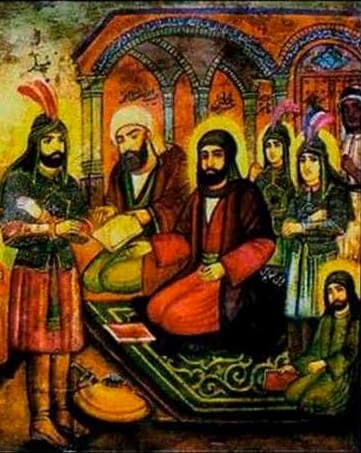
Kufa, a night in spring 661. Under the palms of the mud-brick mosque, a man in a simple turban receives, between two prayers, the one who questions him. His voice is low, his speech measured like that of a judge — and the shadow of Dhu al-Fiqar rests against the wall.
—Do you remember the day you entered Islam?
I was a child of about ten, raised in the house of my cousin Mohammed in Mecca. The revelation was very young, still secret, carried in whispers between the mud walls. When my cousin called for belief in one God, I did not hesitate long: I knew him better than anyone, I had eaten his bread and slept under his roof. I was, they say, among the very first to respond. I am often asked if a child can choose God; I reply that I chose nothing but the truth of the man who raised me. That childhood loyalty has never left me — it is the foundation upon which everything else was built, up to these battles and divisions I could not then imagine.
I chose nothing but the truth of the man who raised me.
—They say you slept in the Prophet's bed the night of his flight. How did that happen?
It was the year of the Hijra, in 622. The notables of Mecca had sworn my cousin's death; they surrounded his house to strike him at dawn. He asked me to lie down in his bed, wrapped in his cloak, so that the watchers would think him still there while he made for Medina. I lay down. I heard the voices of armed men behind the door, and I knew the first sword would be for me. I did not move. They call me brave; I say only that a man who loves does not calculate the cost of his body. In the morning, they discovered it was only me — and he was already far away, saved. That night, I learned that loyalty is measured by what one is willing to lose.
A man who loves does not calculate the cost of his body.
—That sword leaning against the wall, Dhu al-Fiqar, what story does it carry?
It was given to me after the day of Uhud, when the ranks had broken and the faithful were counted among the dead. Its split blade, double-pointed, cuts where others do not. At Badr, in 624, already, I had held my place in the front line, for the fear of steel has always seemed less to me than the fear of failing. But I warn you: do not make me only a man of the sword. The Prophet, they say, called me Bab al-'Ilm, the Gate of Knowledge, and that is what I am most jealous of. A blade is only worth the hand that guides it, and a hand is only worth what it has understood of justice. I fear the day when my name will be raised on banners while the Book I served is forgotten.
A blade is only worth the hand that guides it.
—What do you answer to those who contest your right to succeed the Prophet?
The Prophet once said to me words I treasure: 'You are to me as Aaron was to Moses, except that there will be no prophet after me.' I did not claim power at my cousin's death in 632; others took it before me, Abu Bakr, then Umar, then Uthman, and I gave the bay'a to preserve the unity of the umma. Those who today call themselves Shi'at Ali, the party of Ali, hold that succession was rightfully mine. I do not judge men by their fervor for my person; I judge them by their fear of God. What I know is that I never drew my sword for a throne — only, later, to keep the house from collapsing.
—You wrote a long letter to your governor of Egypt. What did you want to convey to him?
When I appointed Malik al-Ashtar over Egypt in 658, I sent him not orders of conquest but a mirror of what a leader should be. I wrote him to open his heart to the people, not to think himself a beast let loose on his subjects to devour their goods, for they are of two kinds: your brothers in religion, or your equals in creation. Power, I have always held as a trust, not as prey. These words, along with my other speeches, were gathered long after me in the Nahj al-Balagha, the Path of Eloquence. I did not know then that a letter to a governor would outlive kingdoms; I only wanted that a man, days away from Kufa, should govern as if he must answer before God.
Power, I have always held as a trust, not as prey.
—They say that one day you lost a lawsuit against an ordinary man. Is that true?
It is true, and I take more pride in it than in my victories. A piece of chainmail armor had been stolen from me, and I recognized it in the hands of a common man. I had him brought before the judge — not as caliph, but as an ordinary plaintiff. The judge asked for my witnesses; I had none that were acceptable. So he ruled against me, and I bowed to the verdict without invoking my rank. What would justice be worth if it bends before the one who commands it? In my mud-brick house in Kufa, my door remains open to petitioners as to the lowliest beggar. A leader who places himself above his own court has already lost the right to judge others.
What would justice be worth if it bends before the one who commands it?
—How did you come to confront Mu'awiya at Siffin?
Mu'awiya was wali, governor of Syria, appointed long ago by Uthman. At the latter's death in 656, the community gave me the bay'a in Medina; he refused, demanding vengeance before obedience. It was the fitna, the discord, opened in the very heart of Islam. Our armies faced each other at Siffin, on the banks of the Euphrates, in 657, for days of iron and dust. When defeat threatened them, his men raised sheets of the Qur'an on the tips of their spears, crying that the Book should judge between us. How could one lift the sword against the Qur'an thus raised? My ranks grew troubled, hesitated, divided. I knew the stratagem for what it was — but I could not command believers to strike the Book. Thus war turned into arbitration.
How could one lift the sword against the Qur'an thus raised?
—That arbitration gave birth to a faction that abandoned you. What do you reproach them for?
After Siffin, it was agreed to settle the dispute by arbitrators at Dumat al-Jandal in 658. But a part of my own men rose up: they cried that judgment belongs only to God and not to men, and reproached me for having accepted that one arbitrate what heaven alone could decide. These were the Kharijites, the Khawarij, those who left the ranks. I answered them that the word of the Qur'an is true, but between its lines it is indeed men who must apply it — otherwise no judge would ever render justice on earth. They did not heed it. Zeal that refuses all compromise ends up turning against its own; I have seen the most ardent piety become the most blind blade.
I have seen the most ardent piety become the most blind blade.
—Your days in Kufa, how did they unfold?
I rise before dawn for the fajr prayer, in the mosque of Kufa, my forehead on the prayer rug. It is the hour when the world falls silent and the soul is bare. After, I recite the Qur'an, then I attend to the affairs of the caliphate: audiences, disputes, letters dictated to my governors. I judge myself, I do not delegate justice as one delegates a chore. In the evening, I gather my sons Hasan and Husayn to speak of God, and I keep a part of my time for the poor who knock at my door. I eat frugally — barley bread, dates — and I dress in undyed wool, without ornament, for a man of the people should not disguise himself as a king.
—They say you asked for clemency for the one who would strike you. What of it?
It was at fajr, that dawn prayer I love more than any other, that a man of the Kharijites, Ibn Muljam, waited for me in the shadow of the mosque with a sword dipped in poison. He struck me on the forehead, at the moment I prostrated. I knew then that my time was ending, here, in Kufa, in this year 661. But I asked my people not to torment my murderer: let him be punished with a single blow if need be, without torture, without relentlessness, for justice is not vengeance. A judge does not cease to be a judge because he is the victim. I depart as I lived, praying that this deceitful world, which flatters to enslave, may not have the last word on my soul.
Justice is not vengeance.


This imaginary interview was generated by artificial intelligence from sources documented in Ali ibn Abi Talib's profile. It dramatises what the figure might have said based on what we know about them, but does not constitute attested historical testimony. For primary sources and factual documentation, refer to the full profile.