Imaginary dialogue between Malik al-Ashtar and Ali ibn Abi Talib
by Charactorium · Ali ibn Abi Talib (599 — 661) · Politics · Literature · 5 min read
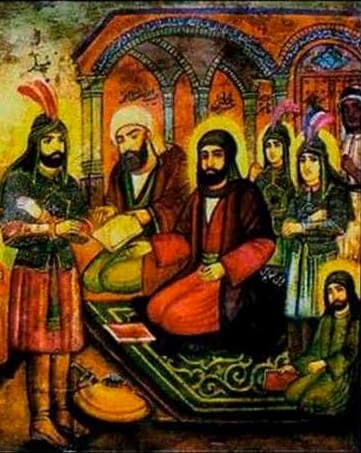
It is in the modest mud-brick house of Kufa, in the early morning of a day in the year 658, that Malik al-Ashtar comes to take leave of Ali ibn Abi Talib. The oil lamp is still smoking, and on the mat lies the long roll of parchment — the instructions Ali has just given him before his departure to govern Egypt. The old comrade-in-arms and the master have known each other since the battlefields; Malik led the charge at Siffin last year, and he leaves with a heavy heart. He comes to seek, one last time, the teaching of the one he serves.
—Commander of the Faithful, before I leave I want to understand the man I serve. They say you were a child when you followed the Prophet — is that true?
True, Malik. I was barely ten years old, and I was already living under the roof of my cousin Muhammad, peace be upon him. When he received the call, I was there, in the house, before even the grown men made up their minds. People often ask me whether a child can choose his faith: I chose nothing, I recognized. It was like recognizing the face of one's own father in the crowd. The powerful men of Mecca laughed at a child praying behind the Prophet and his wife. But you, who have seen since how many mature men have betrayed, you know that a child's loyalty sometimes holds better than a man's oath.
I chose nothing, I recognized. It was like recognizing the face of one's own father in the crowd.
—They also tell of the night of the flight to Medina. You are said to have taken the Prophet's place in his bed. What remains of that night within you?
Fear, first — I will not lie to you, my friend. The young men of Mecca were posted around the house, swords ready, waiting for Muhammad to come out to kill him. He asked me to lie down under his cloak, in his place. I obeyed, not yet understanding that my life was serving as a decoy for his. All night I listened to the steps of the watchmen, praying they would not grow impatient before dawn. When they pulled back the cover and saw my face instead of his, their rage taught me something I have never forgotten: one protects what one loves only by accepting to disappear in its place. That too is governing a people.
One protects what one loves only by accepting to disappear in its place.
—This scroll you have just entrusted to me for Egypt — you spent nights on it. Why so much ink for a simple governor like me?
Because you are not leaving to command soldiers, Malik — that you know better than I. You are leaving to answer for people's lives before God, and that cannot be improvised at a gallop. I wrote for you what I would have wished someone to write for me: that the people are divided into two — your brothers in religion and your fellows in humanity — and that neither deserves your contempt. Reserve the best part of your time for the weak, for they are the ones who have no access to your door. The just word, set on parchment, governs better than an army. A province is held by the pen as much as by the lance — remember this when weariness makes you prefer silence to the letter.
The people are divided into two: your brothers in religion and your fellows in humanity — neither deserves your contempt.
—The Prophet is said to have called you the Gate of Knowledge. Is that not a heavy burden to bear, this knowledge expected of you?
The burden is not knowing, Malik; it is remaining silent when one should speak, and speaking when one should remain silent. The Prophet opened his teaching to me as one opens a spring to a thirsty man; what I have retained, I do not keep in a chest, I pour it out. Knowledge that is not transmitted rots like stagnant water. In the evening, with Hasan and Husayn, I do nothing but pour again. You see, men imagine that knowledge makes one proud: it is ignorance that swells, true knowledge bows the neck. The more I have learned, the more I have measured the extent of what I do not know. Take that to Egypt, along with the rest.
Knowledge that is not transmitted rots like stagnant water.
—A story is told in the markets: a caliph who loses a lawsuit against a common man over a simple dir'. Will you bear it if I ask you to your face?
On the contrary, I bear it with pride, Malik. A coat of mail had been stolen from me; I recognized it in a man's hands, and I claimed it before the judge — not as caliph, but as plaintiff. The judge asked for my evidence. I had none that was admissible: only two witnesses, one of them my own, whom the law rejected. So he ruled against me, and the dir' remained with the other man. Do you know what was most beautiful? That the judge dared to dismiss my case, I who appointed him. A court where the prince wins because he is prince is not a court; it is an antechamber of power. The day my governor of Egypt bends the law for himself, that day I will have lost him.
A court where the prince wins because he is prince is not a court; it is an antechamber of power.
—Let us speak of Siffin, since I was there. My lance was almost touching Mu'awiya's tent when I was called back. Do you regret having stopped my charge for the arbitration?
Every night, Malik, every night. You held their camp at the tip of your lance, and I knew it. But my own men planted the masahif, the leaves of the Qur'an, on the tips of their spears and cried out to let the Book of God judge between us. How could I order the cutting of throats raised behind the Qur'an when my whole army refused to advance? I yielded to the bay'a of an arbitration I sensed was poisoned. My hand was forced, and today those very ones who compelled me reproach me for it. I did not lose a battle that day: I lost the obedience of my own men. Remember this in Egypt — a leader is never betrayed from without before being betrayed from within.
A leader is never betrayed from without before being betrayed from within.
—And those who left, the Khawarij, who now cry out to you that judgment belongs only to God? How do you treat former companions who have become your accusers?
Their slogan is true, Malik, but their use of it is false: yes, judgment belongs to God, but God has entrusted men with the care of rendering justice on earth. They take a true saying to draw sedition from it. They are my brothers of yesterday, those who prayed at my side; their foreheads still bear the mark of prostrations. As long as they content themselves with cursing me, I will not forbid them the mosque nor their share of the spoils, and I will not raise the sword first. But if they shed blood, I will fight them without faltering. One does not cure a fitna by persecuting the discontented; one feeds it. The patience of the ruler is often better than the point of his sword.
One does not cure a fitna by persecuting the discontented; one feeds it.
—At your side still hangs Dhu al-Fiqar, the blade the Prophet gave you. What does the man who carries a sword that has become a legend in his own lifetime feel?
A sword is only iron, Malik; it is the hand and the intention that make it blessed or cursed. This one came to me on the day of Uhud, when my blade had broken and the Prophet handed me his. Men marvel at its double point and tell each other that it cuts by itself; I, I know above all the weight it imposes on me. A weapon received from a holy hand must never serve pride or vengeance, only the just cause. I have struck with it when necessary, and I fear the day I might have struck one time too many. True courage is not to brandish the iron — it is to know when to leave it in the sheath. Take that thought before your own battles.
True courage is not to brandish the iron — it is to know when to leave it in the sheath.
—One last question, master, before the road: if an enemy attempted your life and fell into your hands, what would you do with him?
You ask, Malik, the heaviest question, and I will answer you as I answer myself in the silence of the fajr. He who strikes me takes from me only a life that God will claim anyway; he cannot take from me either my faith or my uprightness. If such a man fell into my power, I would not deliver him to torture or mutilation, for vengeance is not justice — it is its counterfeit. Let the penalty be applied to him, a single one, clean, without relentlessness, and let him be fed as long as he lives. A leader who responds to cruelty with cruelty has only added one more executioner to the world. Go, my friend. Govern Egypt as if God alone were watching you — for that is the case.
Vengeance is not justice — it is its counterfeit.



This imaginary interview was generated by artificial intelligence from sources documented in Ali ibn Abi Talib's profile. It dramatises what the figure might have said based on what we know about them, but does not constitute attested historical testimony. For primary sources and factual documentation, refer to the full profile.