Kids interview Ali ibn Abi Talib
by Charactorium · Ali ibn Abi Talib (599 — 661) · Politics · Literature · 5 min read
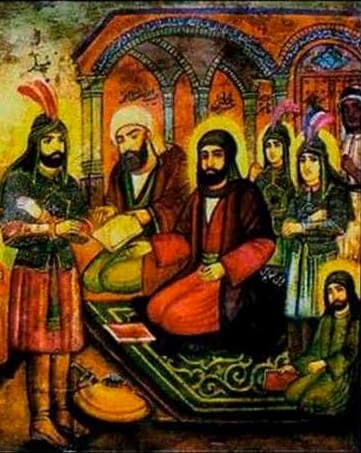
Two young visitors, each twelve years old, have come with their school trip to sit in a circle. Before them, an old man in a light wool cloak looks at them gently. His name is Ali, and he has agreed to answer all their questions.
—How old were you when you became a Muslim?
You know, my child, I was very young. Barely ten years old. I was already living in the house of my cousin Mohammed, in Mecca. Imagine a house of warm stones, carpets, a courtyard where people speak in low voices. One day, he began to receive words that he said came from God. Many were afraid, mocked him, turned away. I was a child, but I said yes right away. I think that when you grow up close to someone, you can feel if they are true. And he was true. I was one of the very first to believe in him.
When you grow up close to someone, you can feel if they are true.
—Were you afraid the night you slept in the Prophet's bed?
Yes. I was afraid, I tell you honestly. It was in 622, the night my cousin had to flee Mecca for Medina. His enemies were waiting outside, swords in hand, ready to enter and kill him. So I lay down in his bed, in his place, wrapped in his cloak. Imagine: you hear heavy footsteps, harsh voices, and you don't move. If they lifted the blanket, it would be me they struck. But he was able to leave in the night, saved. I was afraid, yes. Fear does not prevent doing what is right.
Fear does not prevent doing what is right.
—What was your sword like? They say it was strange.
Ah, my Dhu al-Fiqar! It had a strange blade, yes: split at the tip, like two points or a long groove in the middle. The Prophet gave it to me after a difficult battle, that of Uhud. In my time, a sword is not a toy. It is heavy, cold in the morning, and sometimes decides whether you return home alive. Long after me, people drew this sword on their flags, as a sign. That touches and troubles me at the same time. A weapon should not be a decoration. It should remind us how costly peace is.
A weapon should not be a decoration.
—Were you afraid during battles?
Of course. Whoever tells you they are never afraid in battle is lying, my child. At the battle of Badr, in 624, we were few against the powerful of Mecca. Imagine the dust, the cries, the dry throat, the pounding heart. They called me brave, and it's true I did not retreat. But being brave is not not trembling. It is trembling and advancing anyway, because you are protecting your own. I would have preferred a thousand times a just word to a sword stroke. Only, in those days, sometimes you had to fight simply to stay alive.
Being brave is trembling and advancing anyway.
—Is it true that a caliph can lose a trial?
Yes, and it happened to me! Listen carefully. I was caliph, that is, the leader of the entire community of believers. A dispute over a coat of armor pitted me against a simple man. We went before the judge, like two ordinary people. And I, the leader, lost: I did not have enough evidence. I could have said, “I am the caliph, be quiet.” I did not. I accepted the verdict, head bowed. Do you know why? Because a law that bends before the powerful no longer protects anyone. If I submit to it, then the weakest know it will protect them too.
A law that bends before the powerful no longer protects anyone.
—Why did you forgive the man who killed you?
Ah, you already know this sad story... In 661, a man struck me with a poisoned sword while I was praying, at dawn, in the mosque of Kufa. I was kneeling on my small mat, my forehead turned toward God. It was still dark. Before dying, I asked one thing of my family: not to torture this man, to treat him with justice. They were angry, they wanted to make him suffer. But returning evil for evil does not repair anything. It only adds pain to pain. I wanted to leave while remaining faithful to what I had taught all my life.
Returning evil for evil does not repair anything.
—What was the purpose of the long letter to your governor?
Good question! I had appointed a trusted man, Malik al-Ashtar, to govern Egypt, far away from me. How to explain to him, from a distance, how to lead well? I wrote him a long letter, in 658. In it, I did not speak of gold or palaces. I told him: be gentle with the people, take care of the poor, despise no one, for those you govern are either your brothers in religion or your equals in humanity. Imagine a father writing to his child far away, slipping in everything he knows about life. This letter still speaks to those who command.
Take care of the poor, for leading is first serving.
—How did you write? What did your workspace smell like?
It smelled of leather, ink, and warm dust, my child. I wrote with a calamus, a cut reed dipped in black ink, on parchment scrolls. No high table: we sat on the ground, the scroll resting on the knee. To validate an official letter, I had a ring engraved, my seal, which I pressed into wax. They said I was skilled with words. My speeches and letters were gathered, much later, into a book: the Nahj al-Balagha, “the Path of Eloquence.” You know, a well-placed beautiful word can do more than an entire army.
A well-placed beautiful word can do more than an army.
—What is that story about Qurans mounted on spear tips?
A terrible moment in my life... In 657, at Siffin, on the banks of the great Euphrates River, my troops faced those of Mu'awiya, a powerful governor who refused to obey me. We were Muslims on both sides, and we fought each other. What a misfortune! When his men sensed they were about to lose, they raised copies of the Quran on their spear tips, crying: “Let the Book of God decide between us!” It was clever, and also a bit cunning. This is called an arbitration: you stop the fighting and seek an agreement. But this agreement ended up dividing us even more.
We were brothers, and we fought each other.
—Why did Muslims split because of you?
It is not really “because” of me, my child, but around me. This era is called the first fitna, a word meaning discord, a tear in the community. After the arbitration of Siffin, a group became angry: the Kharijites, “those who went out.” They said only God could judge, not men. They left me, then one of them killed me. Since that time, believers have separated into different paths, which you may know: Sunnis and Shias. This deeply pains me. I so wanted to keep the community united, and history has mainly remembered its division.
I wanted unity, and history remembered division.


This imaginary interview was generated by artificial intelligence from sources documented in Ali ibn Abi Talib's profile. It dramatises what the figure might have said based on what we know about them, but does not constitute attested historical testimony. For primary sources and factual documentation, refer to the full profile.