Imaginary interview with Anggun
by Charactorium · Anggun (1974 — ?) · Performing Arts · Music · 6 min read
Late afternoon in a Parisian apartment where wall batiks sit alongside a contemporary sofa. Anggun has just come back from a studio session, a scarf with Javanese patterns over her shoulders. She offers tea, sits by the window, and agrees to trace the thread of a life split between Jakarta and Paris.
—What was it like becoming a national star while still a teenager?
I recorded my first songs at seven years old, in 1981, when other children were barely learning to read a score. Then, at fourteen, Dunia Milikku came out — 'the world belongs to me,' the title said, and for a few months I almost believed it. In an archipelago of two hundred million people, my face, my voice were known, even in provincial markets. Such success is dizzying when you haven't finished growing up. But very quickly I understood the trap: staying a local glory, singing the same refrains on the same shows until the public gets tired. I loved music too much to let it become a habit. So I began to look across the ocean, toward a elsewhere I didn't yet know.
I loved music too much to let it become a habit.
—Why did you give everything up in Indonesia to start over in Europe?
In 1991, I packed my bags for Europe — first London, where I knocked on doors that remained closed, then Paris. I arrived without speaking a word of French, with a fame that meant nothing on the other side of the globe. Many thought I was crazy: why leave a country where I was loved to become unknown again? But I refused to live on my memories. I took language classes in the morning, until I dreamed in French after a few months, and I had to wait until 1994 for a contract to finally be signed. Three years of patience, doubts, procedures. Starting over from zero is not humiliating: it's the only way to know if you are worth something by yourself, not by what you drag behind you.
Starting over from zero is the only way to know if you are worth something by yourself.
—Do you remember creating 'Snow on the Sahara' in the studio?
Those afternoons with Erick Benzi remain among my fondest working memories. We would lock ourselves in for hours, him at his keyboards and electronic arrangements, me trying to slip underneath the Asian melodies I had carried since childhood, those that resonated like a distant echo of gamelan. It wasn't simple: marrying Western pop with Eastern sounds without one overpowering the other, finding that balance where both breathe together. We started over, erased, doubted. And then one day, the song stood on its own. In 1997, Snow on the Sahara charted in over thirty countries. An artist from a non-English-speaking country breaking through like that was rare. But I think the audience heard that sincere encounter between two worlds, not just a calculation.
Finding that balance where both worlds breathe together.
—What did that desert where the video was shot mean to you?
We went to shoot in the dunes of the Sahara, and I remember that immense silence, that light that crushes everything. The song is about snow on the desert — an impossible image, a contradiction, exactly like my life. A tropical Indonesian singing a French hit in English — isn't that already snow on the Sahara? I also insisted on recording a version in the language of my adopted country, Au nom de la lune, because I wanted to establish myself in France in French, not just pass through. Those endless dunes said something about me: métissage isn't comfortable; it's a paradox you tame. You think nothing can grow there, and yet something is born.
A tropical Indonesian singing a French hit in English — isn't that already snow on the Sahara?
—What would you say about the night you represented France at the Eurovision in Baku?
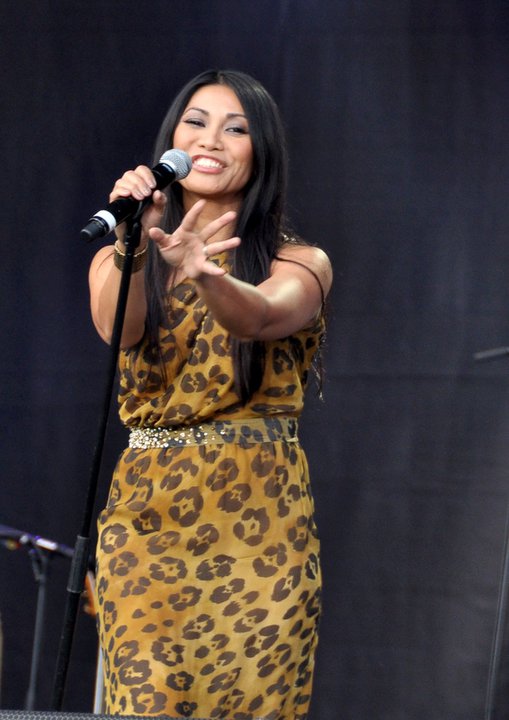
Baku, May 2012. One hundred twenty-five million viewers — that number is dizzying when you think about it too much, so I preferred not to. I wore the colors of France with Echo (You and I), a song about the universality of love and the dialogue of cultures. I chose to sing it in French and English — for me, it wasn't a strategy, it was obvious, my dual language on Europe's biggest television stage. Representing a country that was not the one of my birth but the one of my choice was an immense pride and a responsibility. There is a difference between being born somewhere and deciding to belong there. That night, at the other end of Europe, on that Azerbaijani stage, I felt I was giving back to France a little of the welcome she had given me.
There is a difference between being born somewhere and deciding to belong there.
—Why do you insist on singing in both languages rather than choosing the more universal one?
I've often been advised to sing only in English, the language of the global market, the international single that sells everywhere. But reducing my voice to a single language would betray who I am. In Baku, in 2012, English carried the melody to the world, and French expressed my anchor, my chosen Francophonie. The two weren't fighting for the mic: they were answering each other. That's what I wanted to continue with my album Écho, in 2017, entirely bilingual, like a synthesis of my entire journey. A language is not just a communication tool — it's a way of inhabiting the world. I have two, sometimes three if you count the Indonesian of my childhood, and I refuse to sacrifice any of them on the altar of commercial efficiency.
A language is not just a communication tool — it's a way of inhabiting the world.
—What does that French passport you obtained in 1998 mean to you?
That French passport, I received it in 1998, after years of effort and patience. It's not a simple administrative document stashed in a drawer: it's the seal of a choice. On the day of my naturalization, they asked me if I was giving up something. I replied that I wasn't giving up anything, I was adding. I am proud to be Indonesian and proud to be French. These two identities do not oppose each other; they complement each other and make me who I am. I keep that passport next to the memory of Jakarta, and the two coexist in peace. Naturalization is not about replacing one belonging with another, like changing a coat. It's recognizing that you can love two lands at once, without one being jealous of the other.
I wasn't giving up anything, I was adding.
—How do you experience this dual belonging in everyday life, away from the spotlight?
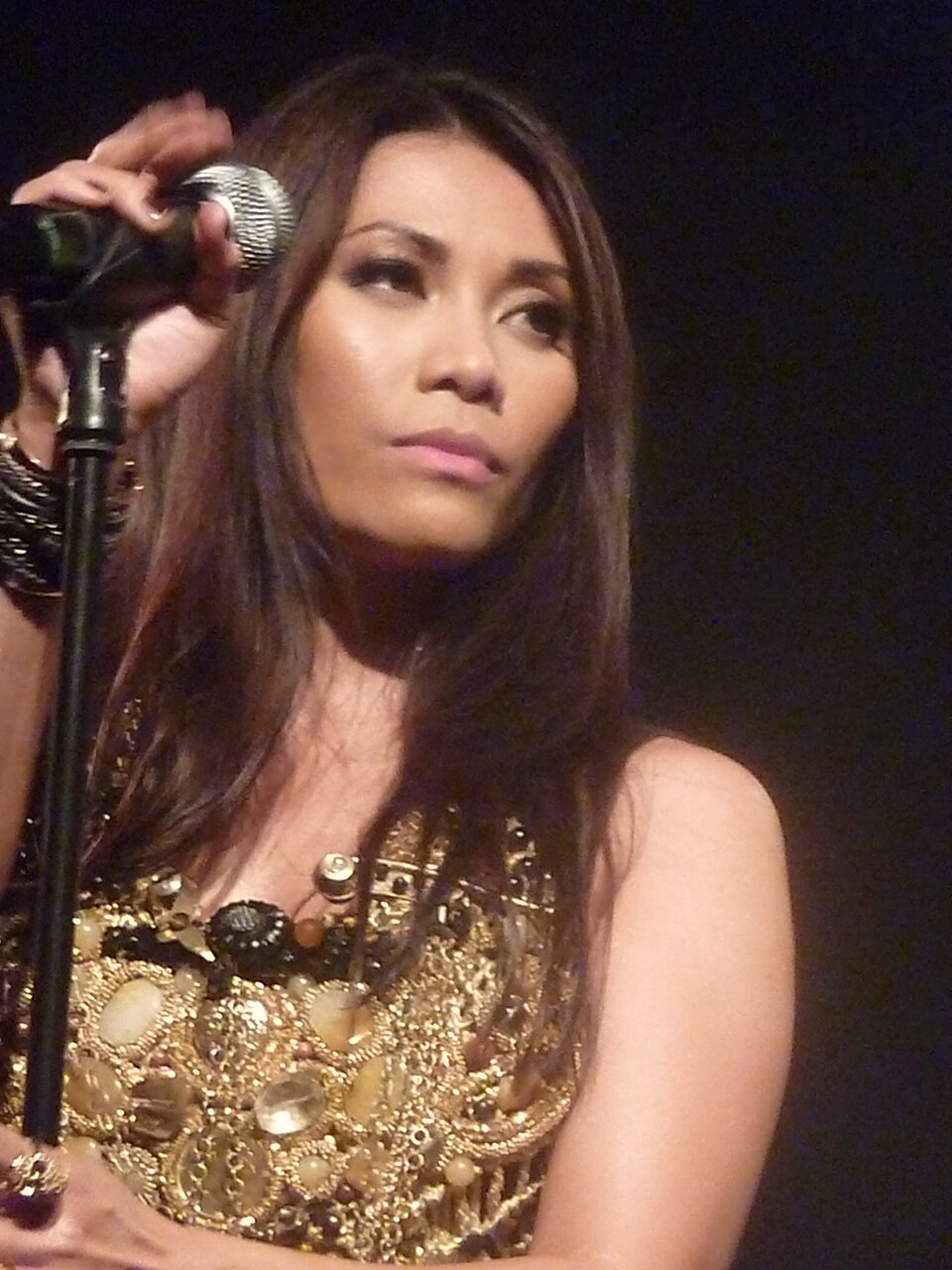
Just look at my home. On my Parisian walls, Javanese batiks, a few wayang puppets, next to all European furniture. In the evening, I sometimes cook a nasi goreng, that fried rice from my childhood, before going out for a French TV show. On stage, my stylists mix traditional Javanese patterns with Parisian haute couture cuts — my silhouette itself tells this double story. People sometimes ask if I don't feel torn, caught between two worlds. Not at all. A home like mine is not a battlefield; it's a place of passage, a porous border where the two cultures speak to each other. The cultural globalization people talk about so much, I live it in my kitchen and on my walls, very concretely.
Cultural globalization, I live it in my kitchen and on my walls.
—How did your humanitarian commitment to Indonesia come about?
When the tsunami devastated Southeast Asia at the end of 2004, Indonesia was hit head-on. I was far away, in Paris, and that distance became unbearable. What was my voice worth, all that success, if I didn't use it in such a moment? I got involved in aid operations for my country of origin. Then, in 2008, UNICEF appointed me a Goodwill Ambassador for Indonesia. I carried their fights: the fight against child labor, access to education, those rights we take for granted and that so many lack. My dual culture, which could have been just a stage argument, finally took on its full meaning. Serving as a bridge between the two shores I inhabit — that's what I believe is my true task.
What was my voice worth, all that success, if I didn't use it in such a moment?
—Do you willingly describe yourself as a bridge between Asia and the West?
A bridge, yes, that's the image that always comes back to me. My whole life fits in that word. As a child in Jakarta, I heard the percussions of gamelan resonating in the city; as an adult, I slipped them under Western arrangements. As a UNICEF ambassador, I carry the voice of Indonesian children before European institutions. On every tour, wherever I go in Europe, I keep a link with the local Indonesian community, that diaspora that supported me in my early Parisian days. A bridge belongs to neither shore nor the other: its reason for being is to connect. For a long time I thought I had to choose my side. I finally understood that my place was precisely there, in the middle, in that passage between two worlds that too many people believe irreconcilable.
A bridge belongs to neither shore nor the other: its reason for being is to connect.
This imaginary interview was generated by artificial intelligence from sources documented in Anggun's profile. It dramatises what the figure might have said based on what we know about them, but does not constitute attested historical testimony. For primary sources and factual documentation, refer to the full profile.