Imaginary dialogue between Erick Benzi and Anggun
by Charactorium · Anggun (1974 — ?) · Performing Arts · Music · 6 min read
It is in a studio in the 18th arrondissement of Paris, one evening in 2017, that Erick Benzi meets Anggun between takes of the album Écho. Scores still lie on the console, and the smell of cold coffee lingers in the booth where they spent so many nights. They have known each other for twenty years, since the desert of Snow on the Sahara, and Erick comes tonight less as a producer than as an accomplice, to get her to talk about her transformation. She sits at the piano, turns off the mic, and smiles.
—Anggun, before I met you, you were already a star in Jakarta. Tell me about the little girl who sang at seven.
You know, Erick, when I recorded my first songs in 1981, I was only seven and I didn't yet know that music would be my whole life. At fourteen, my rock album Dunia Milikku made me a celebrity throughout the archipelago, in a country of two hundred million people. I grew up with the sounds of the gamelan, those gongs and metallic percussions from Java that still resonate in me when I write a melody. My mother dressed me in batik, and I went on stage like other children go to school. That precocity gave me strength, but also solitude: I was an artistic adult in a teenager's body. All that Indonesia, I carried it in my suitcase when I left.
I was an artistic adult in a teenager's body.
—Then you left everything. When you arrived in Europe, you didn't speak a word of French. Why that crazy gamble?
Because I wanted to be reborn, not to coast on my past glory. I arrived with a suitcase and a dream, as I once told a journalist from Le Monde, and I refused to live off my Indonesian fame. I first tried London, without success, before settling in Paris. In the mornings, I took intensive French lessons, working on pronunciation, writing, every vowel. In the afternoons, vocal coaching to adapt my voice to European standards. I chose to sing in the language of my adopted country: Au nom de la lune, in 1997, was my declaration. Many thought I was crazy to start over from scratch. But I preferred to be a sincere beginner than a recycled star. France welcomed me, and I returned that welcome.
I preferred to be a sincere beginner than a recycled star.
—Do you remember our nights in the studio on Snow on the Sahara? Tell me what you were looking for in that fusion we built.
How could I forget, Erick? You, at the console, know better than anyone what we were looking for. I wanted my Asian melodies to meet your Western electronic arrangements, without one overwhelming the other. Those endless afternoons when we would redo a musical phrase twenty times — that's where my sound was born. When we shot the video in the Sahara desert, those infinite dunes said exactly what I felt: the universal is born from blending. The song was a hit in over thirty countries, in 1997, an artist from a non-English-speaking country breaking into the global market. It was unthinkable. But we never thought 'market'. We thought emotion. The rest followed like snow falls, against all logic.
The universal is born from blending, like snow falling on the Sahara.
—You mastered French so quickly. Does writing in a new language change how you feel music?
Enormously. Each language has its own breath, its way of placing the heart on a note. In Indonesian, I sang by instinct; in French, I had to relearn how to think my emotions. At first, I stumbled over nasal vowels, over those r sounds that don't exist in my language. But gradually, the language became another instrument. Francophonie is not just a cultural passport: it's a family I chose. When I finally managed to write a line that sounded right, without an accent in the hidden meaning of the words, I knew I was home. I think a language learned as an adult, you love it differently — with the awareness of every word earned. Maybe that's why I take such care with my French lyrics.
Francophonie is not a passport: it's a family I chose.
—In 2012, you represented France at Eurovision in Baku. How does it feel when you were born in Jakarta?
With immense pride and a touch of vertigo. Singing Echo (You and I) in front of 125 million viewers, in French and English, was embracing my entire story in a single gesture. I chose both languages deliberately: my adopted country and the international stage, united. When I was naturalized in 1998, I said I was proud to be Indonesian and proud to be French, that these two identities do not oppose but complement each other. In Baku that night, with my French passport in my pocket and the memory of Jakarta in my heart, I felt that those two flags became one within me. The ranking didn't matter: I existed fully on that stage, without having to choose half of myself.
These two identities do not oppose each other: they complement each other and make me who I am.
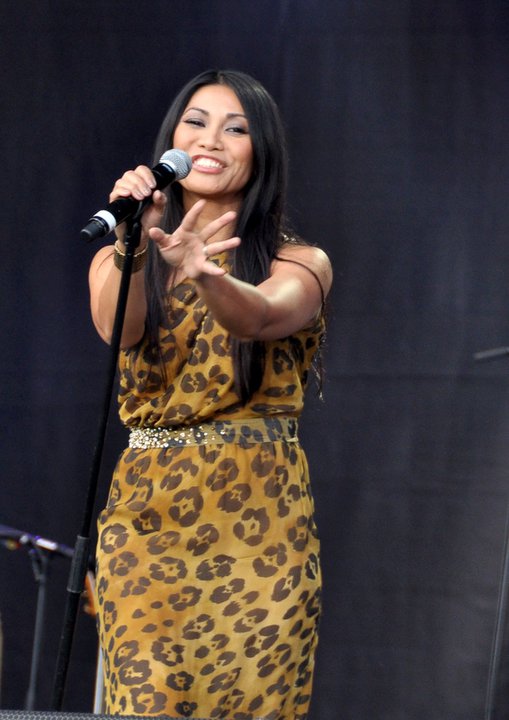
—Since our beginnings, you have always refused to erase your origins. On stage, those batik and haute couture outfits — is that a manifesto?
Yes, a discreet but deliberate manifesto. My stylists blend Javanese batik patterns with French haute couture cuts, and it's not an aesthetic whim: it's my biography sewn into the fabric. I never wanted to look like an interchangeable Western singer, nor like a postcard exoticism. Between the two, there is me, this living blend. In my daily life, I have adopted Parisian fashion, but I always keep an accessory from the East. At home in Paris, there are wayang puppets, batiks on the walls, alongside European furniture. My home, like my wardrobe, is a bridge between two worlds. Cultural globalization, we've analyzed it a lot; I simply wear it on my skin.
My biography, I wear it sewn into the fabric of my dresses.
—The 2004 tsunami devastated Indonesia. Living far away, how did you experience the bond that still connected you to that country?
It was heartbreaking. Seeing my country of origin devastated from France, powerless at a distance, was unbearable. I got involved in humanitarian operations, because you never truly cut the cord with the land that gave you birth. That was partly where my broader commitment came from. In 2008, I was appointed a UNICEF Goodwill Ambassador for Indonesia, especially against child labor and for access to education. I often thought of myself, already singing at seven: how many children didn't have my chance? My dual culture, instead of dividing me, gave me a mission: to serve as a bridge between the West and Southeast Asia. Fame only makes sense if it serves that purpose.
You never truly cut the cord with the land that gave you birth.
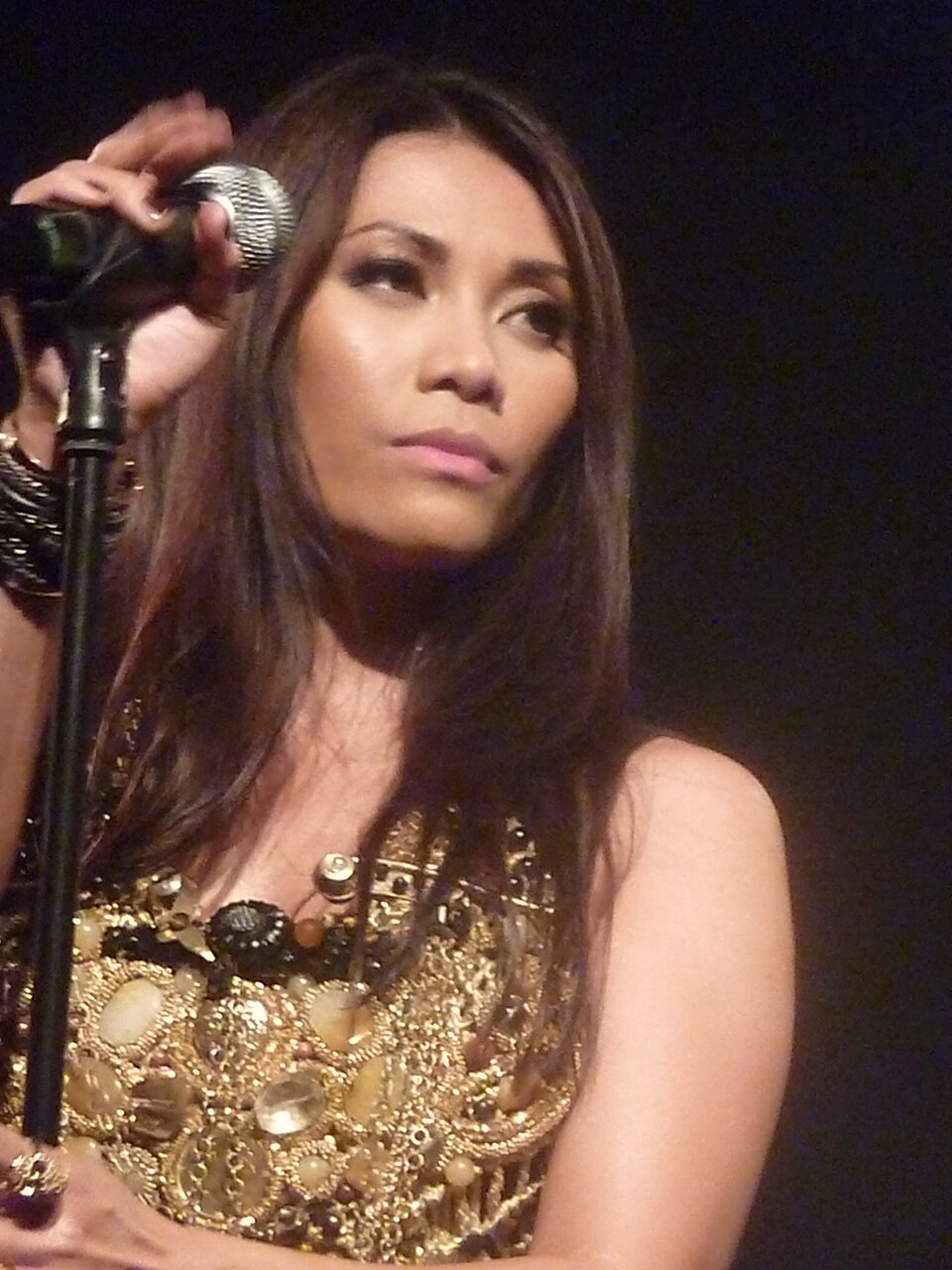
—That Indonesian diaspora in Europe — you relied on it at the beginning. Does it still matter to you today?
Immensely. When I started out in Paris, alone and without bearings, the Indonesian community was my first audience, my first surrogate family. On tour, even today, I keep that reflex: in every city, I meet the diaspora, I preserve that link to my roots. They reminded me, in my moments of doubt, where I came from and why I sing. They are proud to see me carry our colors on world stages, and that pride carries me in return. I think an uprooted artist who forgets their community ends up singing into the void. I sing with Jakarta at my back and Paris in my eyes. Those people are the silent guardians of my identity, the ones in front of whom I never cheat.
I sing with Jakarta at my back and Paris in my eyes.
—For a long time, we were pigeonholed as world music. Did you experience that label as recognition or a prison?
Both, honestly. World music opened doors; it allowed non-Western sounds to exist on the global market in the 1990s. But a label also confines. Sometimes they wanted to reduce me to exoticism, to the singer 'from elsewhere'. Yet I make pop, simply pop, nourished by a thousand influences. You and I, Erick, never composed 'world music': we sought a universal emotion with the tools at hand. Musical blending is not a commercial genre; it's a way of being in the world. I refuse boxes because my entire life is a crossing of borders. My only category is sincerity.
Blending is not a commercial genre: it's a way of being in the world.
—Last question, my friend. If the little singer from Jakarta saw you tonight, in this studio, what would you say to her?
I would tell her not to be afraid. That fourteen-year-old girl, a star in her archipelago, couldn't imagine she would cross oceans, learn a new language, one day carry the colors of another country without ever betraying her own. I would tell her that everything she thinks she has to abandon when leaving, she will instead carry deep inside — the gamelan, the batik, her mother's voice. Nothing is lost, everything transforms. The microphone she already clutches at seven, she will still hold decades later, on stages she doesn't even dare dream of. And above all, I would tell her that being dual is not being divided: it is being vaster. There, Erick, that's what twenty years of music with you have taught me.
Being dual is not being divided: it is being vaster.
This imaginary interview was generated by artificial intelligence from sources documented in Anggun's profile. It dramatises what the figure might have said based on what we know about them, but does not constitute attested historical testimony. For primary sources and factual documentation, refer to the full profile.