Kids interview Ariel Sharon
by Charactorium · Ariel Sharon (1928 — 2014) · Military · Politics · 4 min read

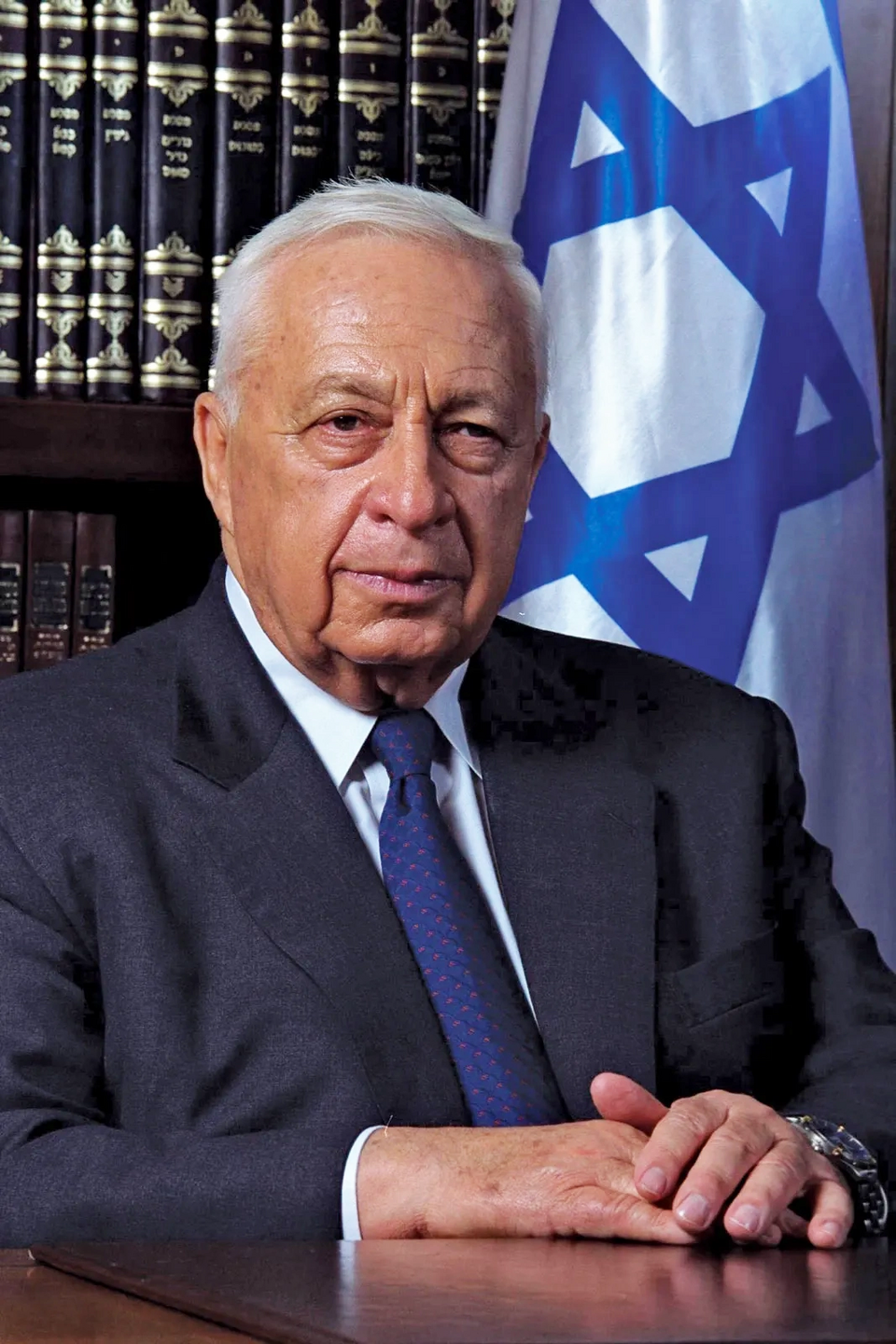
Two twelve-year-old students, on a school trip, pushed open the door of a large quiet room. Sitting in an armchair, an old man with a round face was waiting for them. It was Ariel Sharon, general and former Prime Minister of Israel, ready to answer all their questions.
—Is it true they called you "the Bulldozer"? Did you like that nickname?
You know, my child, I was given two nicknames. "The Bulldozer," because once I got going, nothing could stop me. Imagine a big machine pushing everything in front of it, never backing down: that was me. And then "the Lion of God," because my first name, Ariel, means exactly that in Hebrew. Yes, I liked it. But a nickname also boxes you in. People thought I charged in without thinking. The truth is, I thought a lot, at night, bent over my maps. I only charged when I was sure.
A nickname gives you a reputation, but it also locks you in.
—How old were you when you became a military commander?
I was very young, barely twenty-five. In 1953, I was put in charge of a small unit called Unit 101. Our mission? To respond to attacks coming from across the borders. It was an elite unit, handpicked soldiers. In front of me, I always had a staff map, you know, those large sheets where you draw the terrain, the hills, the villages. I spent hours imagining where to go. That's where I learned my trade: move fast, surprise the enemy. This way of doing things marked the entire Israeli army, the IDF, for years.
At twenty-five, my real weapon was already a map spread on a table.
—They say you crossed a canal with tanks. How do you do that?
Ah, that's my greatest memory as a soldier! In 1973, during the Yom Kippur War, Egypt was attacking us hard. I decided something crazy: get my tanks across the Suez Canal, a huge water ditch separating Africa from Asia. Imagine heavy armored vehicles like houses that had to glide over water, in the middle of the night, under fire. We succeeded. Once on the other side, I encircled an entire Egyptian army. That day, the tide turned in our favor.
I made steel houses cross water, and the tide turned.
—Weren't you scared during that battle? You were wounded, right?
Yes, I was wounded, my boy. A piece of shrapnel hit me in the head. I kept commanding with a big bandage around my forehead, blood trickling a little. Fear? Of course I was scared. Anyone who tells you a soldier is never afraid is lying. But when your men are looking at you, you don't have the right to tremble. So I gritted my teeth. That bandage, later, people talked about it a lot. The soldiers saw their general standing, his head wrapped in white cloth, and it gave them courage. A wound can become an image stronger than words.
A soldier is afraid like everyone else; he just learns not to show it.
—I heard something bad happened in Lebanon. Can you explain?
You ask a difficult question, and I'll answer honestly. In 1982, I was Minister of Defense, and I led our army into Lebanon, a neighboring country in the middle of a war. During that war, in two neighborhoods called Sabra and Shatila, hundreds of defenseless civilians were massacred. It wasn't us who killed, but our soldiers were there, nearby, and didn't prevent the tragedy. An investigative commission ruled that I should have foreseen the danger. I carried that shadow for a long time. A leader is responsible, even for what he didn't do.
A leader is also responsible for what he failed to prevent.
—When you weren't at war, what did you do? What did your home smell like?
Ah, now you touch my true happiness! Far from the fighting, I was a farmer. I had a farm in the Negev desert, in the south, which I called the Sycomore Farm. At home, it smelled of warm earth, dry dust, the smell of animals in the barn. I had cattle, cows, and I loved taking care of them with my own hands. Imagine a big empty space, silence, just the wind and the mooing of animals. It rested my head. People only saw the general in khaki uniform. In my heart, I was also a peasant.
They saw me as a general; in my heart, I was a desert farmer.
—In the evening, after work, did you go back to the farm? What was it like?
Yes, whenever I could! During my years as Prime Minister, my days were hard: meetings from early morning, heavy decisions, arguments in Jerusalem. So in the evening, when I could, I would speed off to my Negev farm. Imagine leaving a room full of shouting people to find yourself alone, under a starry sky, with the smell of the fields. There, no one asked me for anything. I walked among my animals, I breathed. It gave me strength for the next day. A man who decides for a whole country needs a place where he is just a man.
You need a place where you are no longer a leader, just a man.
—You liked settlements, and then you removed them. Why did you change?
You've understood everything, and that's the great paradox of my life! For years, I encouraged Israelis to settle in the occupied territories, to build villages, what we call settlements. I believed in it. And then, in 2005, it was I, the old defender of settlers, who ordered them all to leave the Gaza Strip. That's called the disengagement. Why? Because I came to think that staying cost too many lives, on both sides. An intelligent man has the right to change his mind when reality changes. Stubbornness is not strength.
Changing your mind when the world changes is not weakness, it's growth.
—That must have angered your friends, that decision, right?
Oh yes, enormously! Many of my own friends felt betrayed. My party, Likud, the great Israeli right I had served all my life, split because of me. Some yelled at me, called me a traitor. It wasn't easy, you know, to see people you love turn away. So I did something unexpected: I left Likud and founded a new party, Kadima, which means "Forward" in Hebrew. A nice name for a man my age. Sometimes, to stay true to an idea, you have to leave your own home.
Sometimes, to stay true to an idea, you have to leave your own home.
—If people remember you in a hundred years, what would you like them to say?
A beautiful question to end with, my child. I was a warrior, a go-getter, "the Bulldozer." But if you want to remember me, don't just remember the tanks and battles. Remember that at the end of my life, this old general sought to make less war, not more. Remember that a man can spend his life fighting and, one day, try something else. My last big decision was not to attack, but to withdraw from Gaza. That's what I'd like to leave you: one can change, even old, even when everyone thinks you can't move.
Remember that a man can change, even old, even when no one believes it.
This imaginary interview was generated by artificial intelligence from sources documented in Ariel Sharon's profile. It dramatises what the figure might have said based on what we know about them, but does not constitute attested historical testimony. For primary sources and factual documentation, refer to the full profile.