Imaginary dialogue between Yitzhak Kahan and Ariel Sharon
by Charactorium · Ariel Sharon (1928 — 2014) · Military · Politics · 5 min read

It is at the Sycomore Farm, in the warm dust of the Negev, that Judge Yitzhak Kahan meets Ariel Sharon at the end of 1984. The wind carries the smell of cattle and the distant rumble of a tractor. The two men know each other in a very different way: it was before the commission chaired by Kahan that the Minister of Defense had to explain himself two years earlier about the massacres of Sabra and Shatila. The magistrate has not come to judge again, but to understand the man behind the soldier nicknamed "the Bulldozer."
—General, it is said that in 1973 you crossed the canal with your head bandaged. What drives a wounded man to go through fire like that?
Mr. President, when I sent my tanks to the west bank of the Suez Canal, the Egyptian army thought we were finished. My forehead was cut open, blood was flowing under the bandage, but you don't stop for a little blood when Israel's survival is at stake a few kilometers away. We encircled their Third Army, and suddenly the whole country began to breathe again. You know, war does not forgive hesitation: he who waits for the perfect order has already lost. I half-disobeyed, I pushed, and it saved us. They made me a hero for it; I only refused to retreat before the enemy.
You don't stop for a little blood when Israel's survival is at stake a few kilometers away.
—When you appeared before our commission in 1983, I sensed more anger than doubt in you. Now, in hindsight, what remains of those hours of hearing?
Judge Kahan, I will not hide from you that those sessions were the hardest of my life, harder than any battlefield. I was Minister of Defense, I had led our army into Lebanon to protect our northern borders, and I was held accountable for a carnage committed by others, by the Phalangist militias. Your commission concluded that I should have foreseen the risk. I heard that. It cost me my post. But believe me, I never ordered nor wanted what happened in those camps. The responsibility of a leader is a burden one carries even for what one did not do with one's own hands.
—You speak of burden. Can a man truly bear responsibility for a massacre he did not order, as we wrote?
That is the very question you asked me in your courtroom, and I still think about it in the evening, here, when the desert falls silent. A general who sends his men must anticipate everything: the terrain, betrayal, the madness of others. You are right on that point, and I no longer contest it. But allow me also to tell you my side of the truth: we entered Lebanon to stop the rockets falling on our villages in Galilee. I wanted to strike fast and hard. Perhaps I looked at the map of operations and not enough at the men who inhabited it. That is the bitterest lesson a soldier can learn.
I looked at the map of operations, and not enough at the men who inhabited it.
—Here, among your livestock and fields, you are no longer quite the “Bulldozer” your enemies fear. Who are you, in this Negev?
Ah, Mr. President, you touch what is dearest to me. They call me the Bulldozer, the go-getter, and there is truth to it. But here, at the Sycomore Farm, I become a farmer again. I get up early, I go see my cattle, I feel the Negev soil between my fingers, and I swear these sheep rest me more than any military decoration. My family has always cultivated the land of this country; it is for her, for this soil, that I have fought all my life. People only see the general pushing his tanks. They don't know that deep down, I fight so that I can return to plow in peace.
I fight all my life so that one day I can return to plow in peace.
—You are said to be the tireless builder of settlements in the territories. Is it the strategist or the farmer who plants villages on the hills?
Both, Judge Kahan, because for me it is the same thing. A soldier knows that a held hill is better than a border drawn on paper. A farmer knows that an inhabited land is not easily retaken. Since Likud came to power, I have encouraged our people to settle in Judea and Samaria and Gaza, to build houses, roads, schools there. Each settlement is for me a fait accompli, a root driven into the soil. My adversaries see it as an obstacle to peace; I see it as Israel's security, engraved in the landscape. You don't defend a country with maps; you defend it with men who live on its land.
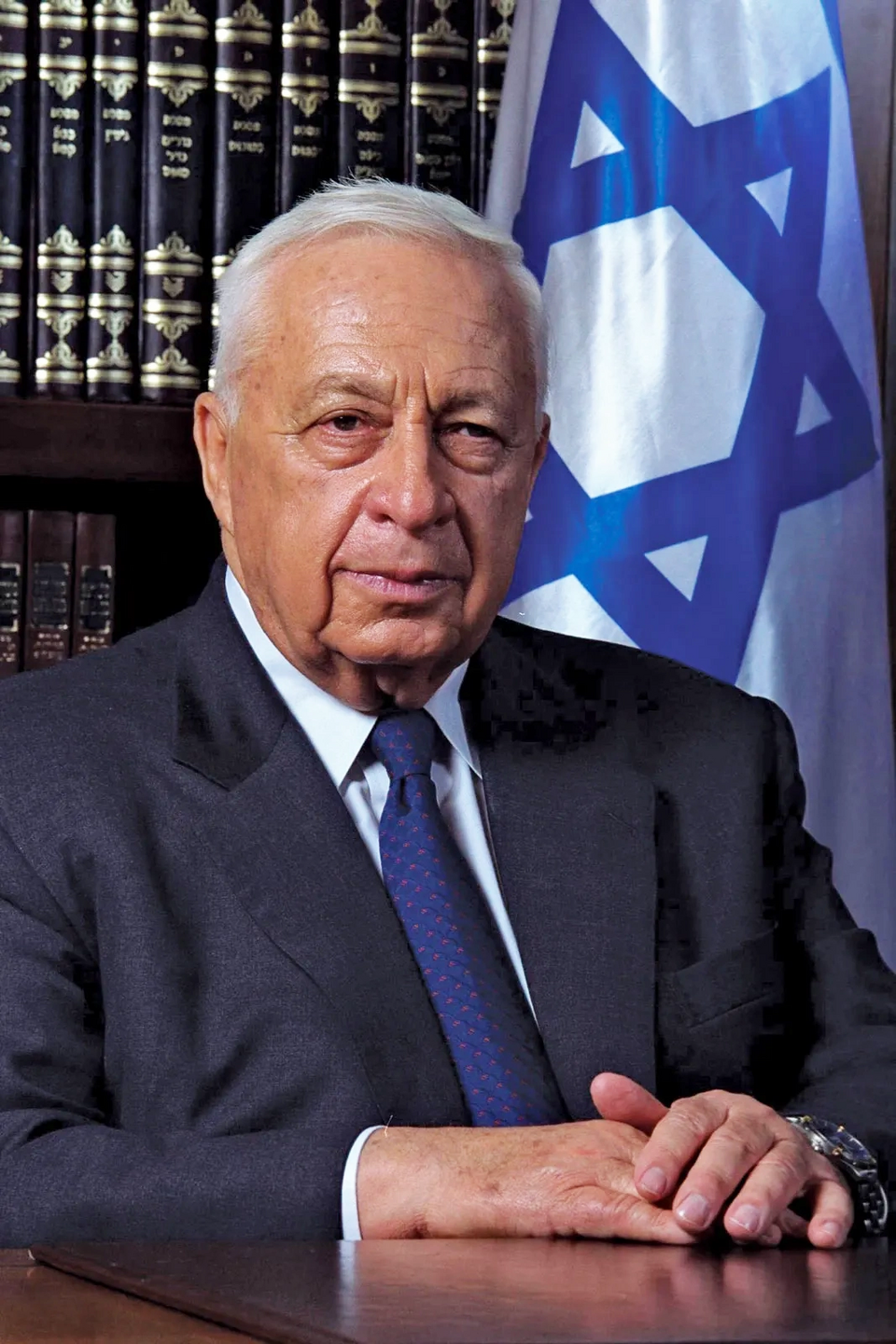
—Long before Suez, in 1953, you forged Unit 101. Many see it as the matrix of our offensive doctrine. Do you acknowledge that?
I readily acknowledge it, and I am proud of it. In 1953, our young state was bleeding from incursions from neighboring countries; our villages lived in fear. I was entrusted with a handful of determined men to retaliate, strike beyond the lines, show that touching an Israeli would cost. Unit 101 lasted a short time, but it changed the spirit of Tsahal: no longer suffer, take the initiative, carry the fight to the enemy. Some have criticized me for the harshness of those reprisals. But we were weak and surrounded, and weakness, in this region, is called an invitation. I learned something there that I never forgot: the best defense for a small country is audacity.
Weakness, in this region, is called an invitation.
—Evening falls on the Negev. How does a man like you, so driven toward action, learn to rest?
Badly, Mr. President, I admit it with a laugh. All my life I have lived in motion, and rest weighs on me more than fatigue. But in the evening, when I return to the farm, something loosens. I sit down, I am served a good meal — hummus, salads, meat, what our Mediterranean land gives best — and I eat, I confess, more than is reasonable. My figure bears witness to that. I love good food as I love everything that is full, generous, alive. These evenings far from Jerusalem, far from tensions, are my true luxury. A general needs such hours so as not to become a war machine.
—After all the commission cost you, has it ever crossed your mind to leave public life and stay here, among your sycamores?
More than once, Judge Kahan, especially in the days following your report. I was stripped of Defense, the press pointed fingers, even my friends lowered their voices when I entered. I could have kept quiet, cultivated my land and let the storm pass. But a man who crossed the canal does not take refuge in a sheepfold. I still believe I have a role to play for this country, even diminished, even contested. The fall is not the end; it is a trial. I was wounded in 1948 in combat, I survived; I will survive this wound too. What keeps me standing is not lost honor, but the country that remains to be defended.
A man who crossed the canal does not take refuge in a sheepfold.
—You planted villages all the way into the Gaza Strip. Those settlements, so exposed, so contested, are they really sustainable in the long term?
That is a question only a judge would dare ask me so frankly. Yes, those settlements are exposed; our families live there amid a large and hostile Palestinian population. I know it better than anyone, I who had those houses built. But what is founded today will weigh in the balance tomorrow, believe me. In politics as in war, you first create facts, then you negotiate. That the future will be difficult, I do not deny it; it will take courage and perhaps painful choices to hold it all together. But I have never shied away from a painful choice when Israel's interest required it. The rest belongs to time.
—One last word, General. Jerusalem and its holy places remain an ember under the ashes. Do you measure what a simple spark could set off there?
I measure it perfectly, Mr. President, and it sometimes keeps me from sleeping. Jerusalem is not an ordinary city: every stone is charged with prayers and grudges. The esplanade that Muslims venerate covers the holiest site of our faith; it is a powder keg that three religions dispute. I believe in the right of Jews to tread every part of our eternal capital, and I will never give up that conviction. But I also know that a poorly weighed gesture in that place can set the entire region ablaze in a single night. A leader must hold both at once: firmness on our rights, and a keen awareness of the fire that smolders beneath our feet.
Every stone of Jerusalem is charged with prayers and grudges.
This imaginary interview was generated by artificial intelligence from sources documented in Ariel Sharon's profile. It dramatises what the figure might have said based on what we know about them, but does not constitute attested historical testimony. For primary sources and factual documentation, refer to the full profile.