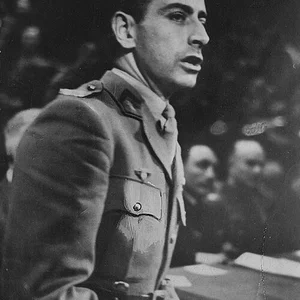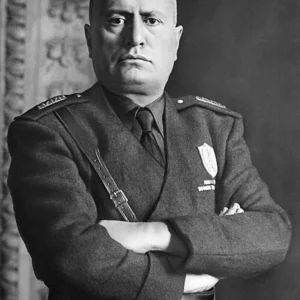

Italian politician, founder of fascism and head of the government from 1922 to 1943. A dictator (“Duce”), he established a totalitarian regime in Italy and brought the country into World War II alongside Nazi Germany.
Benito Mussolini(1883 — 1945)
Benito Mussolini
République sociale italienne, royaume d'Italie
6 min read
Frequently asked questions
Famous Quotes
« Everything within the State, nothing against the State, nothing outside the State.»
« Believe, obey, fight.»
Key Facts
- 1919: founds the Italian Fasces of Combat, the origin of the fascist movement
- October 1922: the March on Rome brings him to power, and he is appointed head of the government by King Victor Emmanuel III
- 1925-1926: establishes a dictatorship by abolishing freedoms and the opposition (the “most fascist laws”)
- 1936: forms the Rome-Berlin Axis with Hitler's Nazi Germany; enters the war in 1940
- 1945: captured and executed by Italian partisans on 28 April
Works & Achievements
Creation of the movement that would give birth to fascism, Mussolini's first nationalist and paramilitary political organization.
Gradual establishment of a one-party state, the first fascist regime in history and a model for other movements across Europe.
Treaty with the Holy See that settled the “Roman Question” and created Vatican City State, strengthening the regime's legitimacy.
Programmatic text (written with Giovanni Gentile) setting out the totalitarian fascist ideology and the absolute primacy of the State.
A colonial war that led to the founding of the Italian Empire, the peak of the regime's prestige but also the source of its diplomatic isolation.
A program of land reclamation and construction (new towns, infrastructure) that fed propaganda about the modernization of Italy.
A collaborationist state led by Mussolini in northern Italy under German protection, the final phase of his rule.
Anecdotes
Before becoming the leader of fascism, Mussolini was a committed socialist activist and edited the party newspaper, *Avanti!*. During the First World War, he radically switched sides by advocating for Italy's entry into the war, which got him expelled from the Socialist Party in 1914.
In October 1922, Mussolini organized the “March on Rome”: tens of thousands of black-shirted fascists converged on the capital. Mussolini himself did not march and waited cautiously in Milan; he only reached Rome by train, once he was certain that King Victor Emmanuel III would appoint him head of the government.
Mussolini cultivated an image of a virile, tireless leader. Propaganda showed him plowing fields bare-chested, piloting planes, or riding horses, and proclaimed that “the Duce is always right.” People were led to believe that the light in his office at the Palazzo Venezia stayed on all night to suggest that he worked without rest.
In 1929, through the Lateran Accords, Mussolini settled the old conflict between the Italian state and the papacy by recognizing Vatican City as an independent state. This compromise earned him great prestige and the support of a portion of Catholics.
In April 1945, fleeing toward Switzerland disguised in a German overcoat, Mussolini was recognized and captured by Italian partisans near Lake Como. He was executed along with his companion Clara Petacci, and their bodies were displayed upside down in Milan, in the Piazzale Loreto.
Primary Sources
I declare here, before this Assembly and before the whole Italian people, that I assume, I alone, the political, moral, and historical responsibility for everything that has happened.
Everything within the State, nothing outside the State, nothing against the State.
Italy at last has its empire. An empire of peace, because Italy wants peace for herself and for all.
The two contracting parties will remain in permanent contact in order to reach agreement on all questions affecting their common interests.
Key Places
Village in Romagna where Mussolini was born in 1883 and where he was finally buried. Today it is a controversial site of memory.
Palace from which Mussolini governed and delivered his great speeches from the balcony overlooking the Piazza Venezia. The symbolic heart of Fascist power.
Site of the founding of the Italian Fasces of Combat in 1919. Milan was the cradle of the Fascist movement.
Seat of the Italian Social Republic (1943-1945), the puppet state led by Mussolini under German tutelage in northern Italy.
The place where Mussolini was executed by partisans on 28 April 1945, after his capture during his flight toward Switzerland.
Square in Milan where the bodies of Mussolini and Clara Petacci were put on display, hung upside down, on 29 April 1945.
Typical Objects

The distinctive uniform of the fascist squads (squadristi). It became the symbol of belonging to the movement and of fascist paramilitary identity.

An ancient Roman emblem (a bundle of rods tied around an axe) adopted as the symbol of fascism. It represented the unity, strength, and authority of the State.

A club used by the squadristi to beat and terrorize political opponents. A symbol of the violence of fascism's early years.

An image distributed on a massive scale glorifying the Duce and the regime's achievements. Visual propaganda shaped public opinion and sustained the cult of the leader.

State radio was used to broadcast Mussolini's speeches throughout the country, even into schools and public squares. A key tool of mass propaganda.

Headgear worn by Italian troops during the colonial campaigns, notably in Ethiopia. It embodies the regime's imperial expansionism.
School Curriculum
Vocabulary & Tags
Key Vocabulary
Daily Life
Morning
At the height of his power, Mussolini rose early and kept fit through horse riding or fencing, activities heavily staged by propaganda. He would then head to his office at the Palazzo Venezia to handle affairs of state.
Afternoon
His afternoons were devoted to audiences, cabinet meetings, and reading the many reports he demanded. He held several ministries at once, which gave him an officially overloaded schedule.
Evening
In the evening, he received associates or visitors, sometimes late into the night. The light left on at his office window sustained the myth of a leader working tirelessly for the nation.
Food
Mussolini ate frugally, partly for health reasons (he suffered from stomach ulcers). He favored fruit, milk, and vegetables, and drank little alcohol, which propaganda portrayed as the virtue of a disciplined man.
Clothing
In public, he alternated between the military uniform adorned with decorations, the black shirt of the Fascists, and, at official ceremonies, the dark suit or head-of-state attire. His posture — jaw thrust forward and hands on hips — was part of his image.
Housing
His family lived at the Villa Torlonia, a vast Roman residence made available to him for a symbolic rent. There he lived with his wife Rachele and their children, far from the public image of the solitary leader.
Historical Timeline
Period Vocabulary
Liens externes & ressources
Références
Œuvres
Fondation des Faisceaux italiens de combat
1919
Instauration du régime fasciste
1922-1925
Accords du Latran
1929
La Doctrine du fascisme
1932
Conquête de l'Éthiopie et proclamation de l'Empire
1935-1936
Grands travaux et assèchement des marais Pontins
années 1930
République sociale italienne (République de Salò)
1943-1945