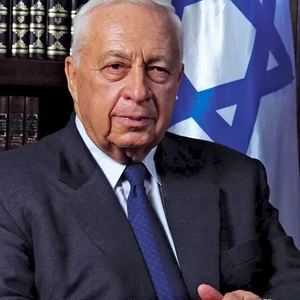

Israeli general and statesman, a major military figure in the Arab-Israeli wars. Prime Minister of Israel from 2001 to 2006, he ordered the unilateral withdrawal from the Gaza Strip in 2005 before being struck by a stroke that left him in a coma.
Frequently asked questions
Key Facts
- Born in 1928 in Mandatory Palestine, died in 2014 after eight years in a coma
- An officer in the Israel Defense Forces, he distinguished himself during the Six-Day War (1967) and the Yom Kippur War (1973), in which he crossed the Suez Canal
- Minister of Defense during the Lebanon War in 1982, held indirectly responsible for the Sabra and Shatila massacres
- Prime Minister of Israel from 2001 to 2006, leading the Likud and then founding the Kadima party in 2005
- Carried out the unilateral Israeli withdrawal from the Gaza Strip in 2005
Works & Achievements
An elite unit tasked with reprisal operations, which shaped the offensive doctrine of the Israeli army.
A daring maneuver during the Yom Kippur War that turned the tide of the conflict and made Sharon a national hero.
As a minister, Sharon encouraged the construction of Jewish settlements in the occupied territories.
An account of his life as a soldier and statesman, an important testimony on the military history of Israel.
The unilateral withdrawal of settlers and the army from the Gaza Strip, the most significant and most controversial decision of his term.
A new centrist party created by Sharon after his break with Likud, which reshaped Israeli political life.
Anecdotes
Nicknamed “the Bulldozer” for his determination and his go-getter attitude, Ariel Sharon was also called “the Lion of God,” because his first name Ariel means “lion of God” in Hebrew. These nicknames summed up his image as a man of action whom nothing seemed able to stop.
During the Yom Kippur War in 1973, Sharon led his tanks across the Suez Canal to encircle the Egyptian Third Army. He fought with his head bandaged, wounded in the forehead, which strengthened his legend as a heroic and impetuous general among Israeli soldiers.
Before entering politics, Sharon was a farmer and adored his farm in the Negev, named “Sycamore Ranch.” This attachment to the land contrasted with his warrior image: he loved tending to his livestock and often spoke about his farm.
In 2005, it was Sharon himself, long a champion of the settlements, who ordered the withdrawal of all Israeli settlers from the Gaza Strip. This decision surprised the entire world and deeply divided his own political camp, pushing him to leave the Likud to found a new party, Kadima.
In January 2006, a severe stroke plunged Sharon into a deep coma. He remained in this state for eight years, kept alive in the hospital, until his death in 2014 — a paradoxical end for a man who had spent his whole life in motion.
Primary Sources
The disengagement plan is intended to provide maximum security and to minimize friction between Israelis and Palestinians.
In it, Sharon recounts his life as a soldier and statesman, from his childhood on a farm to the great Arab-Israeli battles.
The commission concluded that Defense Minister Ariel Sharon bore indirect responsibility for failing to anticipate the risk of massacres.
Key Places
Agricultural village in Mandatory Palestine where Ariel Sharon was born in 1928 into a family of Jewish immigrants from Eastern Europe.
Site of Sharon's military feat in 1973: he led his forces across it to encircle an Egyptian army during the Yom Kippur War.
Territory from which Sharon ordered the unilateral withdrawal of settlers and the Israeli army in 2005, a major decision of his term.
Capital where Sharon held power as Prime Minister; his visit to the Temple Mount in 2000 preceded the Second Intifada.
Sharon's farm in the Negev desert, where he liked to retreat and tend to his livestock.
Major Israeli city where Sharon was hospitalized after his stroke and where he died in 2014.
Typical Objects

A symbol of Sharon's military career, during which he led decisive armored offensives, notably in the Yom Kippur War. The tank embodied his strategy of rapid movement and breakthrough.

Sharon wore the uniform of the Israeli army (the IDF) for many years before his political career. It marked his authority and his status as a military commander.

During the Yom Kippur War, Sharon fought with his head bandaged after an injury, an image that became a famous emblem of his courage. This dressing remained associated with his warrior legend.

An indispensable tool for the strategist, on which Sharon planned his maneuvers and encirclements. It reflects his talent as a tactician in the field.

At his Sycamore Ranch in the Negev, Sharon used agricultural machinery, a testament to his passion for the land. This object recalls his other side, far from the battlefields.

As Prime Minister, Sharon spoke from official podiums, notably to announce the withdrawal from Gaza. It symbolizes his transition from military command to civilian power.
School Curriculum
Vocabulary & Tags
Key Vocabulary
Tags
Daily Life
Morning
During his years as Prime Minister, Sharon began early with security briefings and the reading of military and diplomatic reports. An early riser, he consulted his advisers on the situation along the borders.
Afternoon
His afternoons were filled with cabinet sessions, meetings with foreign leaders, and strategic decisions. He alternated between the Knesset in Jerusalem and his Prime Minister's office.
Evening
In the evening, when he could, Sharon liked to return to his farm in the Negev to escape the pressure. There he rediscovered the calm of the countryside, far from political tensions.
Food
Known as a bon vivant, Sharon enjoyed fine food and hearty meals, which gave him an imposing figure. Israeli and Mediterranean cuisine — hummus, salads, meats — featured at his table.
Clothing
Depending on the period, Sharon wore the khaki uniform of the IDF and later, in politics, the dark suit and tie of statesmen. At the farm, he put on simple work clothes.
Housing
Sharon split his life between official residences in Jerusalem and his Sycamore Farm in the Negev desert, which was his true home.
Historical Timeline
Period Vocabulary
Liens externes & ressources
Références
Œuvres
Traversée du canal de Suez
1973
Politique d'implantations
années 1977-1990
Warrior (autobiographie)
1989
Plan de désengagement de Gaza
2005
Fondation du parti Kadima
2005