Imaginary dialogue between Prafulla Chandra Ray and Asima Chatterjee
by Charactorium · Asima Chatterjee (1917 — 2006) · Sciences · 5 min read
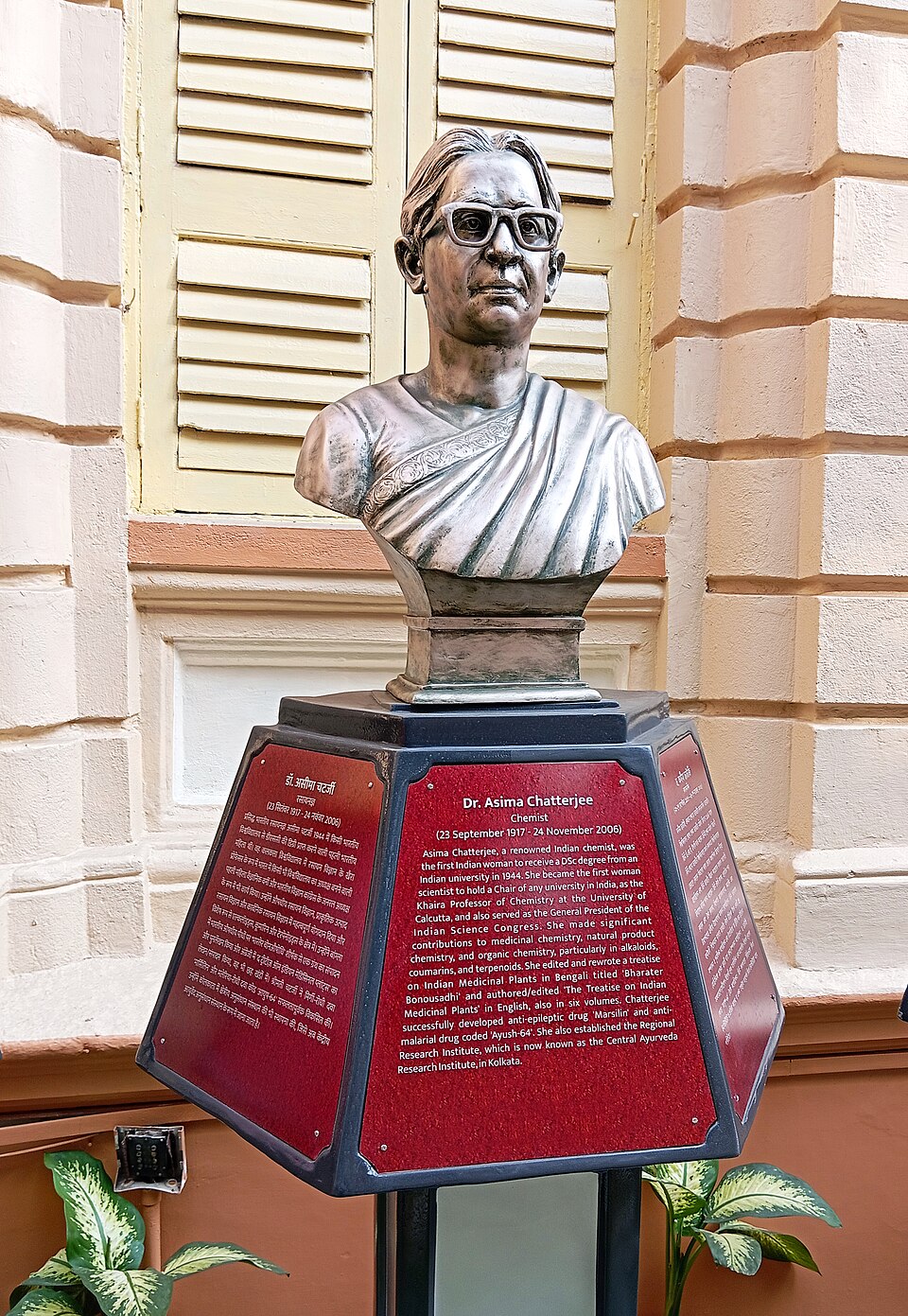
It is in the dusty light of a laboratory at the University of Calcutta, among glass flasks and the smell of ethanol from extractions, that old Prafulla Chandra Ray comes to find his former student. He has trained generations of Bengali chemists, but this one, bent over her vials of alkaloids, intrigues him more than the others. They have known each other since the faculty benches, from the time when she was only a stubborn student refusing to be shut out. The master sets down his cane, sits beside the bench, and seeks to understand what he has sown.
—Asima, my child, do you remember when you used to come listen to me talk about the plants of Bengal? What exactly did you hope for in choosing chemistry?
How could I forget, Acharya? You spoke of salts and alkaloids as a heritage India did not know it possessed, and that seized me. I hoped to prove that a girl from Calcutta could do science as rigorous as that of Europe, without leaving her land. In 1938, I earned my master's degree right here, then I wanted to go further, all the way to the doctorate in science that no woman had yet received from an Indian university. I was told my place was not at the bench. You never did. You treated me as a researcher, not as an exception. What I seek is to wrest from plants their useful secrets, not honors.
I was told my place was not at the bench. You never did.
—I hear you are thinking of crossing the ocean, to America. Why move away from the laboratories I taught you to love?
Do not see that as a betrayal, master. I want to complete my training where natural products are isolated with methods we do not yet have: Wisconsin, then Caltech in California, where pigments are studied. But I promise you, it is not to stay. Too many of our people leave and never return. I will come back to build here. What is the use of learning the art of extracting a molecule if it is to practice it far from the ferns and periwinkles of Bengal? You taught me that Indian science will not be made in exile. I carry your lessons as luggage, and I will bring them back enriched.
Too many of our people leave and never return. I will come back.
—Tell me about your plants. What are you looking for in these periwinkles and ferns that you grind on your bench from morning till night?
Remedies, master, hidden in the sap. Take the periwinkle, Vinca: it harbors alkaloids whose exact structure I labor to establish, molecule by molecule. There is also a small water fern, Marsilea minuta, that our villagers have known forever; from it I extract something to calm epileptic seizures. And I am tackling malaria, that scourge emptying our countryside. My chromatography column separates the compounds, my polarimeter measures how they bend light — because an alkaloid is recognized by the way it twists the ray. Each plant is an enigma that ancient knowledge guessed without ever writing it in formulas.
Each plant is an enigma that ancient knowledge guessed without ever writing it in formulas.
—Our grandmothers already healed with these plants long before us. Does your chemistry merely translate Ayurveda into the language of scholars?
You put your finger on what matters most to me. Ayurveda knows that a plant heals; it does not know why. My work is to find the responsible molecule, to isolate it, to measure it, so that the remedy becomes safe and reproducible. That is not to despise our elders, but to do them justice by showing they were right. I dream of cataloging all the medicinal plants of India in a rigorous treatise, with their active principles. Phytotherapy and chemistry are not enemies, master: one guesses, the other demonstrates. You yourself never separated the laboratory from the country's heritage.
Ayurveda knows that a plant heals; it does not know why. My work is to find the why.
—How many young girls have I seen give up, for lack of an open door. What do you intend to do for those who follow you?
Open the door for them, precisely, and not just show it from afar. At Lady Brabourne College, I founded the chemistry department with my own hands; I train students who, without that, would never have touched a burette. In the afternoons, I guide my doctoral students in isolating molecules, and I make no distinction between boys and girls at the bench: only the seriousness of the work counts. You know better than anyone what it costs to shake up habits. Every student I train is one more proof that there is nothing in a test tube that a woman's hand cannot hold.
There is nothing in a test tube that a woman's hand cannot hold.
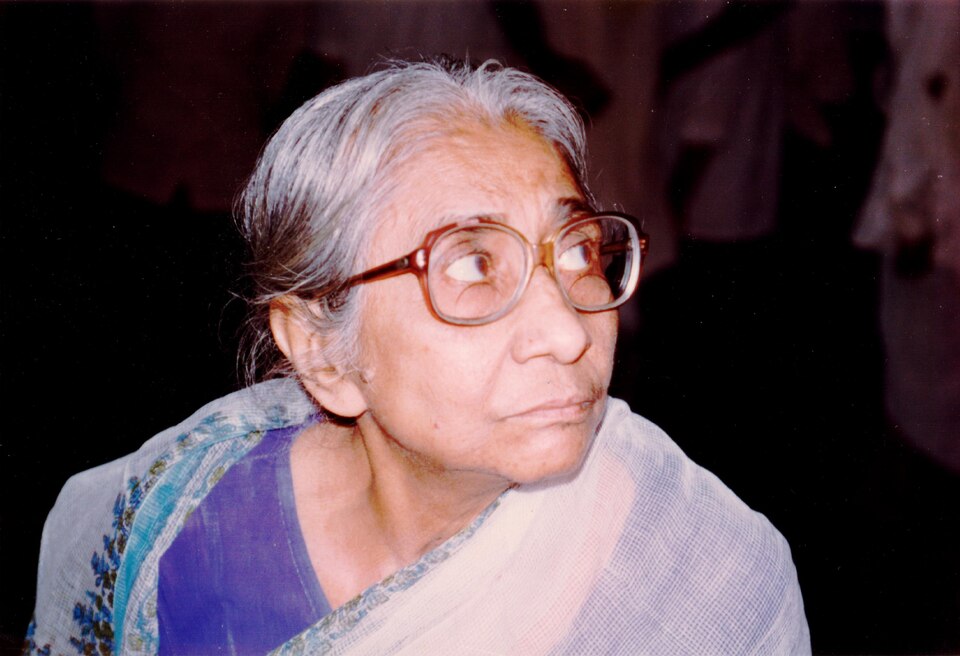
—You are accumulating papers, hundreds they say. What is the point of writing so much? Will recognition come only for a woman?
I write because science that is not published does not exist, master. More than four hundred papers, yes, in journals here and abroad, because a result kept to oneself is a lost result. As for recognition, I do not wait for it; sometimes it comes anyway. I was awarded a great research prize that no woman had received before me — I saw it less as a personal honor than as a breach opened for those who follow. In the evening, when I go through the international literature under my lamp, I think of those who will read these pages and tell themselves that it was possible.
Science that is not published does not exist.
—Our country is about to govern itself. What science do you want for this India that soon will owe nothing to anyone?
A rooted science, master, as yours always was. You taught me that a people who import all their knowledge remain subjects, even if outwardly free. I want research that starts from our resources: our plants, our diseases, our needs — malaria, epilepsy, what afflicts our people and not the salons of Europe. Great institutes are being built, research councils are spoken of for the whole country. If one day I am called to speak before assembled scholars, I will tell them this: the chemistry of independent India must draw from its own soil. That is the only patriotism that counts in a laboratory.
A people who import all their knowledge remain subjects, even if outwardly free.
—These molecules you isolate, how do you know you have the right one? Our senses deceive us, you know that better than I.
Our senses, yes, but not our instruments. Once the extract is purified on the column, I place my solution in the polarimeter: each optically active alkaloid rotates polarized light by an angle unique to it, like a signature. I cross-check this measurement with chemical reactions, crystallization, comparison with known compounds. Nothing is accepted without repeated proof. It is patient work, master, where one repeats an extraction started the day before ten times before daring to assert a structure. You taught me that distrust: never trust a molecule on its word. The lab notebook keeps the trace of every doubt before every certainty.
Never trust a molecule on its word.
—And if modern medicine one day disdains these plant remedies as village superstitions? Do you fear that?
I fear it, and that is why I work as I do. If our remedies remain grandmother's recipes, they will be brushed aside. But if I prove, formula in hand, that a fern contains a genuine antiepileptic principle, then no one can despise them anymore. My herbarium, my flasks, my papers are not nostalgia: they are a defense. I want the Treatise on the medicinal plants of India to stand in scholarly libraries alongside Western treatises. The flora of our country is a pharmacy that the whole world will eventually consult — provided we ourselves write the science of it.
The flora of our country is a pharmacy that the whole world will eventually consult.
—Evening falls, Asima, and I am growing old. What would remain, in your opinion, if one had to measure a life in the laboratory?
Do not speak thus, master; your lessons will live long after both of us. What will remain of a life at the bench, I believe, are not prizes or titles, but the molecules understood and the hands trained. Each elucidated structure is one more stone on a path that others will tread. I would like it to be said one day that an Indian chemistry existed, born of our plants, carried by our people, and that a woman took her full part without ever asking permission. You opened the way; I only try to extend it a little further, as far as my flasks and my students will carry me.
What will remain of a life at the bench are the molecules understood and the hands trained.
This imaginary interview was generated by artificial intelligence from sources documented in Asima Chatterjee's profile. It dramatises what the figure might have said based on what we know about them, but does not constitute attested historical testimony. For primary sources and factual documentation, refer to the full profile.