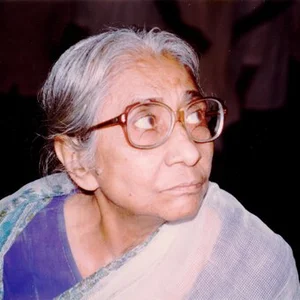

Asima Chatterjee (1917-2006) was a pioneering Indian chemist who specialized in the chemistry of natural products and medicinal plants. She was the first woman to receive a Doctor of Science degree from an Indian university.
Frequently asked questions
Key Facts
- Born on September 23, 1917, in Calcutta (British India)
- First woman to earn a Doctor of Science degree from an Indian university (University of Calcutta, 1944)
- Major work on the alkaloids of periwinkles (vinca) and the chemistry of Indian medicinal plants
- Developed antiepileptic and antimalarial drugs from plant-based compounds
- First woman elected to preside over a session of the Indian Science Congress (1975)
- Died on November 22, 2006
Works & Achievements
The first Doctorate of Science awarded to a woman by an Indian university, a historic milestone for women in science.
Work isolating and elucidating the structures of molecules from medicinal plants, foundational to Indian natural products chemistry.
A treatment developed from a local fern (Marsilea minuta), an example of turning India's flora into medicine.
Development of molecules against malaria from Indian plants, targeting a major public health disease.
Creation of a teaching and research facility in chemistry that opened the discipline to many female students.
Coordination of reference volumes cataloguing India's medicinal plants and their active compounds.
A vast body of internationally recognized research that made her a leading figure in Indian organic chemistry.
Anecdotes
In 1944, Asima Chatterjee became the very first woman to earn a Doctor of Science degree awarded by an Indian university, the University of Calcutta. At a time when very few Indian girls pursued higher education, she opened a path that had remained closed until then.
A large part of her career was devoted to studying India's medicinal plants in order to extract useful molecules from them. From a small aquatic fern (*Marsilea minuta*), her team developed an antiepileptic drug, and other local plants served as the basis for treatments against malaria.
In 1975, she was elected General President of the Indian Science Congress Association, the huge annual gathering of Indian scientists: she was the first woman to hold this prestigious position. That same year, the government awarded her the **Padma Bhushan**, one of the country's highest civilian honors.
On **September 23, 2017**, for the hundredth anniversary of her birth, Google dedicated a Doodle to her on its homepage worldwide, depicting her surrounded by molecules and plants. It was international recognition for a scientist long little known outside India.
As a young researcher, she was mentored by **Prafulla Chandra Ray**, nicknamed the “father of Indian chemistry,” and moved in the circles of great scholars such as the physicist **Satyendra Nath Bose**. She also completed her training in the United States, at the University of Wisconsin and at Caltech, before returning to build up research in India.
Primary Sources
Opening address delivered as General President, in which she stresses the importance of scientific research rooted in the natural resources and needs of independent India.
Series of articles describing the isolation and structure of alkaloids extracted from plants such as Rauwolfia, Vinca, and Alstonia, based on her work in natural products chemistry.
Scholarly compilation cataloguing Indian medicinal plants, their properties, and their active compounds, the edition of which she directs for the CSIR.
Award conferred for her major contributions to the chemical sciences; she is the first woman to receive this Indian research prize.
Key Places
Asima Chatterjee's birthplace and the center of her entire scientific life. She was born here in 1917 and died here in 2006.
Where she pursued her studies, earned her doctorate, and spent most of her research and teaching career in chemistry.
The institution where she completed part of her university training in chemistry.
The college where she founded and headed the chemistry department, training many female students.
The site of a research stay in the United States that enriched her training in natural products chemistry.
The institute where she completed her research, notably on natural pigments, before returning to India.
Typical Objects
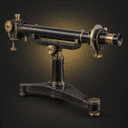
An instrument that measures the rotation of polarized light by a molecule. Essential for characterizing the optically active alkaloids she studied.
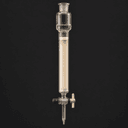
A glass tube filled with a packing material used to separate the compounds of a plant extract. A key tool for isolating pure molecules from medicinal plants.
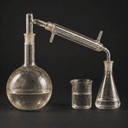
Flasks, condensers and beakers used to extract and concentrate the active compounds of plants. The daily routine of a natural-products chemist.
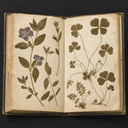
A collection of dried and classified plants, such as the periwinkle (Vinca) or Marsilea ferns. The raw material of her pharmacological research.
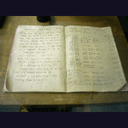
A notebook in which experiments, measurements and molecular structures are recorded. The indispensable written trace of a long research career.
📷 CC BY-SA 2.0 · Wikimedia Commons ↗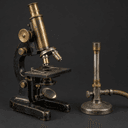
The basic equipment of a 20th-century chemistry laboratory, used to observe and heat samples. Symbols of the scientific teaching she helped organize.
School Curriculum
Vocabulary & Tags
Key Vocabulary
Daily Life
Morning
In the morning, she heads to her laboratory at the University of Calcutta, where glassware, plant extracts, and experiment notebooks await her. She often begins by preparing or checking extractions started the day before.
Afternoon
The afternoon is split between teaching students and supervising her doctoral candidates, whom she guides in isolating and analyzing molecules. She discusses results, chemical structures, and new research directions.
Evening
In the evening, she writes papers and scientific correspondence, combs through the international literature, and prepares her lectures. She also devotes time to her family in Kolkata.
Food
Her diet is that of a Bengali household: rice, lentils (dal), vegetables, river fish, and tea. Meals are defined by the spices and culinary traditions of Bengal.
Clothing
In daily life as in the laboratory, she wears the sari, the traditional Indian garment, often made of cotton for Calcutta's humid climate. For official ceremonies, she dons more elegant saris.
Housing
She lives in Kolkata, in the dense urban environment of twentieth-century India, close to the university institutions. Her surroundings blend scientific modernity with Bengali cultural heritage.
Historical Timeline
Period Vocabulary
Liens externes & ressources
Références
Œuvres
Doctorat ès sciences (D.Sc.) de l'université de Calcutta
1944
Recherches sur les alcaloïdes de la pervenche (Vinca) et d'autres plantes
années 1940-1990
Médicament antiépileptique Ayush-56
années 1970-1980
Recherches sur des composés antipaludéens
années 1970-1980
Fondation du département de chimie de Lady Brabourne College
1940-1950
Direction d'éditions sur les plantes médicinales indiennes
années 1990
Plus de 400 articles scientifiques publiés
carrière (1940-1990)