Imaginary interview with Bibha Chowdhuri
by Charactorium · Bibha Chowdhuri (1913 — 1991) · Sciences · 5 min read
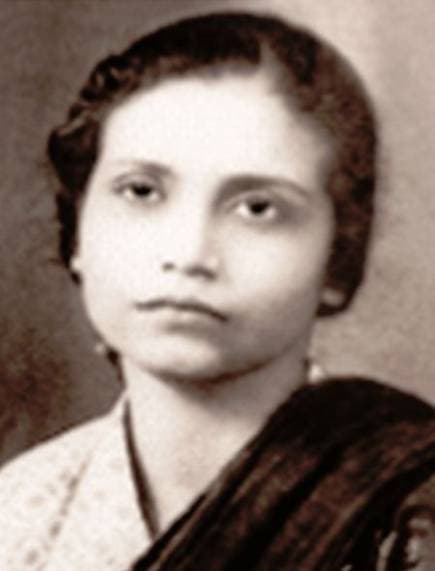
Calcutta, a monsoon morning. In a bright room at the Bose Institute, a woman in a cotton sari looks up from a microscope where plates blackened by the sky lie. Bibha Chowdhuri agrees to tell a life spent tracking, grain by grain, particles from space.
—What did a typical workday in your laboratory look like?
It began before the heat. I left the family home and went to the Bose Institute, where the plates exposed the day before awaited me. People think physics thunders; mine whispered. I leaned over the measuring microscope and counted. A track is a line of blackened grains in the nuclear emulsion, sometimes as thin as a hair, and you had to follow every point to guess the mass of what had passed there. A single plate could occupy me the whole afternoon, back bent, eyes burning. People imagine flashes; we had the patience of copyists. It was a craftsman's work as much as a scholar's.
People think physics thunders; mine whispered.
—Why this technique of photographic plates rather than another instrument?
Because it keeps the memory. A cloud chamber shows you a track, then the trail fades like a breath on glass; a Geiger counter gives you a click, a number, but nothing to contemplate. The plate, however, preserves the track forever in its gelatin. You can come back to it, remeasure it, show it to a colleague months later. With Debendra Mohan Bose, we understood that this emulsion was an archive of the sky, a notebook where particles wrote their own passage. I spent my life reading that tiny writing, and recording it, line after line, in my laboratory notebook.
—They say you climbed mountains for your experiments. How did that go?
You had to go where particles are more numerous. Near the ground, cosmic rays become scarce; at altitude, the sky pours down more. So we carried our plates to the ridges of the Himalayas, up to Sandakphu, over three thousand six hundred meters. Imagine: you haul fragile boxes up misty trails, expose them to the cold for days, then come down praying the gelatin hasn't suffered. That exposure altitude was part of our calculations as much as the geometry of the tracks. The laboratory, for us, was not just a room in Calcutta: it was also the mountain, open to all winds from space.
The laboratory, for us, was also the mountain, open to all winds from space.
—Your 1941 articles in Nature dealt with the mass of the mesotron. What exactly were you seeking?
We were trying to weigh the invisible. In cosmic rays, one guessed at an intermediate particle, neither as light as the electron nor as heavy as the proton — what was then called the mesotron. With Bose, we showed, in two notes in Nature in 1941 and 1942, that from the mere density of grains in a track one could estimate this mass. That was new: reading a mass from a photograph. Yukawa had predicted that such a particle bound the nucleus; we perhaps held its signature on our plates. I remember the contained excitement of those months, the feeling of being close to a threshold.
We were trying to weigh the invisible.
—They say the war deprived you of a great discovery. What happened?
World War II cut our supply lines. The most sensitive plates came from England, and they stopped arriving. Yet it is precisely the sensitivity of the emulsion that decides everything: too coarse, it cannot distinguish fine disintegrations. We were on the verge; we lacked the grain. A few years later, in Bristol, Cecil Powell had perfected emulsions, discovered the pion in 1947, and received the Nobel Prize in 1950. I never saw it as a theft — science advances that way, by relays — but I know in which direction we were looking, and I know that the sea between Calcutta and England weighed on this story.
We were on the verge; we lacked the grain.
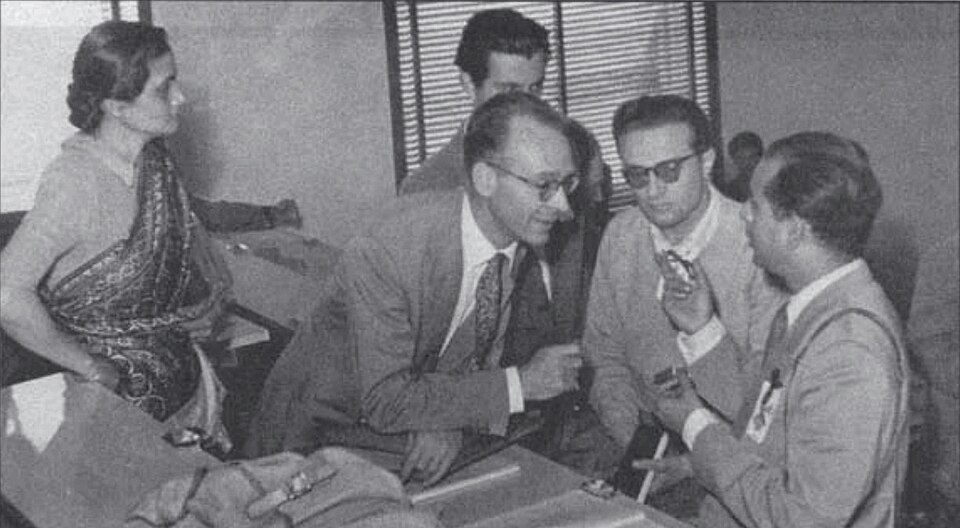
—Do you remember your master's degree in physics, in 1936?
How could I forget? In 1936, at the University of Calcutta, I was the only woman in my class. You entered the lecture hall and eyes settled on you like on a polished anomaly. In an educated Bengali family, I had been allowed to study — that was already a lot for the time — but beyond the door, the scientific world was almost entirely male. In the morning, I tied my cotton sari and left for the halls; in the evening, I returned to domestic life, reading, tea. I learned very early that it was not enough to be as capable: you had to be capable with enough calm that there was nothing to say.
It was not enough to be as capable: you had to be capable with enough calm that there was nothing to say.
—How did you reconcile this laboratory life with the Bengali home?
Without drama, but without ease either. The day belonged to the plates and the microscope; the evening belonged to the house in Calcutta, to meals of rice, dal, and river fish, to exchanges with my family. I never opposed the two worlds. The long hours of measurement required the same patience as Bengali domestic life, that quiet regularity of repeated things. And in the evening, when I prepared a publication, I felt that my master Bose had passed on to me a rigor that did not stop at the laboratory door. You can wear a sari and count particles; one never prevented the other.
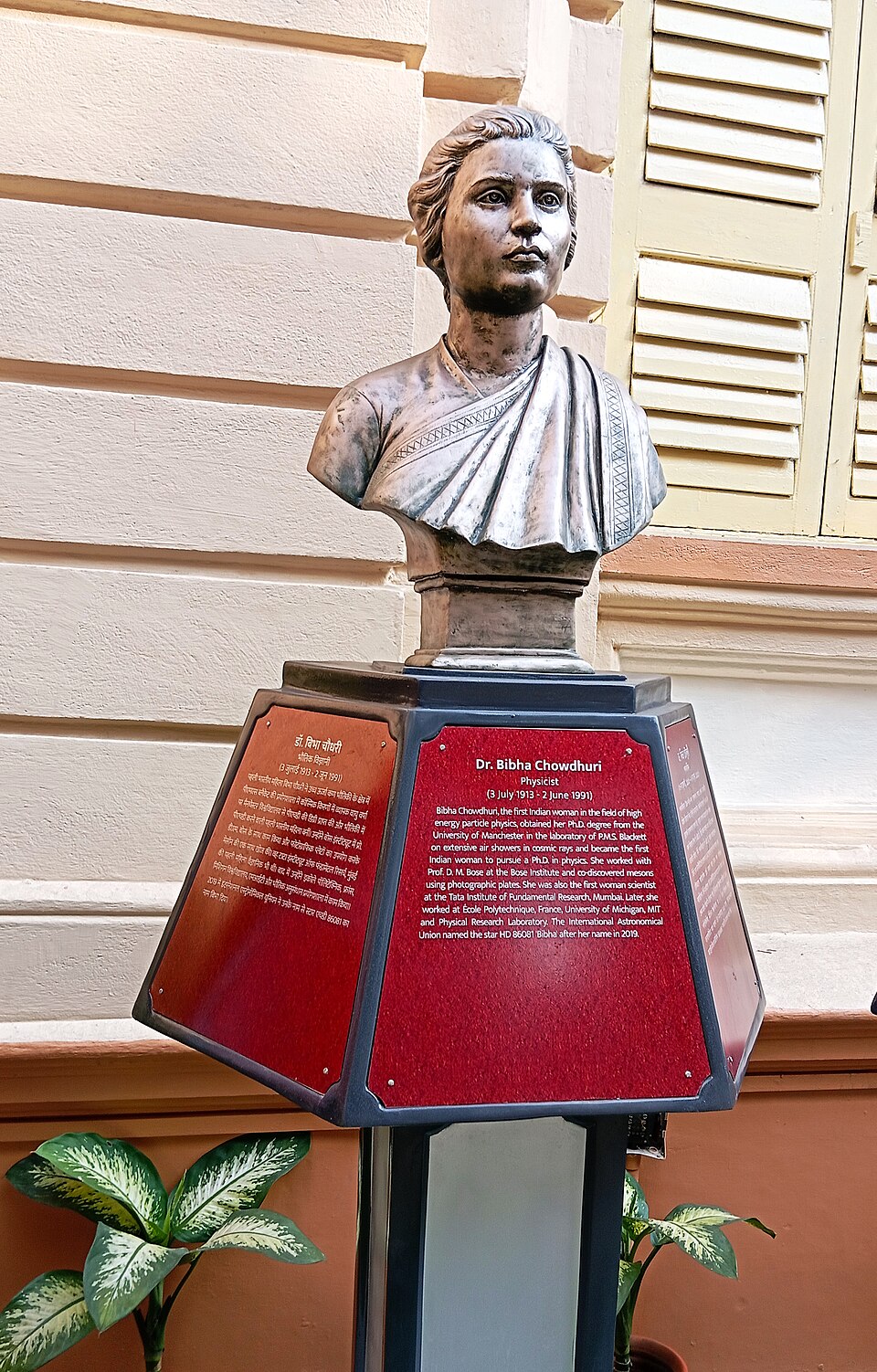
—After the war, you left for Manchester. What did you find there?
I found the sky multiplied. Under the direction of Patrick Blackett — who would receive the Nobel in 1948 — I devoted my thesis to atmospheric showers, those cascades of particles that a single very energetic cosmic ray generates by hitting the air. One particle strikes, and suddenly thousands rain down, like a spark igniting a sheaf of wheat. In Manchester, we had instruments, counters arranged in networks, an entire school. After the years of scarcity in Calcutta, it was a breath of air. I matured there, and I returned with a method and a confidence that newly independent India would be able to use.
—What did the TIFR in Bombay and the laboratory in Ahmedabad represent for you?
The return, and the building. At the Tata Institute of Fundamental Research founded by Homi Bhabha, in Bombay, I resumed my research on high-energy particles, in a country that wanted its own physics. Then, at the Physical Research Laboratory in Ahmedabad, that of Vikram Sarabhai, I pursued the same thread — cosmic rays, high-energy physics — within a generation that built institutions from almost nothing. It was no longer the solitary adventure of the Calcutta plates: it was a collective, national effort. I felt I was adding my stone, discreet, to an edifice that would outlive me.
—If you were told that a star would one day bear your first name, what would you think?
You invite me to dream beyond my own life, so I allow myself a moment. Spending my days bent over plates to capture what falls from the sky, and imagining that one day the sky would return the favor by hanging my name on a distant star… the idea has an ironic sweetness. I always worked in the shadow of the microscope, counting traces that no one saw. If my name should one day shine up there, I hope that people will remember above all the method and the patience, and all those, like Bose, with whom I shared those hours. The star would be beautiful; the work, however, was already the reward.
I always worked in the shadow of the microscope, counting traces that no one saw.
This imaginary interview was generated by artificial intelligence from sources documented in Bibha Chowdhuri's profile. It dramatises what the figure might have said based on what we know about them, but does not constitute attested historical testimony. For primary sources and factual documentation, refer to the full profile.