Imaginary dialogue between Debendra Mohan Bose and Bibha Chowdhuri
by Charactorium · Bibha Chowdhuri (1913 — 1991) · Sciences · 5 min read
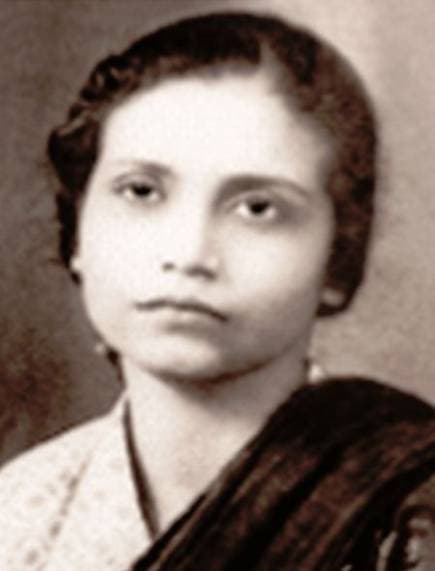
It was at the Bose Institute in Calcutta, one evening in 1957, that the old professor Debendra Mohan Bose met his former student, as she was about to leave TIFR for Sarabhai's laboratory in Ahmedabad. On the bench, a measuring microscope and a pile of emulsion plates still slept under the warm light of the waning monsoon. They had known each other for nearly twenty years, since those first nights spent counting invisible tracks. Bose had come, not as a master, but as an old accomplice, to make speak the one who had been his most patient hand.
—Bibha, do you remember our first plates, at the end of the 1930s? You would spend hours bent over the microscope. What were you really looking for?
I was looking for ghosts, Dada — furrows of blackened grains, so fine that an eyelash seemed like an avenue beside them. You had taught me to count each grain, to measure the length of a track to deduce a mass. It was work of a goldsmith and a monk at once. A single plate sometimes took me a whole day, and I would leave the room with burning eyes. But when a track appeared clearly, with that curvature that betrayed an unknown particle, I felt we were holding something that no one in the world had yet seen. Our articles in Nature, in 1941 and 1942, were born of that stubborn patience. You signed, I counted — and together we measured the invisible.
I was looking for ghosts — furrows so fine that an eyelash seemed like an avenue beside them.
—We brushed the meson, you and I. Tell me frankly, do you think the war stole that discovery from us?
I think so, yes, even if it serves no purpose to dwell on it. Our emulsions were not sensitive enough; the finest plates were made in England, and the war cut off all routes. We were in Calcutta, measuring an intermediate-mass particle with whatever means we had, while the world was in flames. A few years later, Powell received the perfected emulsions we had been waiting for, and the Nobel prize in 1950 for the method we had opened. I am not bitter, Dada — science advances through the hands that have the right tools. But I know, and you know, what we held at our fingertips.
Science advances through the hands that have the right tools — but we held it at our fingertips.
—Tell me again about our climbs to Sandakphu. Why on earth did we have to haul our plates up to over three thousand six hundred meters?
Because the sky is closer there, quite simply. The higher you go, the more numerous and energetic cosmic rays become — the atmosphere that protects us below starves them at the same time. On those Himalayan ridges, our emulsions captured in a few days what would have taken weeks to collect in Calcutta. I remember the biting cold, the porters, the boxes we protected like relics. We walked in the mist, and I thought that these particles from the depths of space ended their journey in our small glass plates. There was something dizzying about tracking the infinitely large on the roof of the world to then read it at the infinitely small, under the lens.
We tracked the infinitely large on the roof of the world to read it at the infinitely small.
—In 1936, you earned your master's in physics at the University of Calcutta. I was told you were the only woman in your class. How did you experience that?
As both an obvious fact and a solitude. I entered lecture halls where I was not expected; some looks weighed on me, others politely ignored me, which amounts to the same. But I had decided very early that physics would never ask my sex before surrendering its truths. Equations do not look at who solves them. I worked harder, perhaps, so that nothing could be held against me except being there. My family supported me, which was not a given for a Bengali girl of that time. And when I received my diploma, the only woman among all those men, I did not think of myself as an exception — I thought that others must surely follow.
Equations do not look at who solves them.
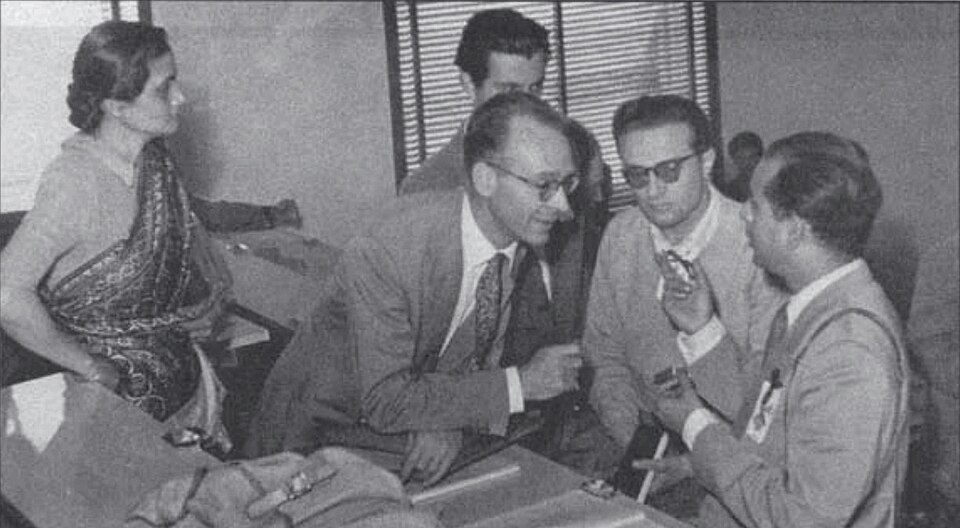
—After the war, you went to Manchester, to Blackett. What did you learn there that we could not teach you here?
Scale, Dada, and another way of thinking about chance. With Blackett, I devoted myself to atmospheric showers — those cascades of particles triggered by a single very energetic cosmic ray when it strikes the air. Where we read one track after another, they counted entire rains of particles, with counters arranged in a network. I learned the statistics of these showers, the coincidence between detectors, a whole new rigor. Blackett ran his laboratory like a conductor, and I gained a confidence that the solitude of Calcutta had not given me. But I owe you the essentials, believe me: without our plates and your patience, I would have arrived there empty-handed.
Where we read one track after another, they counted entire rains of particles.
—Now you are back home, moving from Bhabha's TIFR to Sarabhai's laboratory in Ahmedabad. What are you trying to build by returning to India?
An Indian science that no longer has to beg for its tools from London. When Homi Bhabha founded TIFR, I felt a door open: a place where we could do high-energy physics on our own soil, with our own minds. I continued there the cosmic rays we had never stopped loving, you and I. And now Sarabhai calls me to Ahmedabad, to his Physical Research Laboratory, to continue. I am growing old as this nascent physics grows, and that delights me. We began, you and I, with borrowed plates and a microscope; I want to leave to those who come entire laboratories.
An Indian science that no longer has to beg for its tools from London.
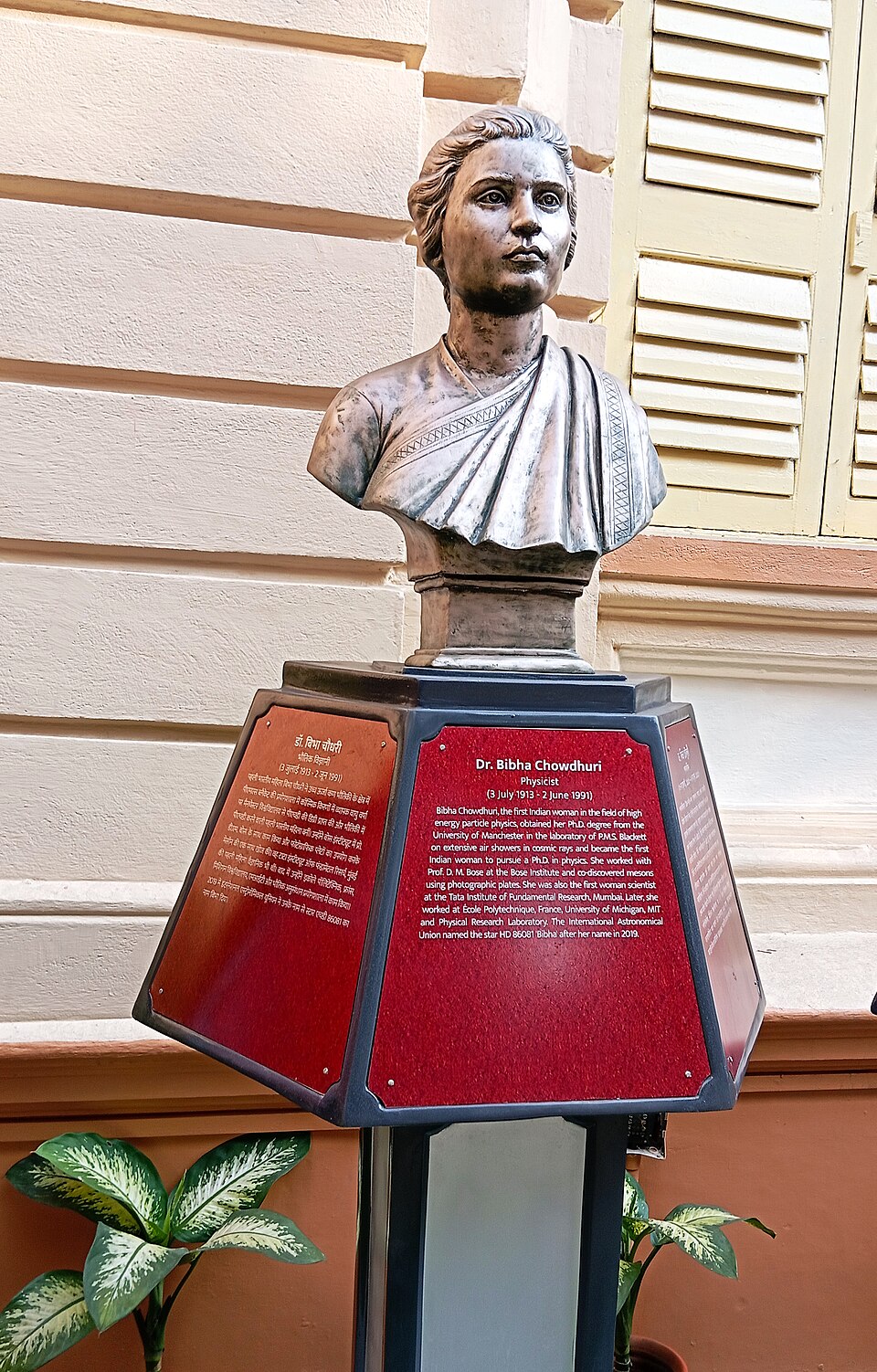
—You have always worked in the shadows, my Bibha — mine, those of the great names. Does it not weigh on you to remain so little named?
There was a time when it stung, I admit. The master is cited, rarely the hand that counted the grains. But I have come to understand that recognition is a slow thing, and sometimes unfair to those who do not raise their voice. I never knew how to push myself forward; it is neither in my temperament nor in my Bengali upbringing. What I know is that my name appears on those pages of Nature, next to yours, and nothing will erase it. The rest belongs to the future, and the future has a broad back. Perhaps one day, someone will open those old issues and wonder who this Choudhuri was who measured mesotrons in Calcutta.
The master is cited, rarely the hand that counted the grains.
—If young Indian girls ever read your story, what would you want them to take from your life, you who paved the way?
That one can be both quiet and stubborn, and that stubbornness counts more than noise. I want them to know that the microscope never asked a woman to apologize for being there. That one can come from a home in Calcutta, wear the sari, love rice and evening dal, and spend one's days measuring particles from the edge of the universe. Science is not a foreign country reserved for Western men. If one of them, one day, climbs a ridge to expose her detectors, or bends her youth over an emulsion plate, then my nights of counting will not have been in vain. That is the only legacy I care about.
The microscope never asked a woman to apologize for being there.
—One last thing, between us. Of all these years, which moment at my microscope will you cherish above all?
The night a track appeared that I did not expect — a curvature too sharp to be a simple electron, too light for a proton. I looked up, heart pounding, and went to fetch you despite the late hour. You came in slippers, Dada, and we looked at that little mark like two children before a fireworks display. We did not yet know all it said, but we knew it said something. That shared silence, bent over a glass plate, was worth all the honors the world has distributed since. That is what I keep: not the missed discovery, but the exact joy of the moment when the invisible consents to show itself.
We looked at that little mark like two children before a fireworks display.
This imaginary interview was generated by artificial intelligence from sources documented in Bibha Chowdhuri's profile. It dramatises what the figure might have said based on what we know about them, but does not constitute attested historical testimony. For primary sources and factual documentation, refer to the full profile.