Kids interview Bibha Chowdhuri
by Charactorium · Bibha Chowdhuri (1913 — 1991) · Sciences · 5 min read
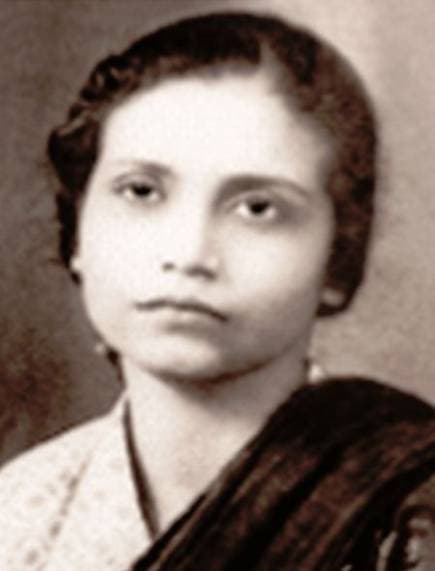
Two young visitors, on a discovery class, push open the door of a small laboratory. Before them, an Indian lady in a cotton sari, bent over a microscope. She looks up, smiles, and invites them to sit close by.
—How old were you when you became a physicist? Was it hard for a girl?
You know, my child, in 1936 I earned my master's degree in physics at the University of Calcutta. And when I walked into the auditorium on graduation day, I was the only girl. Imagine: rows of boys in shirts, and me, in my cotton sari. At that time, in India, very few girls studied science. They looked at me like a curiosity. But I wasn't afraid of stares. I loved understanding how the world works too much. So I sat down, opened my notebook, and did physics just like the others. Maybe even a little better.
I wasn't afraid of stares — I loved understanding the world too much.
—What did your home smell like in the morning before going to the lab?
Ah, mornings in Calcutta! It smelled of cooking rice and hot tea. In my Bengali family, we ate rice, lentils called dal, vegetables, river fish. Picture a house with an inner courtyard, open, to let in some air during the monsoon — that great warm rain that falls for months. I drank my tea, tied my sari, and left for the Bose Institute. There my plates, exposed the day before, awaited me. It was a simple little joy, that morning walk, between the smell of tea and the urge to see what the night had left on my plates.
The morning smelled of hot tea and the urge to see my plates.
—What is your most important discovery?
Come closer, I'll tell you something. With my mentor Debendra Mohan Bose, we found a way to weigh a tiny particle then called the mesotron. A particle is a very small grain of matter, much smaller than an atom. We wrote about it in a famous journal, Nature, in 1941 and 1942. How did we do it? We looked at the tracks these particles leave as they pass, like footprints in the snow. By measuring the length and thickness of the track, we guessed the weight of the invisible walker. No one had really done that before us. It was new, it was daring.
We guessed the weight of an invisible walker from its footprints.
—Were you sad not to have won the Nobel Prize?
I'll be honest with you. Yes, a little. We were so close! But you know, we worked during the Second World War. The most sensitive plates came from England, and the war prevented us from receiving them. Our footprints remained a bit blurry. A few years later, an English scientist, Cecil Powell, received better plates, perfected the method, and won the Nobel Prize in 1950. The same method we had pioneered! I was sad, yes. But I learned one thing: you don't do science for medals. You do it for truth. And truth is never forgotten.
You don't do science for medals, but for truth.
—Is it true you climbed mountains with your machines?
Yes, my child, and it was magnificent! To catch those particles from space — we call them cosmic rays — you have to go very high. The higher you go, the more they rain down on you. So with Bose, we carried our photographic plates to the top of Sandakphu, in the Himalayas, over three thousand six hundred meters. Imagine the biting cold, the air so thin you breathe fast, and before you endless snow-covered mountains. We set our plates up there, like spreading a butterfly net. Except our butterflies fell from the starry sky and passed through everything, without ever being seen.
We spread our plates like a butterfly net for visitors from the sky.
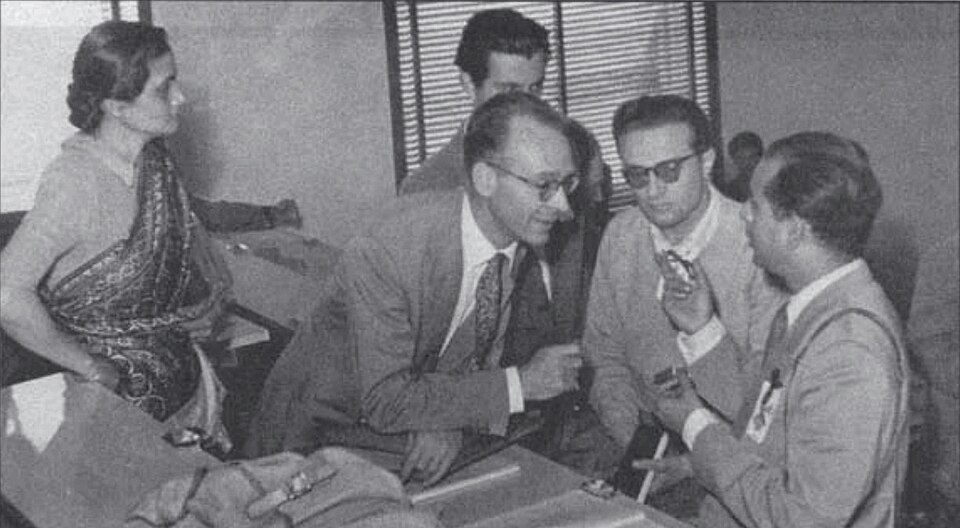
—Where did those rays come from? Were you afraid of them?
Afraid? No, never! Those cosmic rays come from deep space, very far away, from stars and beyond. They pass through the air, the roofs of houses, and even you, right now, without you feeling a thing. When a very powerful ray strikes the air high up, it bursts into a shower of tiny particles: we call that an atmospheric shower, like a sheaf of wheat opening like a fan. That's what I later studied at Manchester. Far from scaring me, these messengers from the sky fascinated me. Just think: a piece of a distant star comes to tickle you, here, silently.
A piece of a distant star comes to tickle you, here, silently.
—How do you see a particle if it's too small for the eyes?
Good question! You don't see it. You see its track. Imagine a snail that left a shiny trail on a leaf: you no longer see the snail, but you know it passed by. Our particles passed through an emulsion, a very sensitive photographic layer, and left a path of tiny blackened grains. Then I sat at my measuring microscope and counted those grains one by one. A single plate could take me hours! It was patient, meticulous, almost like sewing. But each little track told the journey of a particle. And to me, that was more beautiful than any story.
You don't see the particle — you read the track it leaves.
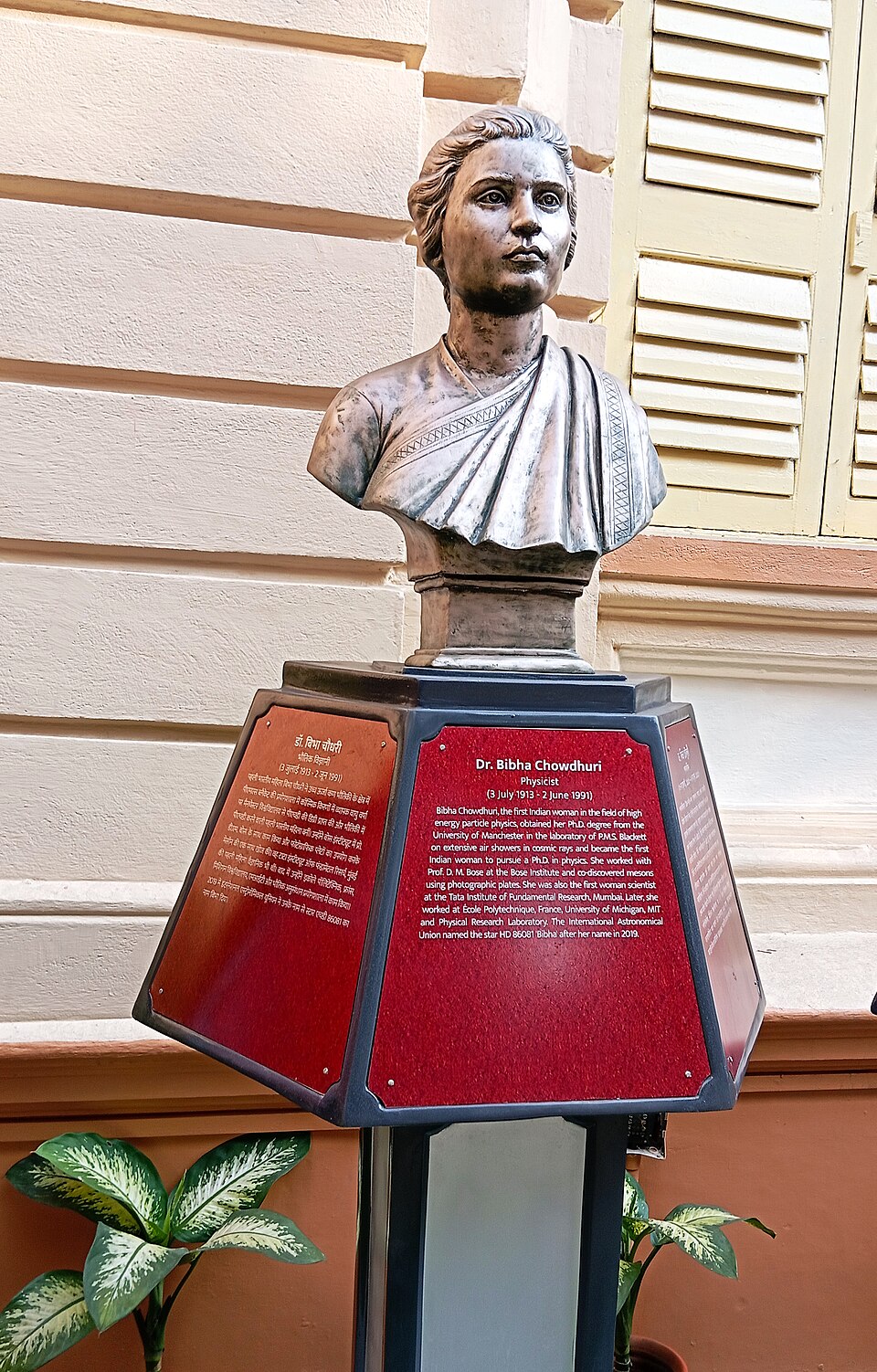
—Why did you go to England after the war?
Because I wanted to learn more, my child. After the war, I went to Manchester to study with a great scientist, Patrick Blackett. He also won the Nobel Prize, in 1948! I prepared my doctorate there, between 1945 and 1949, on those famous showers of particles that open like fans in the sky. Imagine a class where you only think about cosmic rays from morning to night. It was a dream for me. Sometimes you have to leave home, cross the seas, to bring back new knowledge. I knew that one day, I would bring it all back home, to India.
Sometimes you have to cross the seas to bring back new knowledge.
—What did you do when you returned to India?
I helped build something great. When I returned, my country had just become independent, in 1947. Everything had to be built! I worked at the Tata Institute of Fundamental Research, in Bombay, founded by Homi Bhabha. Then at the laboratory of Vikram Sarabhai, in Ahmedabad. Imagine new rooms, young researchers full of hope, an entire nation wanting to do science on its own. I, the little girl from Calcutta alone in her lecture hall, now helped give birth to Indian physics. It was no longer just my plates: it was a whole country learning to look at the stars and particles. I was very proud.
A whole nation was learning to look at the stars on its own.
—If we looked at the sky tonight, would we think of you?
Yes, and it touches me deeply that you ask. Listen to this wonder: in 2019, long after my death, scientists from around the world gave my first name, Bibha, to a distant star. India proposed it. So tonight, if you look up, know that up there shines a star that bears my name. I who spent my life watching for particles from the sky, I have become a little point of light in that same sky. Isn't that lovely? Look carefully, be curious, measure, doubt, start again. One day, maybe, a star will be waiting for you.
I watched the sky all my life — and now the sky, in turn, bears my name.
This imaginary interview was generated by artificial intelligence from sources documented in Bibha Chowdhuri's profile. It dramatises what the figure might have said based on what we know about them, but does not constitute attested historical testimony. For primary sources and factual documentation, refer to the full profile.