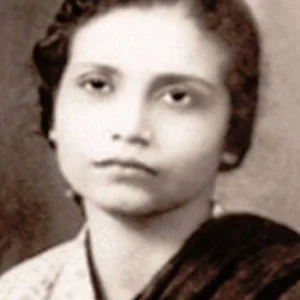

Bibha Chowdhuri (1913-1991) was an Indian physicist and a pioneer in the study of cosmic rays and particle physics. Working with Debendra Mohan Bose, she used photographic plates to detect subatomic particles, coming close to discovering the meson.
Frequently asked questions
Key Facts
- Born in 1913 in Calcutta, in British India
- During the 1930s and 1940s, she conducted research on cosmic rays with D. M. Bose using photographic emulsions, coming close to discovering the pi meson
- Earned a doctorate in 1949 at the University of Manchester under the supervision of Patrick Blackett (Nobel Prize winner)
- Went on to work at the Tata Institute of Fundamental Research and then at the Physical Research Laboratory in Ahmedabad
- In 2019, the International Astronomical Union named a star “Bibha” in her honour
Works & Achievements
A series of papers, co-authored with D. M. Bose, showing that the mass of cosmic particles can be measured from their tracks on photographic emulsion. Pioneering work that paved the way for the discovery of the meson.
Doctoral thesis carried out at Manchester under Patrick Blackett, devoted to the showers of particles produced by cosmic rays in the atmosphere.
Studies of high-energy particles at the Tata Institute of Fundamental Research, contributing to the rise of particle physics in India.
Continuation of her work on high-energy physics and cosmic rays within Vikram Sarabhai's laboratory.
Developing, together with Bose, the use of photographic plates to detect and identify invisible particles — a technique later adopted around the world.
Anecdotes
In December 2019, the International Astronomical Union gave the name "Bibha" to a distant star (HD 86081) to honour the physicist. India proposed this name during a worldwide star-naming campaign, making her one of the few scientists whose first name now shines in the sky.
In the late 1930s, Bibha Chowdhuri and her mentor Debendra Mohan Bose used a microscope to count the tiny tracks left by cosmic rays on photographic plates. They measured the mass of an unknown particle and came close to a major discovery — but, because of the Second World War, they could not bring in the most sensitive plates from England. A few years later, the Briton Cecil Powell perfected the method and won the Nobel Prize.
In 1936, when she earned her master's degree in physics from the University of Calcutta, Bibha Chowdhuri was the only woman in her class. At a time when very few Indian girls pursued scientific studies, she made her mark in an almost exclusively male environment.
To capture more cosmic rays, Chowdhuri and Bose exposed their photographic plates high in the mountains, on Himalayan peaks such as Sandakphu, at over 3,600 metres above sea level. The higher you go, the more numerous these particles from space become.
After the war, Bibha Chowdhuri went to study in Manchester, England, under the supervision of Patrick Blackett, himself a future Nobel laureate in physics. There she studied the “showers” of particles triggered by cosmic rays when they strike the atmosphere.
Primary Sources
The authors describe how, from the tracks recorded on photographic plates exposed to cosmic rays, the mass of an intermediate-mass particle then called the “mesotron” can be estimated.
Continuing their measurements, the authors refine the estimate of the mass of mesotrons obtained through the photographic method of cosmic-ray tracks.
The authors show that the photographic emulsion is a sensitive tool for recording the passage and disintegration of high-energy cosmic particles.
Key Places
Birthplace of Bibha Chowdhuri, where she studied at the University of Calcutta and worked at the Bose Institute. She died there in 1991.
A peak over 3,600 metres high where Chowdhuri and Bose exposed their photographic plates to capture more cosmic rays. The altitude increases the flux of particles.
The city where she pursued her doctorate under the supervision of Patrick Blackett, studying cosmic ray showers.
At the Tata Institute of Fundamental Research, led by Homi Bhabha, she continued her research on cosmic rays after returning to India.
A laboratory founded by Vikram Sarabhai where she worked on particle physics and cosmic rays.
Typical Objects

A plate coated with a sensitive emulsion in which the passage of a charged particle leaves a fine trail of darkened grains. It was the central tool of Chowdhuri's cosmic ray research.

A precise microscope used to examine and measure the length and thickness of particle tracks on the plates. Analyzing a single plate could take hours.

A device filled with supersaturated vapor in which charged particles leave a visible trail of droplets. It was used to visualize the passage of cosmic rays.

An instrument that detects and counts the passage of ionizing particles by emitting a click or an electrical pulse. Essential for spotting cosmic radiation.

A sliding instrument used to perform multiplications, divisions and scientific calculations before the era of electronic calculators. An everyday tool for the physicists of her time.

A notebook in which the researcher recorded her observations, measurements and calculations day after day. The written memory of every experiment.
School Curriculum
Vocabulary & Tags
Key Vocabulary
Daily Life
Morning
In the morning, Bibha Chowdhuri would leave her family home in Calcutta to head to the Bose Institute. Much of her day began bent over a microscope, examining the traces left by cosmic rays on the plates exposed the day before.
Afternoon
The afternoon was devoted to meticulous measurements and calculations: counting the grains of the tracks, estimating a mass, recording every result. The work demanded extreme patience, as a single plate could take hours.
Evening
In the evening, she returned to her family, rejoining Bengali domestic life, reading and preparing her scientific publications. Her exchanges with her mentor D. M. Bose nourished her thinking.
Food
Her diet was that of a well-off Bengali family: rice, lentils (dal), vegetables and river fish in abundance, often accompanied by mild spices. Tea was part of daily life.
Clothing
Like the Indian women of her era and milieu, she most often wore the cotton sari, elegant and well suited to the hot, humid climate of Bengal.
Housing
She lived in an urban house in Calcutta, within an educated family. Bengali dwellings combined open living spaces, an inner courtyard and protection against the heat of the monsoon.
Historical Timeline
Period Vocabulary
Liens externes & ressources
Références
Œuvres
Méthode photographique d'estimation de la masse du mésotron (articles dans Nature)
1941-1942
Recherches sur les gerbes atmosphériques étendues
1945-1949
Travaux au TIFR sur les rayons cosmiques
1949-1957
Recherches au Physical Research Laboratory d'Ahmedabad
1957-1976
Détection précoce de particules subatomiques par émulsion
fin des années 1930