Imaginary dialogue between Jean de Joinville and Blanche de Castille
by Charactorium · Blanche de Castille (1188 — 1252) · Politics · Spirituality · Military · 5 min read

It is in a low-ceilinged hall of the Palais de la Cité, in late winter 1248, that Jean de Joinville meets the aging queen a few weeks before the king's departure on crusade. The light falls obliquely on the parchment rolls spread before her, and in the distance one hears the bells of the royal chapel. The seneschal of Champagne has long known the circle of King Louis, and he has come to gather, before the great journey, the words of the woman who will govern alone once more. She receives him without ceremony, her voice firm despite her sixty years.
—Madam, everyone at court remembers that upon the death of Louis VIII, the great barons refused to obey a foreign woman. How did you hold firm?
I had a twelve-year-old child to protect and a kingdom that people wanted to take from me piece by piece. Mauclerc, Lusignan, the count of Boulogne had formed a league, thinking a widow would be enough to make them bend. They were mistaken. I did not fight all together what I could undo one by one: I divided their alliances, bought off some, threatened others, married off those who needed marrying. I was seen raising troops and appearing before their walls. A queen who governs in the name of her son does not have the right to tremble for a single day. I received their homage, on their knees, their hands in mine in the name of Louis. The kingdom remained whole.
I did not fight all together what I could undo one by one.
—They say a woman cannot wage war. Did you really stand before rebel fortresses, or is that just rumor?
Do you think I governed from a cushion? I received the keys of subdued towns and marched the king's army where it was needed. A regent does not wield the sword herself, but she decides where it strikes. The barons thought to frighten me with iron; they quickly understood that I knew how to wield iron as well as words. The hardest part was not the battle, Seneschal—it was never letting doubt show before men who watched for my every weakness like wolves. A woman's firmness seemed unnatural to them; so I had to be firmer than any of them.
—You negotiated in 1229 the Treaty of Paris that ended the crusade against the Cathars. Was that your greatest coup?
It was a gain that arms alone could never have achieved. The crusade against the heretics of the South had lasted twenty years, and blood flowed without the king's domain growing much. Through negotiation, I attached Lower Languedoc to the crown and sealed it with a marriage that guaranteed the inheritance. A well-conceived treaty is worth more than ten battles: it does not unravel at the first setback. The count of Toulouse became a vassal again, and what war had not taken in twenty years, the pen acquired in a few days. That is what I bequeath to my son: a larger kingdom, without the burden of a conquest to remake every spring.
A well-conceived treaty is worth more than ten battles: it does not unravel at the first setback.
—King Louis speaks of you with rare emotion. You once told me he never did wrong without your being grieved. Is that excessive tenderness?
That is not tenderness, Seneschal, it is duty. A Christian king is shaped from childhood, and I wanted mine to prefer death to sin. You who know him, you know he says nothing lightly: yes, I repeated to him that it was better to see him dead than stained by a mortal sin. I am judged harsh, domineering even. But who else would have armed him against flatterers and the temptations of the crown? I held him by the hand until he could walk alone, then continued to speak plainly when all others fell silent. A king's mother does not have the leisure to be only gentle. I loved my son by making him better than myself.
I loved my son by making him better than myself.
—The king has been declared of age since 1234, yet you still govern his affairs. Are you not afraid of holding him too close?
I am reproached for it, I know. But what else would I do, when the king himself entrusts me with the kingdom to go overseas? Majority gives the scepter, it does not suddenly give all wisdom. Louis consults me because he wants to, not because I force him; if he found my presence burdensome, he would know how to set me aside, for he is king. A son who has been well educated as a prince is not ashamed of his mother at his side. Soon he will be far away, on the sea, and I will answer for revolts, taxes, peace. Believe me, Seneschal, at sixty one does not dream of new burdens—but one does not refuse one's kingdom to one's child.
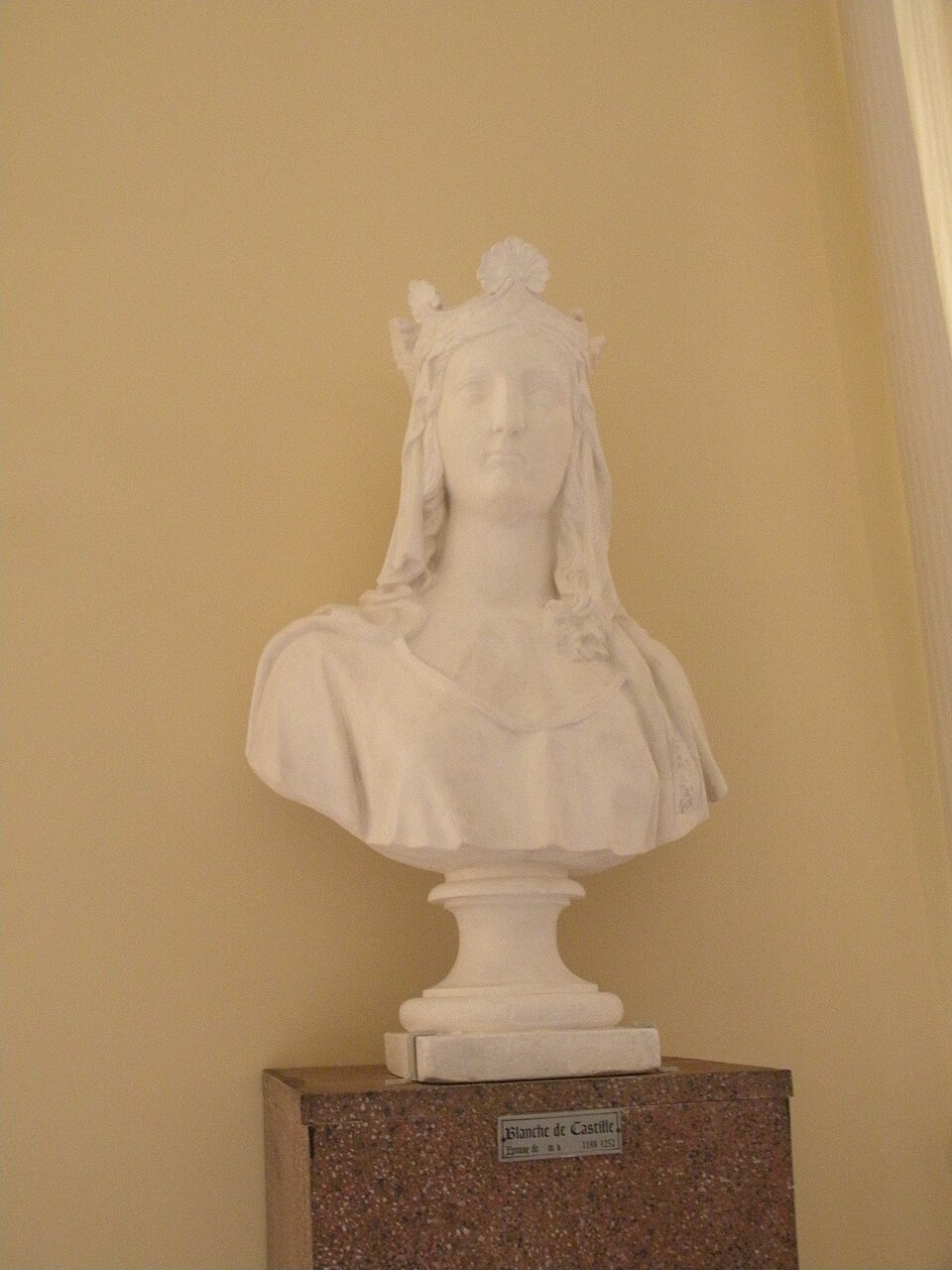
—Since your husband's death, you wear the white veil of widows. Some see it as a weakening of your power. What do you say?
Those people understand nothing of power. The veil took nothing from me; it gave me armor that no baron dares attack. A queen adorned with gold and ermine is exposed to all slander; a sober, pious widow, irreproachable in her dress—how can she be sullied? I kept the crown for assemblies, so that no one would forget that I govern in the name of the Capetians. But in daily life, this white, this gray, say that I belong only to God and the kingdom. They think me weakened because I pray; they discover too late that I decide. When the day comes, I will take the nun's habit—and it will not be a retreat, it will be the culmination of a whole life.
The veil took nothing from me; it gave me armor that no baron dares attack.
—You founded Royaumont and Maubuisson, and you pray every morning at matins. Is this devotion sincere piety or an art of ruling?
Why must one choose? I pray because I believe, and because I believe, I govern better. At dawn, before any council, I am at matins; the Dominican and Franciscan friars, whom I support, visit me in the morning. This is no play-acting: it is from there that I draw the strength to face barons who themselves fear God little. The abbeys I founded are not vain monuments; they are houses of prayer for my lineage and refuges for noblewomen. A kingdom without piety is merely a band of better-armed brigands. By building these Cistercian walls, I also build the endurance of the crown—for what God blesses resists time.
—I must ask you, Madam: your enemies spread rumors of an affair with the legate, Cardinal Romano of Sant'Angelo. How did you bear such infamy?
With the contempt that lies deserve. See, Seneschal, what it is to be a woman and hold power: as soon as they cannot reach me through arms or law, they attack me through the bed. The legate was the pope's man, and I dealt with him concerning Church and kingdom affairs, as was proper. That was enough for embittered barons to invent a fable and spread it in taverns. No male regent would ever have suffered such outrage. I answered with my conduct: nothing in my life gave hold for suspicion. Time silenced those mouths. An irreproachable queen always ends up stifling calumny under the weight of her constancy.
As soon as they cannot reach me through arms or law, they attack me through the bed.
—You seal documents with your seal in the king's name. What do you think about, your hand on the parchment, when you thus commit the kingdom?
I think that every word will weigh long after me. A wax seal affixed to a charter is the king's word made durable; it is not broken like a promise spoken in the air. When I affix Blancha, Dei gratia Francorum regina, I do not commit my person, I commit Louis's crown. That is why I read every act before sealing it, why I weigh fiefs, appanages, gifts. A kingdom is governed as much by parchment as by the sword, Seneschal—even more, for parchment does not die. The clerks keep everything; one day, through these charters, people will know that the regent watched over every acre of the royal domain.
—The king leaves soon for overseas, and you remain to rule. What do you fear most, on the eve of this separation?
What every mother fears: never to see him again. But I do not allow myself that thought for long, for fear does not govern a kingdom. What I truly dread is what will happen here while he is far away: will the barons remember their oath when the king is no longer there to enforce it? I will have to hold everything with one hand, as before, but with twenty more years on my shoulders. You go with him, Seneschal; watch over my son as over your soul. If harm befell him there, it would not be only a queen who wept—the whole kingdom would totter. I will pray every day at Maubuisson for your return, both of you.

This imaginary interview was generated by artificial intelligence from sources documented in Blanche de Castille's profile. It dramatises what the figure might have said based on what we know about them, but does not constitute attested historical testimony. For primary sources and factual documentation, refer to the full profile.