Kids interview Blanche de Castille
by Charactorium · Blanche de Castille (1188 — 1252) · Politics · Spirituality · Military · 6 min read

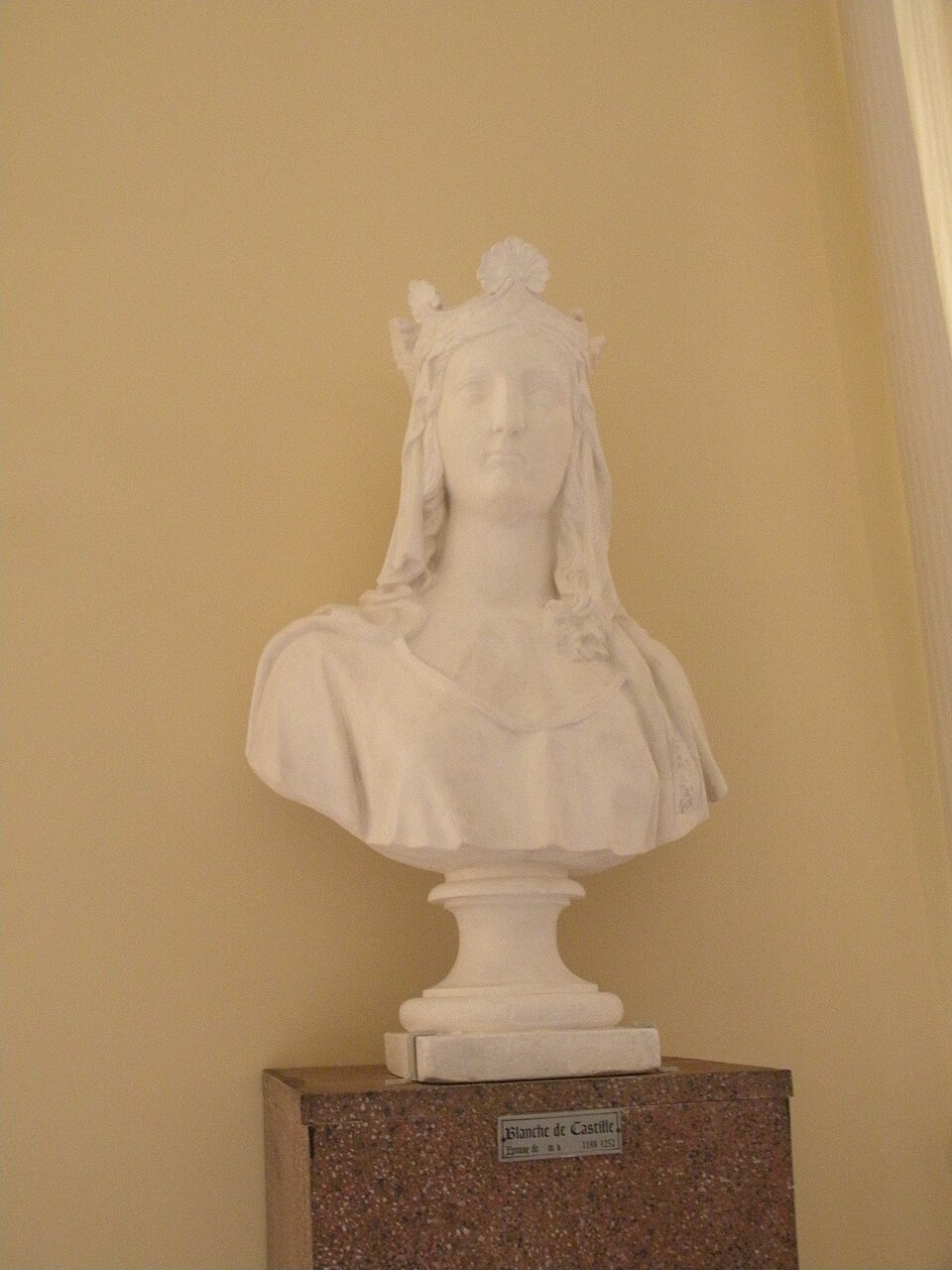
Two twelve-year-old students visit an old white stone abbey with their class that morning. In a silent room, a great lady in a white veil awaits them, a smile on her lips. It is Blanche of Castile, Queen of France, who has agreed to answer all their questions.
—Is it true that they came to get you when you were very little, far away in Spain?
Yes, my child, it is quite true. I was born in Palencia, in Castile, far from here. I was twelve years old when my grandmother, the old queen Eleanor of Aquitaine, crossed the Pyrenees on horseback to fetch me. Imagine a lady over seventy-five years old crossing those enormous mountains, just to choose which of her granddaughters would make a good queen of France! She looked at me, and she chose me. I was told it was because of my character. I left my family, my language, my sun, to marry a prince I did not know. It was frightening. But my grandmother had seen correctly: France was to become my kingdom.
—When your husband the king died, did the great lords want to drive you out?
Ah, you put your finger on the worst moment of my life. In 1226, my husband Louis VIII died suddenly. I found myself alone, with my little Louis of twelve years to protect. The great barons did not want to obey a woman, and a foreigner at that! They formed a league against me, like a pack. Do you know what I did? I did not collapse. I negotiated with one, I distanced another, I divided them one by one. A vassal is a lord who owes loyalty to the king: well, none of them managed to make me bend. I held firm. And my son's throne held.
—You, a queen, did you really go to war against the lords?
Yes, you would be surprised! A queen did not always sit on a cushion. Some lords, like Pierre de Dreux, nicknamed Mauclerc, revolted with weapons in hand, around 1227. I had to respond. They brought me the keys of the fortresses that surrendered, big iron keys, heavy in the hand, which meant: this city obeys the king. I organized armies, I decided where to strike. Imagine a woman in a long gown giving orders to knights in full armor! That had hardly been seen. But protecting my son was worth being thought too bold.
—What was that war in the south against the Cathars?
In the south, a war had been dragging on for twenty years: the crusade against the Cathars. The Cathars were Christians whom the Church deemed heretical, that is, they believed in their own way, and that horrified Rome. A crusade, my child, is a war blessed by the pope. That one burned cities and harvests without ever ending. The papal legate, the pope's envoy, always pushed to strike harder. I saw a kingdom bleeding for nothing. I thought: what is the point of winning a desert? There had to be another way than fire and sword.
—Are you proud of having enlarged France without battle?
In 1229, I had the Treaty of Paris signed. Instead of crushing the Count of Toulouse, we made him bend through words and an arranged marriage for the future. And suddenly, a large part of Languedoc, all that sunny South, entered the king's domain. Without another battle! People thought it was just a little piece of parchment. But that little parchment enlarged France for centuries. You see, I had no sword at my belt. My weapon was patience, and knowing how to wait for the right moment.
My weapon was not the sword: it was patience.
—Were nasty things said about you at court?
Oh, yes... and it hurt me. Because I was often with the pope's legate, Cardinal Roman of Saint-Ange, to settle the kingdom's affairs, my enemies invented an ugly rumor: they said we were lovers. It was false, completely false. But you see, when a woman governs, they don't just attack her decisions: they soil her honor. A man in power is called strong. A woman in power, they look for a shameful secret. I learned to carry those lies with my head held high. I knew who I was before God, and that was enough for me.
A king is called strong; a queen, they look for a shameful secret.
—Were you very strict with your son the king?
Strict... no. Loving, but yes, demanding. I loved my little Louis more than anything in the world. But I repeated to him that a king must first be a good Christian. They say I told him I would rather see him dead than know him in a state of mortal sin. That may seem terrible to you! But in my time, saving one's soul mattered more than saving one's life. I woke him at dawn for prayer, I watched over every one of his lessons. I wanted to make him a just king above all. And you know what? He became Saint Louis.
—Even after he became a great king, did he still obey you?
Ah, you are clever to ask that! Yes, even grown, even crowned king, my Louis still listened to me. At twenty, in 1234, he was declared of age, and I gave up the regency, that government I exercised in his place when he was too young. Officially, I was only an advisor. But in reality? I remained at his side at every council, and no major decision was made without my voice counting. Some thought I kept my son under my wing too much. Perhaps. A mother does not easily let go of the child she saved from a pack of barons.
—Did you govern even when you were already old?
Old, yes, but not finished! In 1248, my Louis left on crusade, far away, in Egypt. And at sixty, I was called back to govern the kingdom a second time. Then terrible news arrived: at Al-Mansurah, my son had been taken prisoner. Imagine my mother's heart! But I did not have the right to just weep. I raised money, a lot of money, to pay his ransom and free him. Holding a kingdom together and ransoming one's captive child at the same time, at my age... That is the heaviest task God ever gave me.
—Why are you always dressed in white?
When my husband died, in 1226, I took the white veil of widows. In my country, white was the color of mourning for queens. Instead of my beautiful silk robes embroidered with gold and my ermine fur, I wore very simple clothes, gray and white. And you know what is strange? It made me stronger, not weaker. Seeing me so sober, so pious, my enemies no longer dared to slander me so easily. A queen in mourning who prays a lot is respected. My veil was like armor, but very soft armor.
—Did you build abbeys?
Many! I loved the Cistercian monks, an order that lives very simply, in silence and prayer. In 1228, with my son, I founded the abbey of Royaumont. Then, in 1236, that of Maubuisson. Imagine great buildings of white stone, gardens, monks singing at all hours of the day and night. I often went there to rest from the fatigue of power. Governing is noisy, full of disputes and shouts. There, everything was calm. I think those abbeys were the other half of me: a queen by day, a soul that prays by night.
—Are you afraid of dying far from your son?
It is here, at Maubuisson, that I will pass away, in 1252. Feeling the end approaching, I asked that they clothe me in the habit of Cistercian nuns. After a life of crowns and battles, I want to leave simply, like a nun. My Louis is still in the East; he will not be able to say goodbye, and that wrings my heart. But I leave without regret. I held a kingdom together for a twelve-year-old child. If you remember only one thing about me, remember this: one can be gentle and firm at the same time. Power does not force one to become hard.
One can be gentle and firm at the same time.

This imaginary interview was generated by artificial intelligence from sources documented in Blanche de Castille's profile. It dramatises what the figure might have said based on what we know about them, but does not constitute attested historical testimony. For primary sources and factual documentation, refer to the full profile.