Imaginary interview with Blanche de Castille
by Charactorium · Blanche de Castille (1188 — 1252) · Politics · Spirituality · Military · 6 min read

Autumn 1235. In a vaulted room of the Palais de la Cité, the Seine flows gray behind the narrow windows. The regent receives, straight under her widow's veil, her hands resting on a parchment roll still warm from the seal. She agrees to speak — not of the day's affairs, but of an entire reign won against the disbelief of men.
—How did a little Castilian girl find herself destined for the throne of France?
I was twelve years old at Palencia when my grandmother Eleanor of Aquitaine, more than seventy-five years in her body, crossed the Pyrenees to come and choose herself, among my father Alfonso's daughters, the one who would make a queen. She looked at me a long time, then she took me. I was led to this kingdom whose language I did not yet speak, to marry Prince Louis. Foreign I remained in the eyes of the great even after I had worn the crown at Reims. People forget that a queen from elsewhere never quite ceases to be so: every winter, they reminded me where I came from, as if Castilian blood were a flaw rather than a strength.
A queen from elsewhere never quite ceases to be so.
—What happened at the sudden death of your husband, in 1226?
Louis VIII died returning from the Midi, and I found myself alone, a twelve-year-old son to crown and a kingdom to hold. The great barons — Peter of Dreux called Mauclerc, Hugh of Lusignan, Philip of Boulogne — did not wait for the mourning to end to form a league. Obeying a woman, and a foreigner at that, seemed an humiliation to them. They thought they could knock me down with a breath. I did not cry out, I did not flee: I divided their league as one separates two dogs biting each other, I won one with a land, another with a marriage, and I received in my son's name the feudal homage of those who still hesitated. To hold firm when a whole kingdom expects you to fall is already to reign.
I divided their league as one separates two dogs biting each other.
—People imagine you in a study signing documents. Did you really conduct military affairs?
Does one think one breaks a barons' revolt with ink alone? When a lord closes the gates of a stronghold to the king, one must go and open them. I raised men, marched convoys, besieged walls, and I received the keys of fortresses that were handed back to me, heavy in the hand like a submission. A vassal respects only force that surpasses him; so one must show it before opening one's mouth. They say, to mock, that I led my knights in mourning dress — it is true, and that never made a single enemy lance retreat. The regency was not an armchair: it was a saddle, a seal, and sometimes an army.
The regency was not an armchair: it was a saddle, a seal, and sometimes an army.
—Do you remember the negotiations that led to the Treaty of Paris in 1229?
The Midi had been bleeding for twenty years. The crusade against the Cathars had turned into endless war, ruining lands and hardening hearts. I understood that neither iron nor the stake settled anything, and that a kingdom expands better by a contract than by a massacre. In 1229, at Paris, we sealed the agreement: the Count of Toulouse paid homage, his daughter married a Capetian prince, and Lower Languedoc entered, in time, the royal domain. I was blamed for having bargained for peace where others wanted an eternal crusade. But I saw, myself, a kingdom grow from a single parchment without a single new city being burned. That is my most lasting conquest, and not a sword glitters in it.
A kingdom expands better by a contract than by a massacre.
—Why was a regent so determined to settle this Languedoc question rather than leave it to her grown son?
Because a wound bequeathed to a child becomes infected. If I had handed over to Louis IX a Midi still in flames, he would have spent his youth extinguishing what I could have closed. The Treaty of Paris annexed lands, yes, but above all it made the crown an arbiter rather than an invader. I have always thought that governing means deciding what burden one bears oneself to spare the backs of those who come after. The great houses of the kingdom believed I was playing for my own glory; I was preparing a reign that would not be mine. When my son was declared of age in 1234, he received an enlarged and pacified domain — that is the only inheritance a regent mother can be proud of.
A wound bequeathed to a child becomes infected.
—Rumors alleged a liaison with a papal legate. How did you experience these attacks?
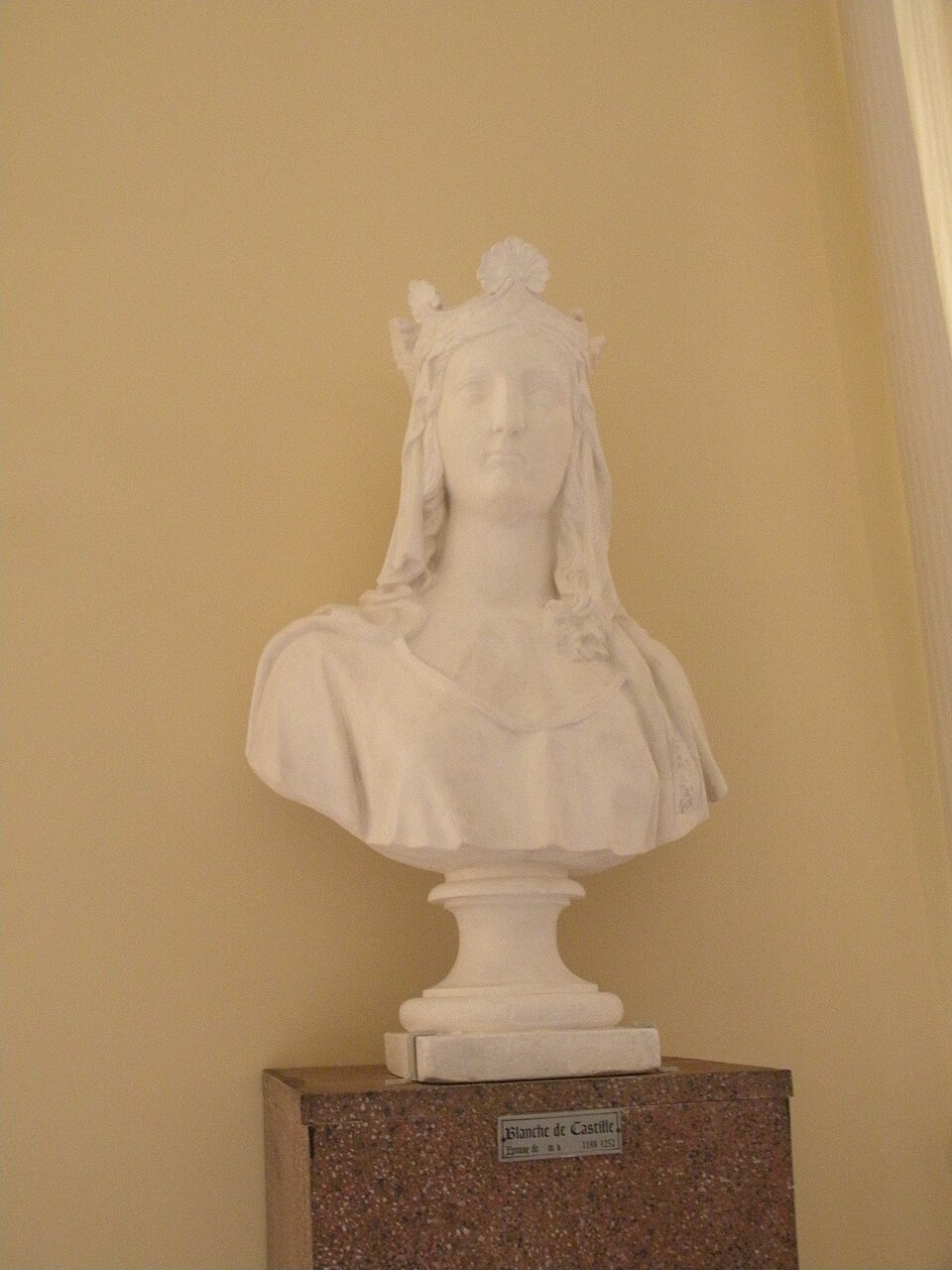
They whispered that I shared more than advice with Cardinal Romanus of Sant'Angelo, the papal legate who supported me against the barons. The gossip was crude, fabricated from scratch by lords unable to bring me down otherwise. This is what is reserved for a woman who governs: unable to attack her deeds, they defile her bed. A king who receives a legate takes counsel; a queen who does the same takes a lover, in the mouths of her enemies. I learned not to reply, for replying would have given substance to the lie. My widow's veil was worth more than all protests: it said, better than I could, the kind of woman I was. Calumny wears out; the charters I sealed, they remain.
Unable to attack my deeds, they defiled my bed.
—You are described as a mother both tender and implacable. Do you recognize yourself in that portrait?
I disown neither. I loved my son Louis with a love that never slept, and it is precisely for that reason that I was harsh. I repeated to him that he would be better off dead than in a state of mortal sin — and I meant it, from the depths of my being. A king does not belong first to his mother nor even to himself: he belongs to God and to his kingdom. So, yes, I watched over his company, his reading, his fasts; even as an adult, he undertook nothing that I had not weighed. They call that dominating. I call it forging. One does not make a Christian king with soft tenderness; one makes him with love and a firm hand.
One does not make a Christian king with soft tenderness.
—What were those evenings like when you raised the future Saint Louis?
After Vespers and Compline, I withdrew to my apartments in the Palais de la Cité, and there, by candlelight, I educated a king. I did not speak to him of battles first, but of justice, of the fear of God, of the weight a crowned man bears for all others. I showed him in my book of hours the images of the saints as one shows models to imitate. A child learns power through the eyes before learning it through books: he saw me receive vassals by day, pray in the evening, never separate the two. What France later called saintliness in my son was first a discipline I sewed into his soul, evening after evening.
A child learns power through the eyes before learning it through books.
—Why did you give so much to founding abbeys like Royaumont and Maubuisson?
Because a kingdom is not held only with armies: it is also held with prayers. In 1228, with my son, I founded Royaumont; in 1236, alone, Maubuisson. I wanted houses of the order of Cîteaux, austere, bare, where one prays without useless ornament, for the true wealth of a soul is in silence. I attended the offices, I supervised the works as I supervised my charters. I also supported the mendicant orders, those friars who preached in the cities and fought heresy better than any crusade. Building an abbey, for a queen, is planting in the kingdom's soil a root that holds after the body has disappeared. Fortresses fall; cloisters, they still sing.
Fortresses fall; cloisters, they still sing.
—You ended up taking the monastic habit. What did that gesture represent for the queen you were?
In 1248, my son left for Egypt, and at sixty I took up the seal a second time, governing the kingdom and gathering the gold for his ransom when he was captured at Mansourah. But my strength was waning, and I withdrew more and more to Maubuisson, which already resembled a retreat more than a palace. On my deathbed, in 1252, I had the habit of Cîteaux brought: after the widow's veil, that of the nun. My son was still in the East, he could not close my eyes. All my life I carried two weights — the crown and the cross. In dying, I kept only the second, the one which, I believe, weighs most justly before God.
All my life I carried two weights — the crown and the cross.

This imaginary interview was generated by artificial intelligence from sources documented in Blanche de Castille's profile. It dramatises what the figure might have said based on what we know about them, but does not constitute attested historical testimony. For primary sources and factual documentation, refer to the full profile.