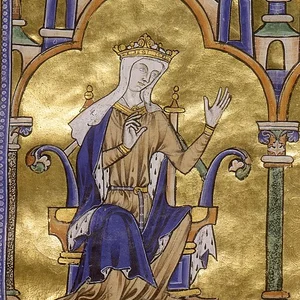

Queen of France and regent, Blanche de Castille (1188–1252) governed the kingdom during the minority of her son Louis IX (Saint Louis) and again during his crusade. A woman of exceptional power, she successfully asserted royal authority against the great barons.
Blanche de Castille(1188 — 1252)
Blanche de Castille
royaume de Castille
8 min read
Frequently asked questions
Key Facts
- 1188: born in Palencia, in Castile (present-day Spain)
- 1200: marriage to the future Louis VIII, strengthening the Franco-Castilian alliance
- 1226: death of Louis VIII — Blanche becomes regent for her son Louis IX, aged 12
- 1226–1236: suppresses the rebellion of the great feudal barons and preserves the unity of the kingdom
- 1248–1252: serves a second regency during the 7th Crusade of Louis IX; dies in 1252
Works & Achievements
Negotiated under Blanche's regency, this treaty ended the crusade against the Cathars and attached Lower Languedoc to the French crown. It was a major diplomatic achievement that lastingly expanded the royal domain.
Blanche governed as sole regent during Louis IX's minority, maintaining royal authority against revolts by the great barons and preserving the unity of the Capetian domain.
A Cistercian abbey founded together with Louis IX, it became the necropolis of several Capetian princes and an important spiritual center of the kingdom.
Another of Blanche's Cistercian foundations, intended for the education of noblewomen and for prayer. She spent her final days there and was buried within its walls.
At the age of 60, Blanche served a second regency during Louis IX's Seventh Crusade, managing the kingdom's affairs and negotiating the ransom for the king captured at Mansourah.
Anecdotes
At just 12 years old, Blanche of Castile was brought from Spain to France by her grandmother Eleanor of Aquitaine to marry the future Louis VIII. The elderly queen, then over 75 years old, crossed the Pyrenees herself to choose among her granddaughters the one who would make the best Queen of France — and she chose Blanche for her determined character.
When Louis VIII died in 1226, Blanche found herself sole regent with a 12-year-old son to protect. The great barons, refusing to obey a foreign woman, formed a league against her. She held firm, negotiated, divided her enemies, and maintained royal authority without ever giving in — a remarkable political feat for the era.
Malicious rumors circulated at court claiming that Blanche had carried on an affair with the papal legate, Cardinal Romanus of Sant'Angelo. This gossip, probably invented by her political enemies, shows just how difficult it was for a woman in power to be taken seriously without her reputation coming under attack.
Blanche was both a loving and a domineering mother. Her son Louis IX is said to have remarked that, in all his life, he had never done anything wrong that his mother had not lamented. Even after Louis came of age to rule, she continued to exert considerable influence over the kingdom's affairs.
Blanche of Castile founded several abbeys, including Royaumont (1228) and Maubuisson (1236), where she died in 1252 after serving a second regency during her son's crusade. She took the monastic veil on her deathbed, a sign that her deep faith had guided her entire political life.
Primary Sources
Queen Blanche was a wise and virtuous woman, and she governed the kingdom of France well during the absence and minority of her son, King Louis.
The good king told me that his mother loved him so dearly that when he was ill, she would rather have seen him dead than know he had committed a mortal sin.
Regina Blancha, femina quidem strenuissima et in consiliis acutissima, regni gubernacula solertissime administrabat.
Nos, Blancha, Dei gratia Francorum regina, notum facimus universis… (acts of regency issued in the name of Louis IX, sealed with the royal seal)
Key Places
Blanche's birthplace in 1188, then capital of the Kingdom of Castile. She grew up here before being chosen by Eleanor of Aquitaine to become Queen of France.
The main residence of the Capetian kings on the Île de la Cité, and the center of royal government. Blanche exercised her regency here and held her councils with the great lords of the realm.
A Cistercian abbey founded by Blanche and Louis IX in 1228. She made it a place of prayer for the Capetian dynasty and regularly attended services there.
Founded by Blanche in 1236, this Cistercian abbey became her final refuge. She died there in 1252 after taking monastic vows.
The traditional coronation site of the Kings of France. Blanche was crowned queen here alongside Louis VIII in 1223, then witnessed the coronation of her son Louis IX in 1226.
Typical Objects

Blanche used a royal seal in her son's name to authenticate acts of government. This wax seal, attached to charters, symbolized her legal authority over the kingdom and was the central tool of her administration.

The crown worn at official ceremonies served as a visual reminder of Blanche's dynastic legitimacy. She wore it during assemblies of barons to emphasize that she governed in the name of the Capetians.

Like any Christian noblewoman of the 13th century, Blanche owned a richly illustrated prayer book. Her deep devotion led her to support the mendicant orders and to found several abbeys.

The acts of the royal chancery, drawn up on parchment and sealed, were the instruments of Blanche's administrative power. Dozens of them bearing her regent's signature are preserved in the National Archives.

After the death of Louis VIII in 1226, Blanche wore the white veil of Capetian royal widows. Far from weakening her authority, this sober attire strengthened her image as a pious and irreproachable queen.

A symbol of her military and political role, Blanche received the keys of many cities brought under royal authority. She personally led military operations to subdue rebel barons.
School Curriculum
Vocabulary & Tags
Key Vocabulary
Daily Life
Morning
Blanche rose at dawn to attend matins, the first canonical prayer of the day in the royal chapel. Deeply devout, she took part in the liturgical offices every day before beginning her governing duties. The Dominican and Franciscan friars she supported financially paid her regular visits in the morning.
Afternoon
The afternoon was devoted to the affairs of the kingdom: receiving vassals, reading and signing royal charters, and consulting with her closest advisors. During her regency, she also had to arbitrate disputes between lords and receive foreign ambassadors. On some afternoons she would review the treasury accounts or oversee construction work at the abbeys she funded.
Evening
In the evening, after vespers and compline, Blanche withdrew to her private apartments. She oversaw the education of her children, particularly that of Louis IX, to whom she taught the duties of a Christian king. Supper brought the court together and was an opportunity to gather news from across the kingdom before retiring in keeping with the monastic rule she partly observed.
Food
The Capetian royal table was abundant: roasted meats (pork, poultry, venison), fish on lean days (Wednesday, Friday, Saturday), white bread, vegetables, and imported spices. Highly devout, Blanche strictly observed the many fast days of the medieval Christian calendar — roughly one third of the year — limiting herself on those days to bread, water, vegetables, and fish.
Clothing
As queen, Blanche wore long gowns of silk or velvet embroidered with gold, and a royal mantle lined with ermine fur for ceremonial occasions. After her widowhood in 1226, she adopted more subdued colors (white, grey, black) and the veil of Christian widows — an attire she kept until her death, when she took the Cistercian habit.
Housing
Blanche lived primarily at the Palais de la Cité in Paris, the administrative heart of the Capetian kingdom. She also stayed at Melun, Fontainebleau, and other royal fortresses during her travels. In her later years, she spent more and more time at the Abbey of Maubuisson, which resembled a monastic retreat far more than a royal palace.
Historical Timeline
Period Vocabulary
Liens externes & ressources
Références
Œuvres
Traité de Paris — fin de la croisade des Albigeois
1229
Première régence du royaume de France
1226-1234
Fondation de l'abbaye de Royaumont
1228
Fondation de l'abbaye de Maubuisson
1236
Deuxième régence du royaume de France
1248-1252