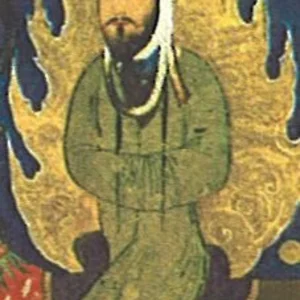

Grandson of the prophet Muhammad and son of Ali, he is the third imam of Shia Islam. His refusal to pledge allegiance to the Umayyad caliph Yazid I led to his death at the Battle of Karbala in 680, a founding event of Shia Islam.
Husayn ibn Ali(626 — 680)
Husayn ibn Ali
Empire ottoman, royaume du Hedjaz, émirat de Transjordanie
6 min read
Frequently asked questions
Key Facts
- Born around 626 in Medina, son of Ali ibn Abi Talib and of Fatima, daughter of the prophet Muhammad
- Recognized as the third imam by Shia Muslims
- Refuses to acknowledge the legitimacy of the Umayyad caliph Yazid I in 680
- Killed along with his followers at the Battle of Karbala on 10 October 680
- His death is commemorated every year during Ashura, a major period of mourning in Shia Islam
Works & Achievements
By refusing to recognize a power he deemed unjust, Husayn made a founding political and spiritual act, held up as a model of resistance to tyranny.
His words addressed to the enemy army before the battle, handed down by tradition, express his dignity and his sense of justice.
Correspondence through which Husayn responds to the call of the Kufans and sends his cousin Muslim ibn Aqil as an envoy.
A long prayer attributed to him, still recited by pilgrims, regarded as a pinnacle of Shia spirituality.
His death gave rise to the mourning rites of the month of Muharram, which shape Shia religious identity to this day.
Anecdotes
Husayn and his elder brother Hasan were so dear to the Prophet Muhammad, their grandfather, that he let them climb on his back during prayer and would sometimes cut his sermons short to take them in his arms. Tradition reports that he called them “the masters of the youth of Paradise.”
In 680, after refusing to recognize the new Umayyad caliph Yazid I, Husayn left Medina and then Mecca to answer the call of the people of Kufa, who had promised him their support. But on the way, he discovered that they had abandoned him, leaving his small band surrounded in the desert.
At Karbala, the Umayyad army cut off access to the Euphrates River to deprive Husayn and his companions of water for three days, under the heat. This episode of thirst deeply marked Shia memory, which still commemorates it today.
On the 10th of the month of Muharram (the day of Ashura), Husayn and about seventy-two companions fell before thousands of soldiers. According to tradition, his half-brother Abbas died while trying to bring a waterskin back to the thirsty children of the camp.
After the battle, Husayn's head and the surviving women of his family, including his sister Zaynab, were taken as captives to Damascus, before the caliph Yazid. Zaynab's courageous speech before the court has remained famous in tradition.
Primary Sources
Husayn said: “By God, I will not give you my hand like a man who is humiliated, nor will I flee like slaves flee.”
A detailed account of Husayn's departure from Mecca, his march toward Iraq, and the encirclement of his band on the plain of Karbala.
“My God, I am in need even in my wealth, so how could I not be in need in my poverty?”
A biographical entry on Husayn ibn Ali, his birth in Medina, his lineage, and the circumstances of his death.
Key Places
City in Arabia where Husayn was born around 626 and where the Prophet's family lived. He spent most of his life there before his final journey.
The holy city of Islam where Husayn took refuge in 680 after refusing to pledge allegiance to Yazid, before setting out on the road to Iraq.
Plain in Iraq where Husayn and his companions were surrounded and then killed on 10 Muharram 680. His shrine there is today a major site of Shia pilgrimage.
City in Iraq whose inhabitants had called on Husayn to join them in challenging Umayyad rule, before abandoning him. It was the destination of his final journey.
Capital of the Umayyad caliphate where Husayn's head and the captive women of his family were brought, before the caliph Yazid I.
Typical Objects

Weapon of the 7th-century Arab fighters, carried by Husayn and his companions at the Battle of Karbala. It became a symbol of resistance against injustice.

Rallying banner of Husayn's small troop, entrusted according to tradition to his half-brother Abbas. Even today, standards are raised during the Ashura processions.

A leather bag used to carry water in the desert. The waterskin of Abbas, killed while trying to bring water to the thirsty children of the camp, is one of the most moving symbols of Karbala.

Husayn's mount during the battle, which tradition says returned alone and bloodstained to the camp to announce his death. An adorned horse features in many commemorations.

Traditional garments of 7th-century Arabia, worn by Husayn as a respected member of the Prophet's family. The cloak (rida) also evokes the famous “Hadith of the Cloak.”

The sacred text of Islam, which Husayn recited and taught. Tradition reports that his companions spent their final night at Karbala in prayer and recitation.
School Curriculum
Vocabulary & Tags
Key Vocabulary
Daily Life
Morning
In Medina, Husayn's day began before dawn with the morning prayer, often at the Prophet's Mosque. He then devoted time to reciting the Quran and to teaching those who came to consult him.
Afternoon
The afternoon was taken up with community affairs: welcoming visitors, mediating disputes, and distributing alms. Tradition emphasizes his generosity toward the poor and travelers.
Evening
The evening brought the family together around a simple meal, followed by the dusk and night prayers. Husayn spent part of the night in prayer, in keeping with the piety attributed to the Prophet's family.
Food
His diet was that of seventh-century Arabia: barley or wheat bread, dates, milk, and occasionally mutton or camel meat during festivals. Water and milk were the everyday drinks.
Clothing
Husayn wore the Arab clothing of his time: a long tunic (*qamis*), a cloak (*rida*) draped over the shoulders, and a turban. The colors were plain, the fabric wool or cotton.
Housing
He lived in a house in Medina made of mud brick and stone, arranged around an inner courtyard, near the Prophet's Mosque. The furnishings remained simple, in keeping with an austere way of life.
Historical Timeline
Period Vocabulary
Liens externes & ressources
Références
Œuvres
Refus de l'allégeance à Yazid Ier
680
Discours et sermons de Karbala
680
Lettres aux habitants de Kufa
680
Du'a al-Arafa (Invocation du jour d'Arafa)
tradition, VIIe siècle
Fondation de la commémoration de l'Achoura
à partir de 680