Imaginary interview with Börte
by Charactorium · Börte (1161 — 1230) · Military · Politics · Exploration · 5 min read
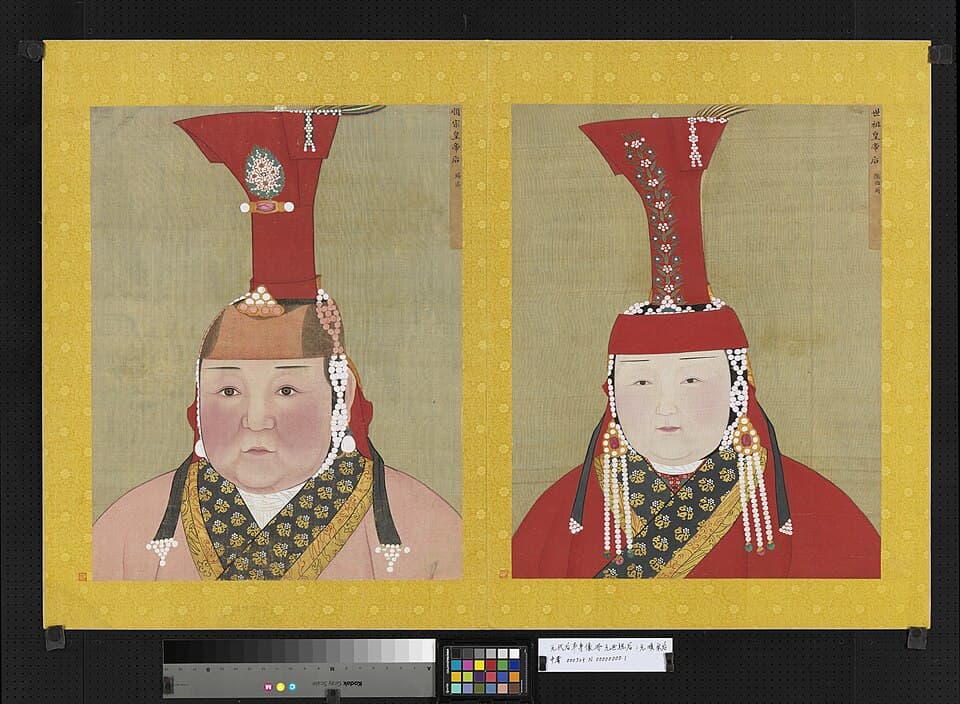
Under the great ger of white felt pitched in the Onon valley, Genghis Khan's principal khatun receives visitors at milking time. Her hands are calloused despite the metal ornaments, and the tall boqta headdress nearly touches the wooden roof ring. She speaks slowly, as one counts a herd.
—How was your marriage to Temüjin arranged, and what did you bring with you?
I was a daughter of the Onggirat, near Lake Hulun, a tribe known more for the beauty of its women than the strength of its warriors. I was betrothed as a child to that boy of the Bordjigin, and when I finally came under his tent, I brought the dowry my mother had sewn: a coat of black sable, thick and glossy as a winter night. Such a coat was worth a herd. Temüjin did not keep it to warm himself: he carried it to old Toghrul, the Ong Khan, as one brings a gift to a father. Thus custom demanded — a young man without fathers had to find one. That coat never covered my shoulders, yet it covered us all.
That coat never covered my shoulders, yet it covered us all.
—Why did that gift to Toghrul matter so much to you?
We had nothing then. My husband's family had lived in poverty ever since Yesügei, his father, was poisoned on the road; they scratched the earth for roots and fished in the Onon. A man alone on the steppe is a dead man; he needs an anda, a protector, an alliance. In giving away my sable, Temüjin was not impoverishing himself — he was buying an oath. And the old khan kept his word: his riders came when needed. That is why I do not mourn that fur. A wise woman knows that a fine object kept in a chest feeds no one, while a well-placed gift binds an ally for ten years.
—Do you remember the night the Merkit came?
One does not forget the sound of hooves in the dark. The Merkit came from the Selenga valley to the north, to avenge an old wrong: long ago Yesügei had taken their woman, and they were taking a woman from his son. There were not enough horses for all; Temüjin fled to the sacred mountain Burkhan Khaldun to save his life, for a dead khan rescues no one. I was carried off on a cart like a piece of plunder. I did not scream — what use is screaming on the steppe, where only the wind answers? I waited. A captive learns quickly that patience is also a weapon.
A captive learns quickly that patience is also a weapon.
—How did your husband manage to get you back?
Alone, he was nothing; but he had woven ties. He went to Toghrul, to whom he had given my coat, and to Jamukha, his anda, his sworn brother from youth. The three assembled their riders, and we fell upon the Merkit camp in a thunder of composite bows. They say he ran among the tents shouting my name until I heard him and threw myself from my cart toward him. That raid, the first great victory of his life, made his name known across the steppe. Thus my abduction, a shameful thing, launched his glory. The ways of fortune are obscure to men.
—Soon after your return, your first son was born. What would you say about Jochi's birth?
Jochi was born shortly after my rescue, and malicious tongues counted the moons on their fingers. His very name, in our speech, sounds like 'the guest,' the one who arrives. My husband took him in his arms and acknowledged him as his own before all — a man is the father of the child he raises under his tent, not a slave to gossip. But doubt is an ember that smolders long under the ashes. I knew, as I nursed him, that this boy would carry that weight all his life. A mother sees these things before others. I could only love him more, as one protects the lamb the herd eyes with suspicion.
Doubt is an ember that smolders long under the ashes.
—How did you experience the question of succession among your four sons?
I gave him four sons: Jochi, Chagatai, Ögedei, and Tolui. Four pillars for a single roof, and a roof stands only if the pillars do not fight. When the time came to name an heir, the eldest and the second quarreled before their father — one calling the other a son of a Merkit. My mother's heart bled, but my khatun's reason approved the choice that followed: it was Ögedei, the third, a man of measure and generous cup, who was designated. Better a less proud son who would keep the peace than a contested eldest who would ignite war between brothers. I had seen too many tribes devour each other to wish that on my own lineage.
—As principal empress, what were your days like?
People think a khatun lives in idleness; they are mistaken. I governed my own camp, my ordo: dozens of yurts, herds stretching out of sight, servants to command. From dawn, before the sun gilded the felt, we milked the mares and ewes — milking first, always, because without milk there is no koumiss or dried cheese. In the afternoon, I oversaw the beating of felt, the tanning of hides, the sewing of deel. A great lady does not sit idle: she leads her camp as a noyan leads his riders, eye on everything, hand firm.
A great lady does not sit idle: she leads her camp as a noyan leads his riders.
—How did the camp you managed serve the entire empire?
An empire does not march on bows alone. It marches on its stomach, and the stomach — I was the one who filled it. My ordo was a living storehouse: the herds that provided meat and leather, the skins of koumiss for feasts and oaths, the yurts loaded onto great wheeled carts pulled by oxen when the camp migrated. When my husband went to war against the Jin country, everything behind him had to hold firm: the beasts guarded, the provisions counted, the servants at work. A khatun who lets her camp collapse disarms her khan as surely as an enemy. That is why my boqta headdress was worth nearly a helmet.
—It is said that you warned Genghis Khan against the shaman Teb Tengri. How did that happen?
Teb Tengri, the shaman, rode to heaven on a horse, they said, and spoke in the name of the Eternal Blue Sky. His word carried great weight, for no one dares contradict one who claims to bear the will of Tengri. But I saw clearly: this man was setting my husband's brothers against each other and would soon dare to touch the khan himself. One morning, in our yurt, I spoke. A woman has no sword, but she has the voice of the hearth, and a husband listens to his khatun where he would listen to no other. I told him that he who lowers his brothers today will want to sit on his seat tomorrow. He understood.
—What does this episode reveal about a woman's place in Mongol state affairs?
People imagine we spun felt while the men decided war. Not at all. In the evening, around the hearth of the yurt, when we shared koumiss and stories, alliances and campaigns were weighed aloud, and a khatun's opinion counted. After my warning, the overmighty shaman was broken, and the khan's authority remained unchallenged. I never rode a horse to battle, yet I fought that battle. Heaven gives men the strength of the arm; sometimes it gives women the ability to see far. Foolish would be the khan who listened to only one of these two voices.
Heaven gives men the strength of the arm; sometimes it gives women the ability to see far.
Read further
This imaginary interview was generated by artificial intelligence from sources documented in Börte's profile. It dramatises what the figure might have said based on what we know about them, but does not constitute attested historical testimony. For primary sources and factual documentation, refer to the full profile.