Kids interview Börte
by Charactorium · Börte (1161 — 1230) · Military · Politics · Exploration · 5 min read
Two young visitors of twelve arrive at the camp, a little intimidated by the large felt yurts. A woman with a sharp gaze invites them to sit near the hearth. She smiles: she has many things to tell them.
—What was it like, the night the Merkit carried you off?
You know, my child, it was terrifying. We had been married only a short time. One night, riders from the Merkit tribe came from the Selenga valley to the north. Imagine the sound of horses in the dark, the cries, and me being carried far from home. I thought I would never return. But my husband, young Temüjin, did not abandon me. He begged his protector Toghrul and his sworn friend Jamukha to help him. They gathered their warriors to come and take me back. That battle launched his entire career as a leader.
They carried me off in the night, but they never stopped coming for me.
—Were you afraid he would never come to rescue you?
Yes, I was afraid, I won't lie to you. When you are a prisoner among your enemies, each day feels as long as a winter. But my husband was not alone: he had sealed a sacred friendship with Jamukha, what they called an anda, a blood brother. And he had given a precious gift to Toghrul, the Kerait chief, to secure his help. Thanks to them, an army rose. Remember this: an alliance is not empty words. It is what brings you home when all seems lost.
A true alliance is what brings you home when all seems lost.
—What was that gift your husband gave to Toghrul?
Ah, that is a lovely story. For my wedding, I had brought as a dowry a magnificent black sable coat, a very rare and expensive fur. The sable is a small animal from cold forests, whose fur shines like silk. Well, my husband did not keep that coat for himself. He gave it to Toghrul, a powerful chief, to make him his protector. Imagine: a simple coat that becomes a friendship between two armies. That gift enabled his very first great victory. Sometimes an object is worth a thousand soldiers.
A well-given coat can be worth a thousand soldiers.
—Why did people doubt about your son Jochi?
That is a delicate question, and I will answer you frankly. My first son, Jochi, was born shortly after my liberation from the Merkit. So within the family, some whispered: is he truly Temüjin's son? That doubt, my child, followed Jochi all his life. His father recognized and loved him. But when it came time to choose an heir for the empire, that murmur weighed heavily. Jochi was set aside in favor of his brother Ögedei. It is sad: sometimes an unfair rumor decides a man's fate.
An unfair rumor can weigh more than all a father's love.
—How was it decided who would become the great leader after Genghis Khan?
It was an enormous decision, you know. My husband had built the greatest empire in the world, from the steppe to distant cities. At his death, my four sons risked fighting among themselves for power. A war between brothers is the worst misfortune. So we chose Ögedei, known as wise and just, as the great khan. He was elected in 1229. This choice prevented my sons from tearing each other apart right away. Remember this: preparing who comes after you is already protecting tomorrow's peace.
Preparing who comes after you is already protecting tomorrow's peace.
—What did you do all day in the camp?
Oh, I was very busy, more than a war leader! I was called khatun, meaning empress, the great lady. I ran my own camp, called an ordo: my yurts, my herds, my servants. At dawn, we milked the mares and ewes. In the afternoon, I watched over the animals, had felt prepared and hides tanned. Imagine a small town of tents that moves with the seasons, and I made it run. A Mongol empress did not sit around doing nothing. She worked from morning to night.
A Mongol empress didn't sit around: she kept an entire camp running.
—What did it smell like, and what did you eat in your yurt?
Ah, you are curious about real things, I like that! In my felt yurt, it smelled of wool, hearth smoke, and milk. We lived off our herds: mutton, dried cheese called aaruul, hard as a stone. And especially koumiss, mare's milk left to ferment until it tingles the tongue. In the evening, the family huddled around the fire to eat and listen to songs. There was no engine noise, just the wind and the horses in the night.
It smelled of wool, smoke, and milk: that was the smell of home.
—What clothes did you wear, you, the empress?
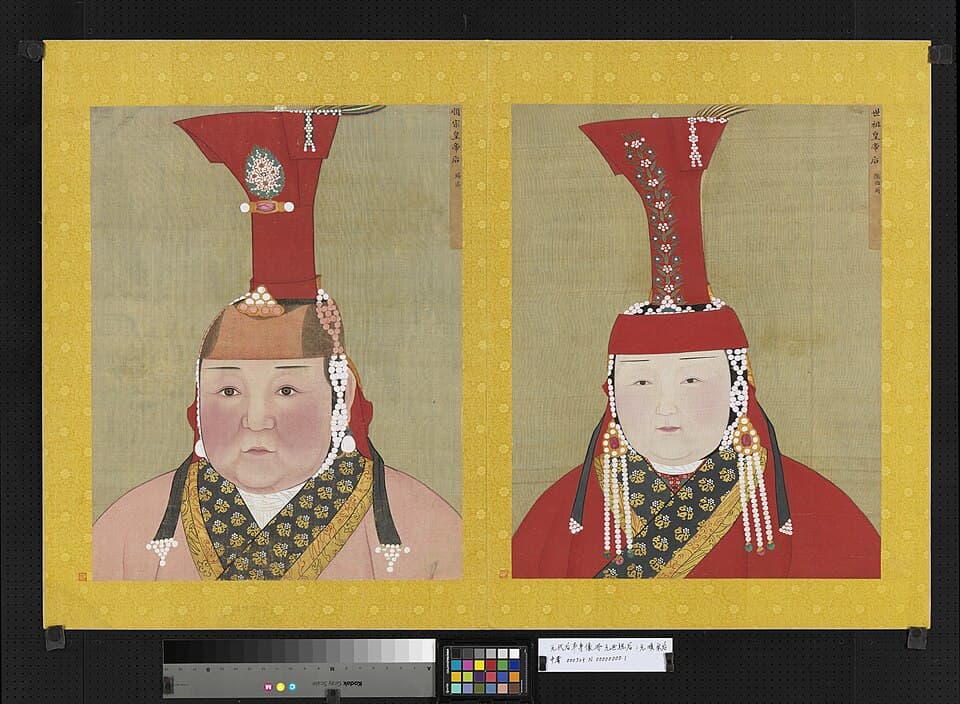
I wore the deel, a long wrapped robe fastened with a belt. In winter, it was lined with fur to keep from freezing on the steppe. But what showed my rank was my headdress: the boqta, a very tall conical hat, reserved for married noblewomen. Imagine a tall pointed hat visible from afar! When it was seen, everyone knew at once: here comes a great lady. I added metal ornaments. Among us, my child, clothing did not serve to hide. It told everyone who you were.
Among us, clothing didn't hide: it told everyone who you were.
—Why did you warn your husband against the shaman Teb Tengri?
Because I saw a danger that others did not want to see. Teb Tengri was a shaman, a man believed able to speak to the spirits of the sky. He had become very powerful, too powerful. He began to come between the brothers, to challenge my husband's authority. So I warned him, calmly but firmly. I made him understand that this shaman threatened everything he had built. My husband listened to me, and he broke that power. You see, listening to wise advice, even given in a low voice, can save an empire.
Advice spoken in a low voice can save an entire empire.
—Did he really listen to you, Genghis Khan, when you gave your opinion?
Yes, my child, and I am proud of it. Many imagine that steppe women kept silent. That is false. As khatun, the first wife, my opinion counted in state affairs. I received messengers, I settled disputes. When I warned him against the shaman Teb Tengri, he did not brush aside my words. He reflected, then acted. A great leader is not one who knows everything alone. It is one who knows how to listen to those he trusts.
A great leader is not one who knows everything, but one who knows how to listen.
—How old were you when you married Temüjin?
I was very young, you know. I was betrothed to Temüjin when I was about ten, and he was nine. In our time, among nomads, it was the custom: the future husband would come live with the bride's family for a time to seal the alliance. We did not marry for good until a few years later. Then I brought my famous sable coat as a dowry. Do not think it was love like in fairy tales. It was first two families uniting. But over time, true trust grew between us.
We were united as children, but trust built over time.
—How does it feel to know that so many kings descend from you?
It is an immense feeling, almost too big for me. I gave my husband four sons: Jochi, Chagatai, Ögedei, and Tolui. At their father's death, they divided an empire stretching from China to Persia. And all the great khans who followed descended from me. The chronicle of Rashid al-Din, a distant scholar, even wrote it. Imagine: a girl from the Onggirat tribe, abducted one night, become the ancestor of so many rulers. I tell you, my child: you never know what great destiny sleeps in a little girl of the steppe.
You never know what great destiny sleeps in a little girl of the steppe.
Read further
This imaginary interview was generated by artificial intelligence from sources documented in Börte's profile. It dramatises what the figure might have said based on what we know about them, but does not constitute attested historical testimony. For primary sources and factual documentation, refer to the full profile.