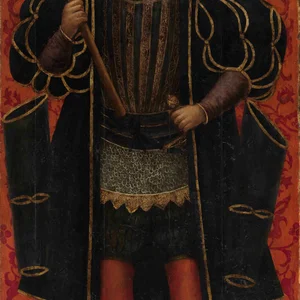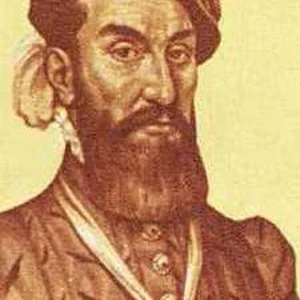

A 16th-century Spanish conquistador and explorer, he survived the shipwreck of the Narváez expedition in Florida (1528) and crossed North America for eight years with three companions before reaching Mexico. His account, the *Naufragios*, is one of the first European eyewitness records of the interior of the American continent.
Cabeza de Vaca
Cabeza de Vaca
9 min read
Frequently asked questions
Famous Quotes
« We were so utterly destitute that we had nothing left to eat, nor any clothing to cover ourselves.»
Key Facts
- 1527: Treasurer of the Pánfilo de Narváez expedition, tasked with colonizing Florida
- 1528: Shipwreck on the coast of present-day Texas, reducing the expedition to a handful of survivors
- 1528–1536: Crossing of North America (Texas, New Mexico, Sonora) with three companions, including the African Estevanico
- 1542: Publication of the *Naufragios* (*La Relación*), the first European account of the North American interior
- 1540–1542: Governor of Río de la Plata (present-day Paraguay), removed from office for his pro-indigenous policies
Works & Achievements
An account of his shipwreck in Florida and eight years of wandering across North America, published in Zamora. It is one of the earliest European testimonies about the peoples and landscapes of the American interior, and a founding text of Hispanic-American travel literature.
A record of his governorship of the Río de la Plata (1540–1544), written by his secretary Pero Hernández and published together with a new edition of the *Naufragios*. The text documents his attempts at humanistic governance and his conflicts with Spanish settlers.
A collection of administrative reports and letters addressed to Charles V and the Council of the Indies, describing the lands traversed, the peoples encountered, and their potential resources. These documents influenced the subsequent expeditions of Coronado and other explorers.
Anecdotes
The surname “Cabeza de Vaca” (Cow’s Head) did not originate with him but with a maternal ancestor, Martin Alhaja, who during the Reconquista in the 13th century reportedly marked a strategic mountain pass with a cow’s skull to guide the Christian army to victory. This honorific nickname was passed down from generation to generation, all the way to this conquistador of the New World.
After the 1528 shipwreck, Cabeza de Vaca and his companions were enslaved by Native American tribes along the Texas coast. To survive, Álvar learned to heal the sick by blending Native American rituals with Christian prayers. His reputation as a healer spread so rapidly that he was soon welcomed as a medicine man by peoples who had never met him, and crowds of several hundred people would sometimes follow him in search of his cures.
Among the four survivors of the Narváez expedition who crossed North America, one was named Estebanico, a Berber slave from Azemmour (Morocco). He thus became the first known African to have crossed the North American continent, well before any other European. After their arrival in Mexico, Estebanico continued exploring and was killed during an expedition to New Mexico in 1539.
Upon his return to Spain in 1537, Cabeza de Vaca was barely recognizable: gaunt, with weather-beaten skin, dressed in animal hides. He had traveled on foot roughly 15,000 kilometers over eight years through lands no European had ever set foot on. His account astonished the court of Charles V, as it described peoples and landscapes entirely unknown to the Old World, as well as his own profound inner transformation.
Appointed governor of the Río de la Plata (present-day Argentina and Paraguay) in 1540, Cabeza de Vaca distinguished himself with a surprisingly humanist policy for the era: he banned the mistreatment of Native Americans and opposed the abuses of the colonists. This stance earned him the hostility of local conquistadors, who arrested him in 1544, had him shipped back to Spain in chains, and accused him of mismanagement.
Primary Sources
“That night we came to an island, and I saw traces of fire; I marveled to see this in such a land. The next day we searched for food on the island, and found nothing but some rotten fish.”
“We passed through many and diverse nations, by all of whom we were well received, and they gave us to eat of what they had, for they held us to be men come down from heaven.”
“I endeavored that the natives of the land receive no harm from the Christians, and I ordered it proclaimed that no one should mistreat them in deed or word, under severe penalties.”
“This Álvar Núñez Cabeza de Vaca was one of the four Christians who escaped from the fleet of Pánfilo de Narváez, and traveled overland for eight years among the Indians, enduring great hardships and miseries.”
Key Places
Birthplace of Cabeza de Vaca, in Andalusia, where he was born around 1488 into a minor noble family. It was from here that he would depart to join the Spanish expeditions to the Americas.
The area where the Narváez expedition landed in April 1528 and began pushing inland, fatally losing contact with its ships. This marked the beginning of the disaster that would lead to a series of shipwrecks.
The presumed site of the final shipwreck in November 1528, where survivors washed ashore on an island they named "Malhado
In 1536, Cabeza de Vaca and his companions reached the Spanish outposts in northern Mexico and then Mexico City, capital of New Spain. Their arrival caused a sensation: they were the first people known to have crossed the interior of the North American continent.
Capital of the province of Río de la Plata, where Cabeza de Vaca served as governor from 1542 to 1544. He pursued a policy of protecting the indigenous people there, which earned him the hostility of the colonists and ultimately led to his arrest.
Typical Objects

At the outset of the Narváez expedition, Cabeza de Vaca wore the standard metal armor of Spanish soldiers. He was forced to gradually abandon it as he wandered, since it was ill-suited to marching through hostile environments and to surviving among Native American peoples.

To survive, Cabeza de Vaca became a traveling trader between rival tribes, exchanging shells, pigments, hides, and ritual objects. These goods, circulating among peoples who could not speak to one another, secured him protection and a unique safe passage.

Having become a respected healer, Cabeza de Vaca treated the sick by combining breath, laying on of hands, and Christian prayers blended with Native American rituals. Feathers and hides were part of the symbolic material expected of a medicine man in the cultures he passed through.

Back in Spain, Cabeza de Vaca wrote his account from memory and from notes, using the tools of any educated man of the 16th century: a trimmed goose quill and parchment or rag paper. The manuscript was printed in Zamora in 1542.

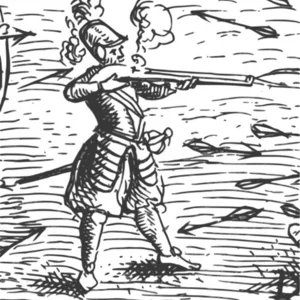
The arquebus was the standard individual firearm of Spanish soldiers of the era. The Narváez expedition carried them, but they were quickly lost or rendered useless during the successive shipwrecks and the wandering through unknown lands.

Shells from the Atlantic or the Gulf of Mexico held high symbolic and commercial value for many tribes of the interior. Cabeza de Vaca used them as a medium of exchange during his travels between different Native American groups.
School Curriculum
Vocabulary & Tags
Key Vocabulary
Tags
Daily Life
Morning
During his years of wandering (1528–1536), Cabeza de Vaca rose at dawn with the Native American group hosting him. The morning began with the search for food: roots, berries, small game, or fish depending on the season and region. As a traveling healer, he might also be called early to the bedside of the sick.
Afternoon
Afternoons were devoted to traveling long distances on foot, often without adequate footwear, or to trading between tribes. Cabeza de Vaca learned several Native American languages, which allowed him to negotiate safe passage and to exchange shells, flints, or hides for food and hospitality.
Evening
In the evening, the group settled into local dwellings — reed huts, skin shelters, or caves depending on the peoples encountered. Evening gatherings could include healing ceremonies in which Cabeza de Vaca played a central role, blowing on the sick and reciting Christian prayers that his hosts interpreted as powerful ritual formulas.
Food
Food varied dramatically by region and season: dried fish and shellfish along the Texas coast, pecans and roots on the inland plains, agave, ceremonial peyote, and game in the desert areas of northern Mexico. In his *Naufragios*, Cabeza de Vaca describes periods of extreme famine during which he ate bark, spiders, and animal droppings to survive.
Clothing
Having left Spain wearing a Spanish soldier's armor and clothing (linen shirt, hose, doublet), Cabeza de Vaca eventually wore nothing but roughly sewn animal skins, and sometimes nothing at all, like the nomadic peoples he lived among in the warmer regions of Texas. By the time he returned to Mexico in 1536, his former compatriots barely recognized him.
Housing
During his wandering, housing was never fixed: Cabeza de Vaca slept in reed and skin huts among the coastal peoples of the Gulf, under makeshift shelters on the grassy plains of Texas, and in adobe houses among the sedentary populations of northern Mexico. This diversity of dwellings reflects the extraordinary variety of Native American cultures he passed through.
Historical Timeline
Period Vocabulary
Liens externes & ressources
Références
Œuvres
Naufragios (La Relación)
1542
Comentarios
1555
Rapports et lettres au Conseil des Indes
1537-1545