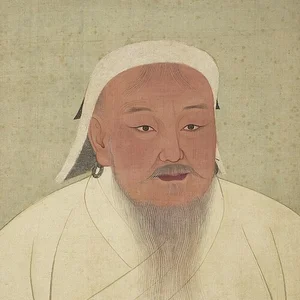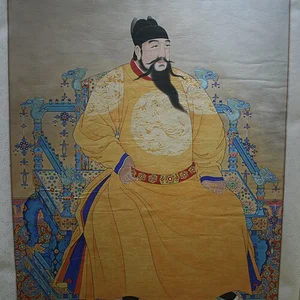

Third emperor of the Ming dynasty (1402–1424), Yongle is known for moving the capital to Beijing, commissioning Zheng He's great maritime expeditions, and consolidating Chinese imperial power.
Yongle
Yongle
9 min read
Frequently asked questions
Key Facts
- 1402: Yongle seizes the throne after a civil war against his nephew, Emperor Jianwen
- 1403–1424: reigns during the Yongle era, a period of great expansion of the Ming empire
- 1405–1433: commissions Zheng He's seven maritime voyages, reaching as far as East Africa
- 1420: completes construction of the Forbidden City and transfers the capital from Nanjing to Beijing
- 1421: makes Beijing the official capital of China
Works & Achievements
A monumental encyclopedia spanning 22,877 handwritten volumes, compiling the entirety of Chinese knowledge. Commissioned by Yongle to preserve and disseminate Han culture, it remains one of the greatest editorial undertakings in history.
A palatial complex covering 72 hectares at the heart of Beijing, built according to the principles of Confucian cosmology. A masterpiece of Chinese imperial architecture, it has been a UNESCO World Heritage Site since 1987.
A series of seven naval expeditions to Southeast Asia, India, the Middle East, and East Africa, commissioned by Yongle. These voyages asserted the prestige of Ming China and enabled diplomatic and commercial exchanges on an unprecedented scale.
Yongle had the Grand Canal restored and extended to connect Beijing to the rice-producing regions of the south. This vital infrastructure made it possible to supply the new capital and facilitate economic exchange throughout the empire.
A ritual complex built in Beijing so that the Emperor could perform sacrifices to Heaven according to imperial rite. It embodies the cosmic conception of imperial power, in which the sovereign mediates between earth and Heaven.
Yongle had the great rituals of the imperial court systematized and set down in writing, establishing Neo-Confucian doctrine as the ideological foundation of the monarchy. This standardization reinforced the legitimacy of his rule beyond his military seizure of power.
Anecdotes
Yongle was not the legitimate successor of his father Hongwu: it was his nephew, Emperor Jianwen, who inherited the throne in 1398. Zhu Di, Prince of Yan based in Beijing, refused to submit and launched a three-year civil war — the Jingnan campaign — before seizing Nanjing in 1402. To erase all trace of Jianwen's legitimacy, he had the records of his reign burned and made thousands of officials who had remained loyal to him disappear.
Upon coming to power, Yongle decided to move the imperial capital from Nanjing to Beijing, his power base and a city he knew intimately. He mobilized more than a million workers and craftsmen over fifteen years to build the Forbidden City, a palace complex of 72 hectares containing nearly 10,000 rooms. This monumental decision permanently anchored China's political center in the north, close to the borders threatened by the Mongols.
To gather and preserve all the knowledge of his time, Yongle ordered the compilation of the Yongle Dadian in 1403, a monumental encyclopedia comprising more than 22,000 handwritten volumes. Some 3,000 scholars spent years copying texts on philosophy, medicine, astronomy, history, and literature. It remains to this day one of the largest encyclopedias ever assembled in human history.
Admiral Zheng He, a trusted Muslim eunuch, was tasked by Yongle with commanding seven maritime expeditions between 1405 and 1433. The first fleet comprised 62 giant junks and around 28,000 men — an armada without equal at the time. These voyages reached Southeast Asia, India, the Arabian Peninsula, and as far as the coasts of East Africa, returning with ambassadors, spices, and even a giraffe gifted by the Sultan of Bengal.
Yongle died in 1424 during his third personal campaign against the Mongols in the northern steppes. He was 64 years old and had refused to delegate military command. His body was brought back to Beijing in the utmost secrecy to prevent any rebellion. He rests today in the Changling tomb, the largest of the thirteen Ming mausoleums, 50 kilometers north of Beijing.
Primary Sources
The imperial edicts recorded in the Shilu document Yongle's decisions regarding the transfer of the capital, the maritime expeditions, and the military campaigns against the Mongols. They constitute the most direct official source on his governance.
We command Zheng He and his companions to carry our missives to the countries of the Southern Seas, so that they may know our greatness and come to offer tribute to our Court.
All works and texts from Antiquity to the present day shall be gathered and ordered so that nothing may be lost to future generations.
The Emperor of the Yongle era was of exceptional intelligence and vigor. He extended China's power beyond the seas and secured the northern frontiers through his personal campaigns against the Oirats and the Tatars.
We have traversed more than one hundred thousand li of vast open waters, and beheld in the immensity of the ocean great waves rising as high as mountains.
Key Places
Yongle ordered the construction of the Forbidden City between 1406 and 1420 and moved the imperial capital there. This palace of 9,999 rooms became the center of Chinese dynastic power for five centuries.
Capital of the Ming dynasty founded by Hongwu, Nanjing was the scene of Yongle's seizure of power in 1402. It retained the status of secondary capital after the transfer to Beijing.
Port in Fujian province from which several of Zheng He's great maritime expeditions, commissioned by Yongle, set sail. A stele there still commemorates these voyages today.
The theater of Yongle's personal military campaigns against the Tatar and Oirat Mongols between 1410 and 1424. It was in this region that he died in 1424 during his fifth military expedition.
The monumental burial site of Yongle, located 50 km north of Beijing in the Valley of the Thirteen Tombs. It is the largest of the Ming mausoleums, built during his own lifetime according to his personal instructions.
Typical Objects

Yellow ceremonial garment embroidered with nine five-clawed dragons, reserved for the exclusive use of the Emperor. Yongle wore this robe during grand audiences and dynastic rituals to embody the majesty of the Son of Heaven.

Giant vessels 130 meters long and 50 meters wide, used during Zheng He's expeditions commissioned by Yongle. These ships carried silks, porcelain, and diplomats to impress foreign courts.

Under Yongle, the imperial kilns of Jingdezhen reached their peak, producing pieces with floral designs of unmatched refinement. This porcelain was offered as diplomatic gifts to foreign rulers and symbolized the sophistication of Chinese civilization.

A seal carved from jade, engraved with the characters “Mandate of Heaven, lasting prosperity,” affixed to all of Yongle's imperial edicts. Possession of this seal legitimized his power, particularly after his usurpation of the throne from his nephew.

An instrument inherited from Chinese tradition and refined during the Ming era, indispensable to the navigators of Zheng He's fleet for finding their bearings on the open sea. Its mastery allowed the expeditions commissioned by Yongle to reach lands as distant as East Africa.

The weapon of choice of Ming cavalry, used during Yongle's five personal campaigns against the Mongols in the northern steppes. Yongle, a seasoned warrior, distinguished himself on horseback and inspired his troops through his presence in battle.

Lacquered wooden plaques bearing the names of deceased emperors, kept in the Imperial Ancestral Temple in Beijing. Yongle venerated them during regular rituals to justify his dynastic legitimacy in the face of accusations of usurpation.
School Curriculum
Vocabulary & Tags
Key Vocabulary
Daily Life
Morning
The Emperor rose before dawn for the morning rituals, purifying himself according to precise rites before entering the Great Audience Hall. From sunrise, he presided over the full court where ministers, generals, and high-ranking eunuchs submitted their written reports while kneeling and touching their foreheads to the ground in accordance with the kowtow protocol.
Afternoon
The afternoon was devoted to governmental work: Yongle reviewed petitions, rendered judgments, and issued edicts transmitted to the provinces through the imperial relay network. Deeply passionate about military arts, he regularly supervised the training of his personal guard and the troops stationed in Beijing, particularly cavalry exercises.
Evening
In the evenings, Yongle studied the Confucian classics and historical records in the company of his scholarly advisors, in keeping with the tradition of the learned Emperor. Court life was sometimes extended by diplomatic banquets where music, dance, and acrobatics welcomed the ambassadors of tributary states who came to present their gifts.
Food
The imperial table featured several dozen dishes prepared by hundreds of specialized cooks: beef, pork, mutton, and poultry steamed or roasted, freshwater fish, vegetables stir-fried in sesame oil, thick soups, and carefully selected rice. Officers tasted each dish before the Emperor to eliminate any risk of poisoning, and the blue-and-white porcelain tableware from Jingdezhen was reserved for his exclusive use.
Clothing
Yongle wore yellow silk robes embroidered with nine five-clawed dragons during official ceremonies, a color reserved for the sovereign alone. Outside of ritual occasions, he wore garments in less codified colors but always in fine silk; during his military campaigns, he donned black lacquered armor adorned with dragon motifs, embodying the warrior Emperor.
Housing
Yongle resided in the Forbidden City, which he had built — an enclosed world of 980 buildings, gardens, pavilions, and inner courtyards organized according to the principles of feng shui and Confucian hierarchy. At the heart of this palace, his private apartments were surrounded by a court of several thousand eunuchs, ladies-in-waiting, and servants, in near-total isolation from the outside world.
Historical Timeline
Period Vocabulary
Liens externes & ressources
Références
Œuvres
Yongle Dadian (永樂大典) — Grande Encyclopédie de l'ère Yongle
1403-1408
Construction de la Cité Interdite (紫禁城)
1406-1420
Expéditions maritimes de Zheng He (鄭和下西洋)
1405-1424
Réforme et extension du Grand Canal (大運河)
1411
Temple du Ciel (天壇)
1420
Codification du Lijiao — Rites impériaux Ming
1403-1424