Imaginary dialogue between Temüjin (Gengis Khan) and Börte
by Charactorium · Börte (1161 — 1230) · Military · Politics · Exploration · 5 min read
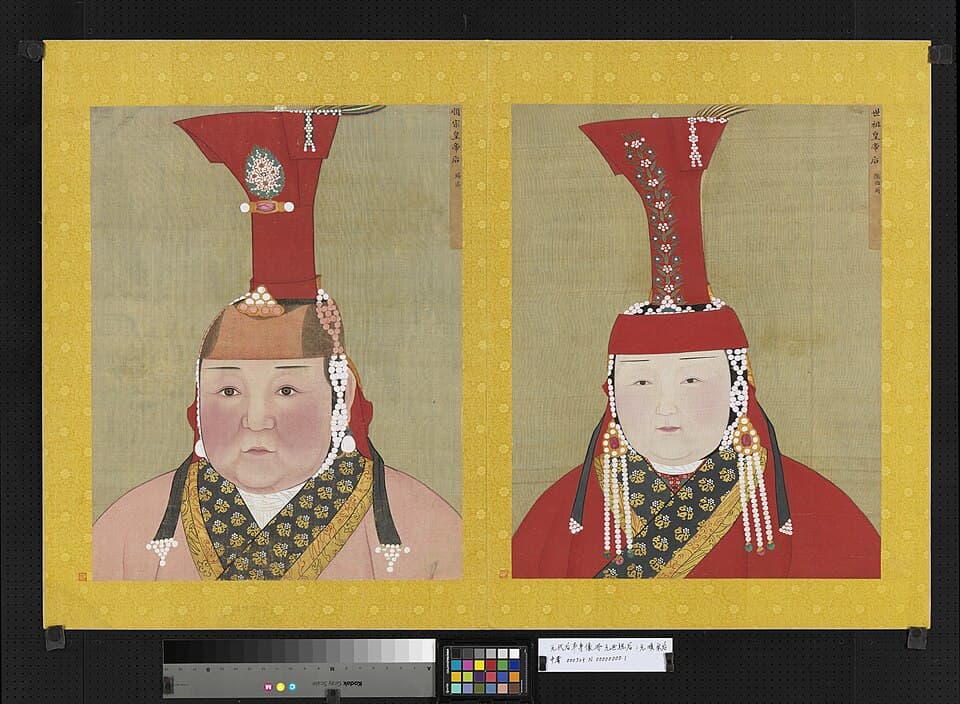
It is under the great yurt of the main ordo, in the Onon Valley, that one winter evening Temüjin comes to sit by the hearth of Börte. Outside, the carts sleep under the frost; inside, the smell of felt and warm koumiss fills the air. They have known each other since childhood, since those betrothals were tied when she was ten and he nine, and tonight the khan comes not as a sovereign but as a husband, curious to hear from the one who has shared every season of his life tell, in her own way, the path they have traveled.
—Börte, do you remember the day of our wedding, when you arrived under my tent with that black sable coat? What did it mean to you?
How could I forget it, you who held it in your hands that day? My mother had chosen that coat as the finest part of my dowry, a fur dark and dense like a winter night. You did not keep it long: you went and brought it to Toghrul, the Ong Khan, to revive the alliance that protected your impoverished family. I admit I felt a pang seeing it leave on another's shoulders. But you had explained your thinking, and I understood that this gift was worth more than an ornament: it was worth an army. It was that fur that gave you a protective father when you no longer had your own.
This gift was worth more than an ornament: it was worth an army.
—There is one night I never speak of without shame: the night the Merkit carried you off. What do you keep from those days of captivity?
Do not lower your eyes, my husband. That night, the riders came in the dark, and our camp was too weak to repel them; you fled to the sacred mountain, as you had to do to survive. As for me, they threw me onto a horse and took me north, toward the Selenga. I lived for months in uncertainty, not knowing if you would come. Then I learned that you had gathered Toghrul and Jamukha, that thousands of warriors were marching for me. When you found me in the chaos of battle and cried out my name, I understood that nothing, ever, would weigh heavier for you than taking me back.
Nothing, ever, would weigh heavier for you than taking me back.
—Our son Jochi was born shortly after your return from the Merkit. You know the whispers about his birth. What do you have to say to me about it?
I know the whispers, and I know they hurt you as much as they hurt me. Jochi came into the world barely after I had returned to you, and that was enough for tongues to wag in the camps. But you took him in your arms and named him your son before everyone. I ask you never to let this doubt rob you of your eldest. He is brave, he is loyal, he carries your blood like his brothers. What the steppe whispers is worth nothing against what a father decides. Do not open between our sons a wound that our enemies are waiting to deepen.
What the steppe whispers is worth nothing against what a father decides.
—When I am gone, one of our sons must hold the empire. You know them better than I do; which one would you choose?
That is the question I dread most, for no mother wants to choose among her children. Jochi and Chagatai cannot rule together: their quarrel would tear apart all you have built. Tolui, our youngest, is a warrior of your mettle, but he must first guard the hearth and our lands. That leaves Ögedei: he knows how to listen, how to yield when necessary, and his brothers will follow him without feeling humiliated. Choose him, not because he is the strongest, but because he is the one who will prevent the others from killing each other. An empire is not passed on to the bravest, but to the one who unites.
An empire is not passed on to the bravest, but to the one who unites.
—While I wage war far away, you hold the ordo. Tell me, my khatun, what do your days here look like?
They begin before dawn, when the mares and ewes are milked in the cold. I distribute the servants' work, I watch over the herds that are our true wealth, I see to the felt, the hides, the clothes your warriors will wear. My camp is a small court: messengers arrive, disputes are settled, provisions are counted. An empire is not fed by victories alone, my husband; it is fed by fermented milk, woven wool, and well-guarded beasts. When you return from campaign, you find fat herds and an orderly camp: that silence, that abundance, is my battle, and I wage it every day.
An empire is not fed by victories alone; it is fed by milk, wool, and well-guarded beasts.
—You are recognized from afar by your tall headdress, the boqta. This rank of principal empress — do you wear it as an honor or a burden?
Both, my khan, like anything of value. The boqta on my head tells everyone that I am the first of your wives, that my opinion carries weight in affairs. It is an honor, yes, but one that obliges me. The other women watch me, the servants await my orders, and I am not allowed to falter in public. I wear this headdress straight even on days when my heart aches knowing you are in danger. Rank does not intoxicate me: it keeps me upright. I have always thought that a khatun is judged not by her finery, but by the order she leaves behind when the camp moves.
A khatun is judged not by her finery, but by the order she leaves behind.
—You once warned me against the shaman Teb Tengri, when everyone feared him. What had you seen that I did not?
I saw what a wife sees from inside the yurt, where men of power think they are not watched. Teb Tengri spoke in the name of Heaven, and you listened to him because a khan needs Heaven. But I saw his brothers humiliate yours, I saw his influence grow until it touched your own brothers. A man who claims to speak for the spirits ends up wanting to speak in your place. I told you plainly, because I have never feared you as others do. You acted, and authority returned where it belonged: in your hands, not a soothsayer's.
A man who claims to speak for the spirits ends up wanting to speak in your place.
—Have I always listened to you enough, Börte? Or have you ever kept silent when you should have contradicted me?
You have listened to me more than any chief listens to his wife, and that is perhaps your greatest wisdom. But yes, I have sometimes kept silent. When you returned from campaign with your eyes still full of blood, I kept certain truths to myself, waiting for the hour when the hearth had restored you to yourself. A right word spoken at the wrong time is lost; spoken at the right time, it changes the course of things. I never spoke to flatter you or to command you, only to keep you straight. Continue to let a voice contradict you by the fire: the day no one dares, you will already be surrounded by flatterers and disguised enemies.
The day no one dares to contradict you, you will be surrounded by flatterers and disguised enemies.
—Our sons have grown, the empire has expanded from the steppe to the lands of the Jin. What do you feel looking at all we have built?
I feel pride, but a cautious pride, for I have known the time when we had nothing. Remember: your family driven out, reduced to gathering roots, and I who followed you in that misery with only my dowry for hope. Today the carts are countless, the kurultai gather chiefs from afar, and our four sons are lords. But I do not forget that all this rests on fragile alliances and men's loyalty. Greatness does not reassure me; it worries me for our grandchildren. An empire too vast can shatter on its own heirs, if we do not first teach them to remain united.
An empire too vast can shatter on its own heirs.
—If I were to remember one thing from you, Börte, what would you want it to be? Speak to me as a husband, not the khan.
Remember that I followed you when you were nothing, and I would have stayed by your side even if you had remained so. The world will know the khan, his conquests, his laws; I have known the boy who crossed the snow to take back his wife from the Merkit. It is that man I loved, before the titles and the armies. Do not let greatness make you forget the cold we shared on the banks of the Onon. If you remember only one thing from me, let it be this: I never served you out of fear, but out of choice, and such a bond is worth more than all oaths extracted by fear.
I never served you out of fear, but out of choice.
Read further
This imaginary interview was generated by artificial intelligence from sources documented in Börte's profile. It dramatises what the figure might have said based on what we know about them, but does not constitute attested historical testimony. For primary sources and factual documentation, refer to the full profile.