Kids interview Catherine of Siena
by Charactorium · Catherine of Siena (1347 — 1380) · Literature · Politics · Philosophy · 5 min read
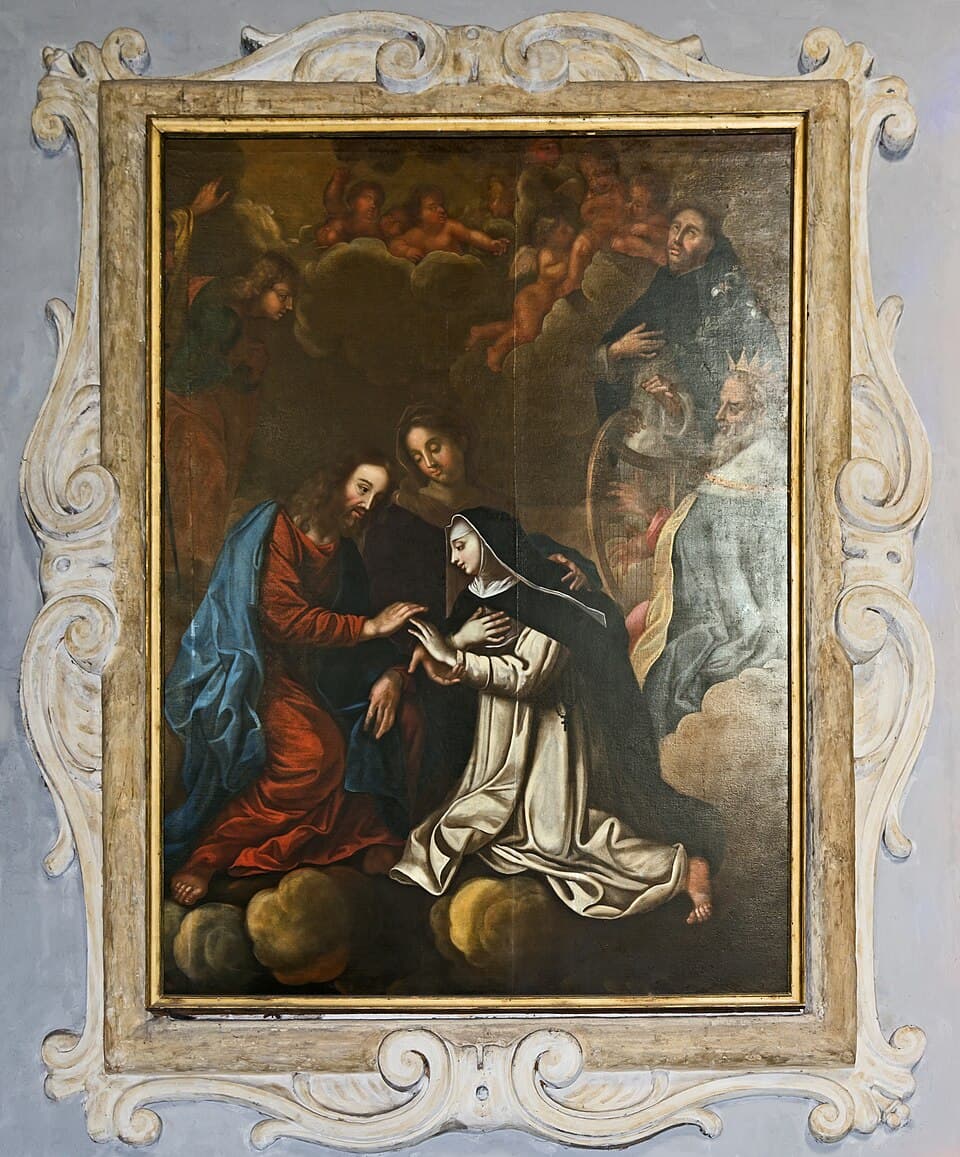
Two twelve-year-old students, on a school trip, push open the door of a small cell in Siena. A woman in a white habit and black mantle greets them with a broad smile. She seems touched that children have come, from so far away, to listen to her tell her life story.
—How old were you when you decided never to marry?
You know, my child, it all began very early. I was barely seven when I had my first vision, on the way to the Dominican church. That day, I promised in my heart to give myself to God alone. My parents, though, wanted to marry me off, like all the girls of Siena. Imagine: you grow up near your father's dye shop, in the Fontebranda district, and you decide to say no to all that. It didn't go down well at home! But I held firm. And in 1363, I joined the Mantellate, women who serve God without being shut up in a convent.
I said no to marriage to say yes to something greater.
—What did you do in the streets all day?
Many things, and not the prettiest! You see, I could have stayed quietly praying. But being a Mantellate means living in the world, not behind walls. So in the afternoon, I went to the hospital Santa Maria della Scala to care for the sick. I touched the lepers, those poor people everyone fled from. I also accompanied prisoners to their death. Imagine a street with no engine noise, just horses, mud, and suffering people. My white habit and black mantle made me recognizable from afar. The rich ladies of the city found me very strange!
Serving God, for me, meant touching those no one wanted to touch.
—Is it true that you received wounds, like Jesus on the cross?
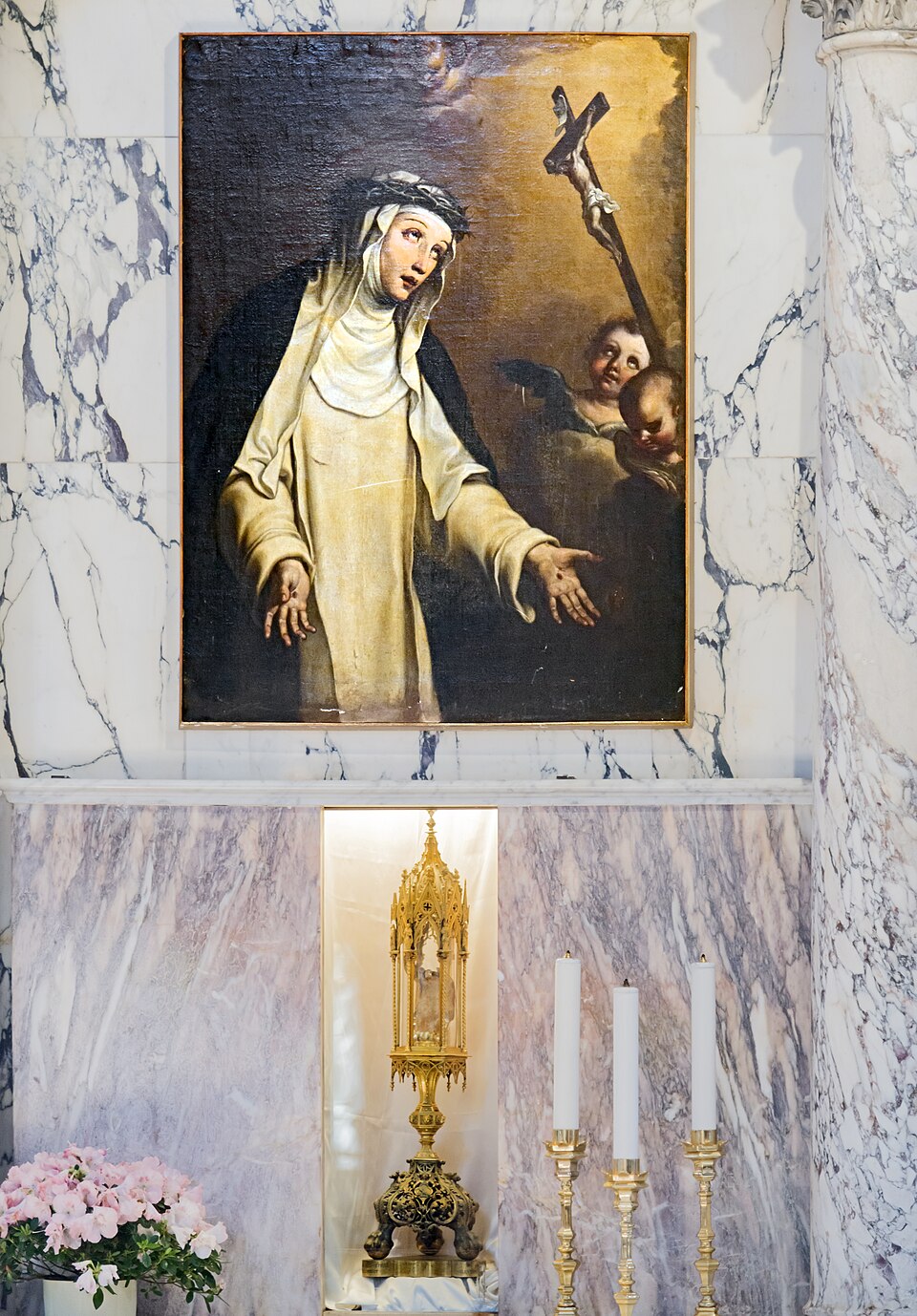
That is told, yes. It was in 1375, in the church of Santa Cristina, in Pisa. I was in ecstasy before a crucifix — you know, those moments when my senses suspended and I felt very close to God. And there, I felt in my hands, my feet, and my side the pain of the five wounds of Christ. They call that the stigmata. But listen carefully: I begged for them to remain invisible. I was too afraid of being admired for it, as if I were a marvel. The pain, though, remained. It stayed with me without anyone being able to see it on my body.
I kept the pain, but I asked to hide the marks.
—How did you write all your letters if you didn't know how to write?
Ah, that's a good question, and a bit mysterious! For a long time, I couldn't hold a pen. So I spoke, and faithful friends wrote in my place. I called them my famiglia, my family of the heart: secretaries who noted everything, pen and parchment in hand. I dictated hundreds of letters that way. Imagine: my words went out to kings, popes, simple poor people, without my hand having traced anything! Later, they say I learned to read almost all by myself, all at once. My close ones saw it as a gift from Heaven. I, for my part, mostly said thank you.
I had no pen, but I had a voice that carried far.
—What was it like when you dictated your great book in ecstasy?
It was overwhelming, my child. My great book, I called it The Dialogue of Divine Providence, in 1378. It takes the form of a conversation between the soul and God. And I dictated it during my ecstasies, those states where I no longer felt anything of the world around me. My secretaries wrote without stopping, a little frightened, a little amazed. Imagine a silent room, a few candles, and a woman speaking with closed eyes for hours. The words came like a river. I did not seek them; I felt they were given to me. That book remained after me, and that still amazes me.
The words came like a river: I did not seek them, I received them.
—Why did you dare to write to the Pope to scold him?
Because someone had to! In my time, the popes no longer lived in Rome: they had moved to Avignon, in France, for almost seventy years. It was called the “captivity.” Pope Gregory XI hesitated to return, he was afraid. So I wrote to him with all my frankness. I tenderly called him “sweet Father,” but I also shook him up! Imagine: a simple dyer's daughter scolding the head of the entire Church. It was audacious, I know. But I believed a true shepherd must have courage. In one letter, I begged him: “Be courageous, and not cowardly.”
A dyer's daughter can say to a pope: be courageous, not cowardly.
—Were you afraid when you left to meet the Pope in Avignon?
A little, yes, like you get stage fright before something immense. In 1376, I made the long journey to Avignon to speak to Gregory XI face to face. Imagine the road back then: weeks of travel, mountain passes, inns, never going fast. There, I had real audiences with the pope. I told him again what my letters cried out: return to Rome, your place is there. And you know what? In 1377, he finally returned, ending sixty-eight years of absence. I didn't do it alone, of course. But I put my whole heart into it.
—Is it true that you ate almost nothing at all?
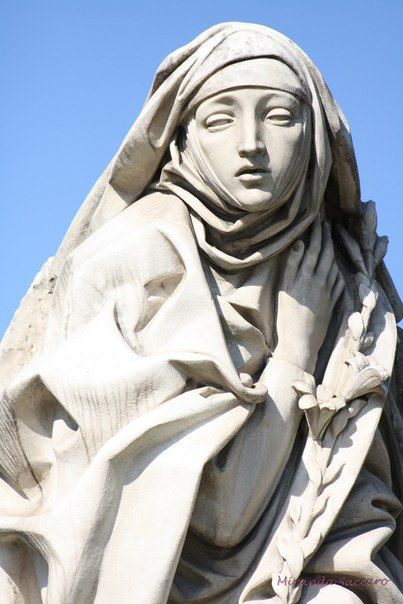
It's true, and I sense you're a bit worried, that's kind. Little by little, I almost stopped eating. Sometimes I took some very bitter herbs, but then I spat them out. I said I lived mainly on the Eucharist, the host I received at Mass each morning. For me, that was my real food. Imagine a life where a simple bowl of water and a piece of bread already seem like a feast. Many people around me didn't understand; some admired me, others worried. I'm not saying it was wise, my child. Don't do as I did: your body also needs to be loved.
Don't do as I did: your body also needs to be loved.
—Did you die because you no longer ate?
My body gave out, it's true. I died in Rome, in 1380, on the day I turned just thirty-three. In my final weeks, I could no longer swallow anything at all. But my heart, it still burned. You see, at that time, the Church was tearing itself apart: two men claimed to be pope at the same time, it was called the Great Schism. That caused me immense sorrow, like seeing a family break apart. So I spent my days praying for it to remain united. I gave my last strength to that dream. I left tired, but not sad: I had loved to the end.
I left tired, but I had loved to the end.
—If we could see you today, what would remain of you?
What remains are above all my words, my child. I left neither castle, nor army, nor money. Just letters — hundreds — written in the everyday language, the one spoken in Tuscany, not only the Latin of scholars. And my Dialogue. Imagine: a girl who couldn't hold a pen, and whose words still travel centuries later. Long after my death, the Church even gave me a beautiful title, Doctor of the Church, reserved for great masters of the faith. If you want to remember one thing from me: you don't need to be powerful to change things. It takes courage and a little love.
You don't need to be powerful to change things: courage and a little love are enough.
This imaginary interview was generated by artificial intelligence from sources documented in Catherine of Siena's profile. It dramatises what the figure might have said based on what we know about them, but does not constitute attested historical testimony. For primary sources and factual documentation, refer to the full profile.