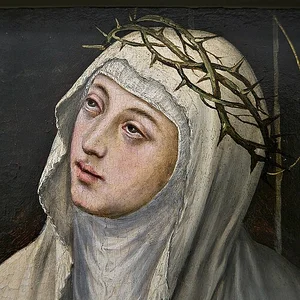

An Italian mystic and theologian of the 14th century, Catherine of Siena played a major political role by convincing Pope Gregory XI to leave Avignon and return to Rome. A Doctor of the Church, she left behind a remarkable body of spiritual and epistolary work.
Catherine of Siena(1347 — 1380)
Catherine of Siena
8 min read
Frequently asked questions
Famous Quotes
« Be who you were meant to be, and you will set the whole world on fire.»
« If you are what you should be, you will set the whole world ablaze.»
Key Facts
- Born in 1347 in Siena, the twenty-fourth child of a family of dyers
- A Dominican tertiary from adolescence, she devoted her life to prayer and caring for the sick
- In 1376, she convinced Pope Gregory XI to leave Avignon and bring the papacy back to Rome
- Author of The Dialogue of Divine Providence and nearly 380 letters addressed to popes, kings, and clergy
- Proclaimed a Doctor of the Church by Paul VI in 1970, one of the first women to receive this title
Works & Achievements
Catherine's spiritual masterpiece, dictated in ecstasy to her secretaries, taking the form of a dialogue between the soul and God. Translated into Latin as early as the 15th century, it is considered one of the great mystical texts of the Middle Ages.
A collection of 382 letters addressed to popes, kings, condottieri, clergy, and ordinary believers, written in vernacular Tuscan. Remarkable for their candor and eloquence, these letters offer a unique window into the politics and spirituality of the 14th century.
A collection of 26 prayers uttered by Catherine during her ecstasies and transcribed by her secretaries. They reveal the depth of her inner life and her theology centered on the blood of Christ.
Anecdotes
Catherine of Siena learned to read on her own — miraculously, according to her contemporaries — as an adult. She dictated all her correspondence and writings to secretaries before she herself acquired the ability to write, which those close to her considered a divine gift.
At the age of seven, Catherine reportedly had her first vision of Christ in glory above the Dominican church in Siena. This mystical experience shaped her entire life: she immediately made a vow of virginity, despite her parents' wishes to see her married.
In 1375, Catherine received the stigmata of Christ during an ecstasy in Pisa. She prayed that they remain invisible during her lifetime to avoid vanity, and it is said that the pain remained without the marks being visible to others.
To persuade Pope Gregory XI to leave Avignon, Catherine wrote him letters of striking frankness, calling him 'the sweet Christ on earth' while rebuking him for his timidity. This boldness from a simple craftswoman addressing the supreme pontiff was remarkable for the era.
Catherine died in Rome at only 33, worn out by prolonged fasting and austerities. In her final weeks, she could no longer swallow any food and spent her days in prayer for the unity of the Church — at the very moment when the Great Schism was tearing Christendom apart.
Primary Sources
Open the eye of your understanding, and look into me, and you will see the dignity and beauty of my reasoning creature. But more than this, look at the ineffable love I have had for her.
I beg you, I beg you, sweet Father, in the name of Christ crucified, not to be afraid; but come, come and fight the enemies of God. Be courageous, and not a coward.
I have found such great consolation and fragrance of virtues in you that my soul has rejoiced in God; and I give thanks to His divine Majesty who has granted you such grace.
She would go entire days without taking any bodily nourishment, sustained, she said, by the Eucharistic communion alone, which several eyewitnesses attested to under oath.
Key Places
Catherine's birthplace, where she grew up in the Fontebranda neighborhood, near her father's dyeing workshop. Here she had her first mystical experiences and began her apostolate among the poor and the sick.
The Dominican church where Catherine was affiliated with the Mantellate and experienced numerous ecstasies. Her head is preserved there as a relic, a site of pilgrimage since the 14th century.
Seat of the papacy since 1309, the city Catherine traveled to in 1376 to persuade Gregory XI to return to Rome. Her stay in Avignon, marked by multiple papal audiences, proved decisive for the history of the Church.
The city where Catherine settled in 1378 to support Pope Urban VI during the Great Schism. She died there on April 29, 1380; her relics are preserved at the Basilica of Santa Maria sopra Minerva.
It was in the church of Santa Cristina in Pisa that, in 1375, during an ecstasy, Catherine received the invisible stigmata of Christ. The city was an important stop in her apostolate throughout Tuscany.
Typical Objects

The garment of the Dominican Third Order that Catherine wore symbolized her consecration to God while remaining in the world. This modest attire set her apart from cloistered nuns and allowed her to move freely within Sienese society.

Catherine dictated hundreds of letters to her secretaries, forming a unique epistolary corpus. These writing instruments represent her considerable influence, wielded solely through the power of her words and writings.
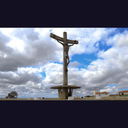
The central object of her mystical life, the crucifix was the focus of her ecstasies and her inner dialogues with Christ. It was before a crucifix in Pisa that she received the stigmata in 1375.
📷 CC BY-SA 2.0 · Wikimedia Commons ↗
Catherine practiced extreme fasting and gradually reduced her food intake to almost nothing. These rudimentary foods illustrate her radical asceticism and the debates of her era surrounding mystical fasting.

Catherine claimed to subsist solely on the Eucharist in her final years. Daily communion was at the heart of her spirituality and theological doctrine.

Catherine's extensive pontifical and political correspondence was authenticated with a seal. This object symbolizes her role as a political mediator between princes, popes, and Italian city-states.
School Curriculum
Vocabulary & Tags
Key Vocabulary
Tags
Daily Life
Morning
Catherine rose before dawn for hours of prayer and meditation, often remaining in a state of ecstasy until sunrise. She then attended Mass and received Communion, the central moment of her spiritual day. Her secretaries gathered early to begin transcribing her dictated letters.
Afternoon
Afternoons were devoted to works of charity: visiting the sick at the hospital of Santa Maria della Scala, caring for lepers, and tending to prisoners condemned to death. She also received visitors — clergy and laypeople alike — who came seeking counsel or spiritual support.
Evening
In the evenings, Catherine resumed dictating her letters or the Dialogue, surrounded by her circle of disciples — the famiglia. She practiced severe bodily penances and slept very little, sometimes only two hours a night on a wooden board.
Food
Catherine maintained a near-permanent fast and, according to her contemporaries, consumed almost no solid food in the final years of her life. She would occasionally chew a few bitter herbs before spitting them out, sustaining herself spiritually, she said, on the Eucharist alone. This extreme dietary asceticism was a source of both wonder and bewilderment among those who knew her.
Clothing
Catherine wore the habit of the Dominican Third Order: a white wool tunic covered by a black mantle, symbolizing penance and purity. Beneath her clothing, she wore an iron cilice to mortify her body. Her plain dress stood in sharp contrast to the rich garments worn by the noblewomen of her social circle in Siena.
Housing
Catherine lived in her family home, the Benincasa house in the Fontebranda district of Siena, in a small cell she had arranged for herself. She refused to enter an enclosed convent, choosing instead to remain in the world and serve the poor. In Rome, during her final months, she stayed in a house near the basilica of Santa Maria sopra Minerva, together with her disciples.
Historical Timeline
Period Vocabulary
Visual Style
Un style inspiré de la peinture siennoise du XIVe siècle : fonds or byzantins, drapés bleu outremer et rouge carmin, visages allongés et sereins caractéristiques de l'école de Duccio, lumière de chandelle dans des intérieurs romans.
Sound Ambience
L'univers sonore de Catherine mêle le chant liturgique dominicain, le tintement des cloches de Sienne et le murmure des prières en latin dans des chapelles de pierre, entrecoupés des bruits d'une cité médiévale vivante.
Liens externes & ressources
Références
Œuvres
Le Dialogue de la Divine Providence
1378
Lettres (Epistolario)
1370–1380
Oraisons (Prayers)
1376–1380