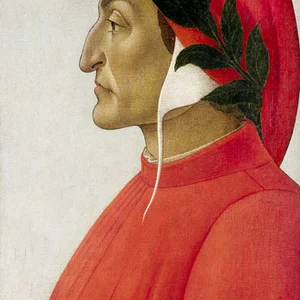

Florentine poet of the 13th–14th century, author of *The Divine Comedy*, a masterpiece of medieval literature. Exiled from Florence for political reasons, he laid the foundations of the Italian literary language.
Dante Alighieri(1265 — 1321)
Dante Alighieri
République florentine
8 min read
Frequently asked questions
Famous Quotes
« Nel mezzo del cammin di nostra vita mi ritrovai per una selva oscura.»
« L'amor che move il sole e l'altre stelle.»
« Lasciate ogne speranza, voi ch'intrate.»
Key Facts
- Born in 1265 in Florence into a minor noble family
- Participated in Florentine political life as a prior in 1300
- Permanently exiled from Florence in 1302 on pain of death
- Wrote *The Divine Comedy* between 1307 and 1321
- Died in Ravenna in 1321; Florence claimed his remains without success
Works & Achievements
An autobiographical collection of sonnets and prose devoted to Dante's love for Beatrice; his first major work, revealing the style of the *Dolce Stil Novo*.
An unfinished encyclopedic treatise written in exile, in which Dante comments on his own *canzoni* and reflects on philosophy, nobility, and knowledge in the vernacular tongue.
A Latin treatise on the Italian vernacular, arguing for the use of the *volgare* as a worthy literary language; a foundational text in Italian linguistic thought.
A political treatise defending the separation of empire and papacy, each sovereign in its own sphere; a work that earned Dante a posthumous condemnation by the Pope.
First canticle: a journey through the nine circles of Hell guided by Virgil, a moral map of human vices across 34 cantos.
Second canticle: the ascent of Mount Purgatory where souls are purified across 33 cantos, widely considered the most human and poetic part of the triptych.
Third canticle: guided by Beatrice through the celestial spheres to a vision of God, the mystical and theological summit of the work across 33 cantos.
Anecdotes
At the age of nine, in 1274, Dante catches his first glimpse of Beatrice Portinari at a Florentine celebration. This mystical love at first sight transforms his entire life: he sees her again nine years later, in 1283, and devotes a great part of his work to her. Beatrice dies at only twenty-four in 1290, and Dante immortalizes her in The Divine Comedy by entrusting her with the role of guide to Paradise.
In 1289, long before he was recognized as a poet, Dante fought on horseback at the Battle of Campaldino, in Tuscany, alongside the Florentine Guelphs against the Ghibellines of Arezzo. This firsthand experience of war and death in combat left a deep mark on his worldview and fed the violent imagery of Hell in his masterpiece.
In January 1302, while he was in Rome on a diplomatic mission to Pope Boniface VIII, Dante learned that he had been condemned in absentia in Florence: permanent exile, confiscation of his assets, and a death threat should he ever set foot in his city again. He would never see Florence again, and wandered from court to court for nineteen years, until his death.
While living in exile in Verona under the protection of the lord Cangrande della Scala, Dante reportedly received a mocking remark at court: a jester claimed to be better appreciated than him because he knew how to please the powerful. Dante is said to have replied coolly that fools always resemble one another — proof of the indomitable pride he maintained despite his misery.
Legend has it that the final cantos of Paradiso were found by his sons after Dante's death, hidden in a corner of his room in Ravenna. He is said to have completed the last canticle just a few weeks before dying in September 1321, as if the poet had wished to keep the key to his celestial vision until the very end.
Primary Sources
At that moment the spirit of life, which dwells in the most secret chamber of the heart, began to tremble so violently that even the faintest pulses of my body felt it; and trembling, it spoke these words: Ecce deus fortior me, qui veniens dominabitur mihi.
Midway upon the journey of our life, I found myself within a dark wood, for the straight way was lost.
It must therefore be understood that there are two ends to which Providence has directed humanity: the happiness of this life, which consists in the exercise of our own virtue, and the happiness of eternal life, which consists in the enjoyment of the divine vision.
The meaning of this work is not simple but manifold: the first meaning is that which derives from the letter, the second is that which derives from the things signified by the letter. The first is called literal, the second allegorical or moral or anagogical.
Dante was of medium height, with an elongated face, an aquiline nose, and eyes rather large than small; his complexion was dark, his hair and beard thick and black, and his expression was always melancholy and pensive.
Key Places
Dante's birthplace, the cradle of his love for Beatrice and his political commitments, yet also the city that exiled him: Dante condemns it harshly in *The Divine Comedy*, depicting it as corrupt and ungrateful.
The last city to shelter Dante, where he completed *Paradiso* and died in September 1321; his tomb still stands there, as Florence's centuries-long attempts to reclaim his remains came to nothing.
The court of Cangrande della Scala, which welcomed Dante during his exile; it was in Verona that he found lasting protection and dedicated *Paradiso* to his patron.
The subterranean kingdom imagined by Dante: nine concentric circles where the souls of the damned endure punishments that mirror their sins, presided over by Lucifer at the center of the Earth.
Site of the 1289 battle where Dante fought as a cavalryman alongside the Florentine Guelphs; this firsthand experience of warfare fed the violent imagery of the *Inferno*.
Typical Objects

Dante's daily working tools during his exile, with which he composed his verses from court to court, often under precarious conditions.

Symbol of the poetic glory Dante dreamed of receiving in Florence; he died without ever being crowned in his city, but posterity made him the poet par excellence.

The foundational text Dante knew by heart, which inspired the structure of his journey through the underworld; Virgil becomes his literary guide through the *Inferno* and the *Purgatorio*.

The distinctive costume associated with Dante by iconographic tradition: a dark robe and red hood, visible in portraits by Botticelli, Raphael, and medieval illuminated manuscripts.

The official document of 1302 that sentenced Dante to exile and death should he ever set foot in Florence again; the archival record most tragically bound to his fate.

Dante was an avid reader of ancient philosophers: Aristotelian metaphysics and ethics, rediscovered through Arabic translations, profoundly shape the structure of *The Divine Comedy*.

The medieval instrument for measuring celestial bodies that Dante evokes in his work; the Ptolemaic cosmology of planetary spheres organizes the entire structure of *Paradise*.
School Curriculum
Vocabulary & Tags
Key Vocabulary
Tags
Daily Life
Morning
Dante rises at dawn and attends morning Mass in the chapel of the court that shelters him in exile. He begins his day by reading philosophical texts (Aristotle, Boethius, Thomas Aquinas) or revising his verses by candlelight in winter.
Afternoon
He devotes the afternoon to composing and dictating his verses, sometimes receiving clerks or students eager to debate philosophy and theology. He takes part in court meals and observes the customs of his hosts with a critical eye often tinged with melancholy.
Evening
Dante rereads and corrects his drafts by candlelight, exchanging letters with men of letters and Italian political figures. The night is also a time for meditation on Beatrice, on exile, and on Florence — reflections that feed directly into the verses of *The Divine Comedy*.
Food
The table of a medieval noble host includes wheat bread, legumes (peas, broad beans), roasted or stewed meats, fish on the lean days prescribed by the Church, and wine diluted with water. Dante himself writes in the *Paradiso* that he ate “the bread of others,” evoking the bitterness of exile.
Clothing
Dante wears the long dark robe of Florentine scholars and lawyers, topped by the distinctive red chaperon that all iconographic tradition has preserved for him. In winter he wraps himself in a woolen cloak; his attire, sober and solemn, reflects his dignity as a fallen statesman.
Housing
In exile, Dante lodges in the palaces of his successive protectors: the Malaspina in Lunigiana, the Scaligeri in Verona, the da Polenta in Ravenna. Without a fixed home, dependent on the generosity of Ghibelline lords, he experiences this condition of perpetual guest as a profound humiliation and a painful uprooting.
Historical Timeline
Period Vocabulary
Visual Style
Esthétique des manuscrits enluminés gothiques italiens du XIVe siècle : tons cramoisis et or byzantin, représentations alternant paysages infernaux ténébreux et sphères célestes lumineuses.
Sound Ambience
Ambiance sonore de la Florence médiévale du XIIIe siècle : cloches d'église, marché animé, plume sur parchemin, chant grégorien et débats politiques feutrés dans les palais communaux.
Liens externes & ressources
Références
Œuvres
La Vita Nuova
c. 1293
Il Convivio (Le Banquet)
c. 1304-1307
De Vulgari Eloquentia
c. 1303-1305
De Monarchia
c. 1312
La Divine Comédie — Enfer (Inferno)
c. 1307-1314
La Divine Comédie — Purgatoire (Purgatorio)
c. 1314-1318
La Divine Comédie — Paradis (Paradiso)
c. 1318-1321