Imaginary interview with Catherine of Siena
by Charactorium · Catherine of Siena (1347 — 1380) · Literature · Politics · Philosophy · 6 min read
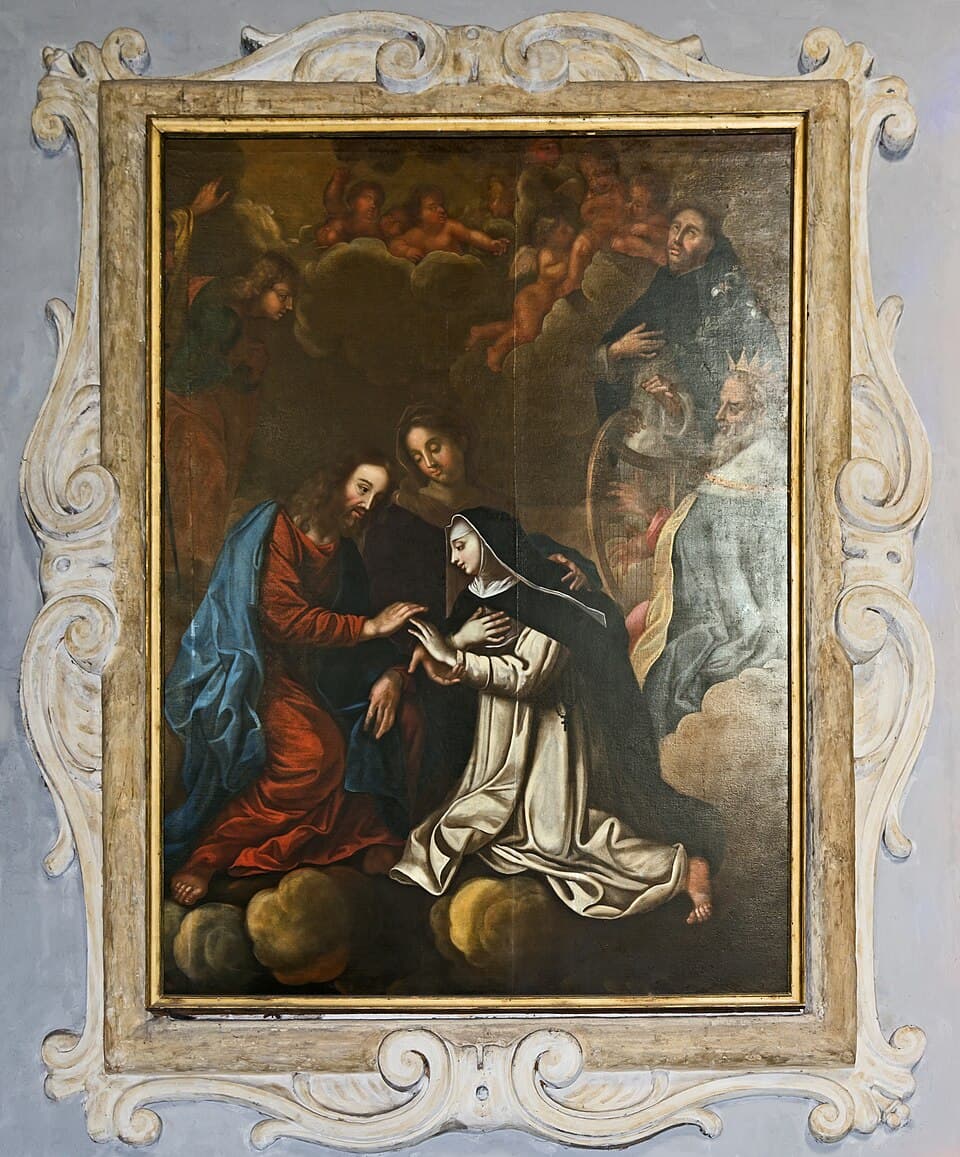
Rome, a winter evening in 1379. In a narrow room near Santa Maria sopra Minerva, a gaunt woman in a white habit and black mantle receives her visitor, her voice low but her gaze burning. Around her are pages covered in a handwriting not her own, and the silence of a divided Church.
—When did you first feel that God was calling you?
I was six or seven. I was coming back with my brother up the road to the church of the Preachers in Siena, when I saw, above the rooftops, Christ in glory smiling and blessing me. I stood there, mouth open, no longer hearing the noise of the streets of Fontebranda where my father dyed his wools. From that day on, my heart wanted no other spouse. My mother dreamed of marrying me off, of dressing me up like other girls; I cut my hair and vowed to keep myself entirely for Him. They thought me mad, or stubborn. I only knew that a door had opened and no one could close it again.
From that day on, my heart wanted no other spouse.
—They say that in Pisa, in 1375, you received the wounds of Christ in your flesh. How did that happen?
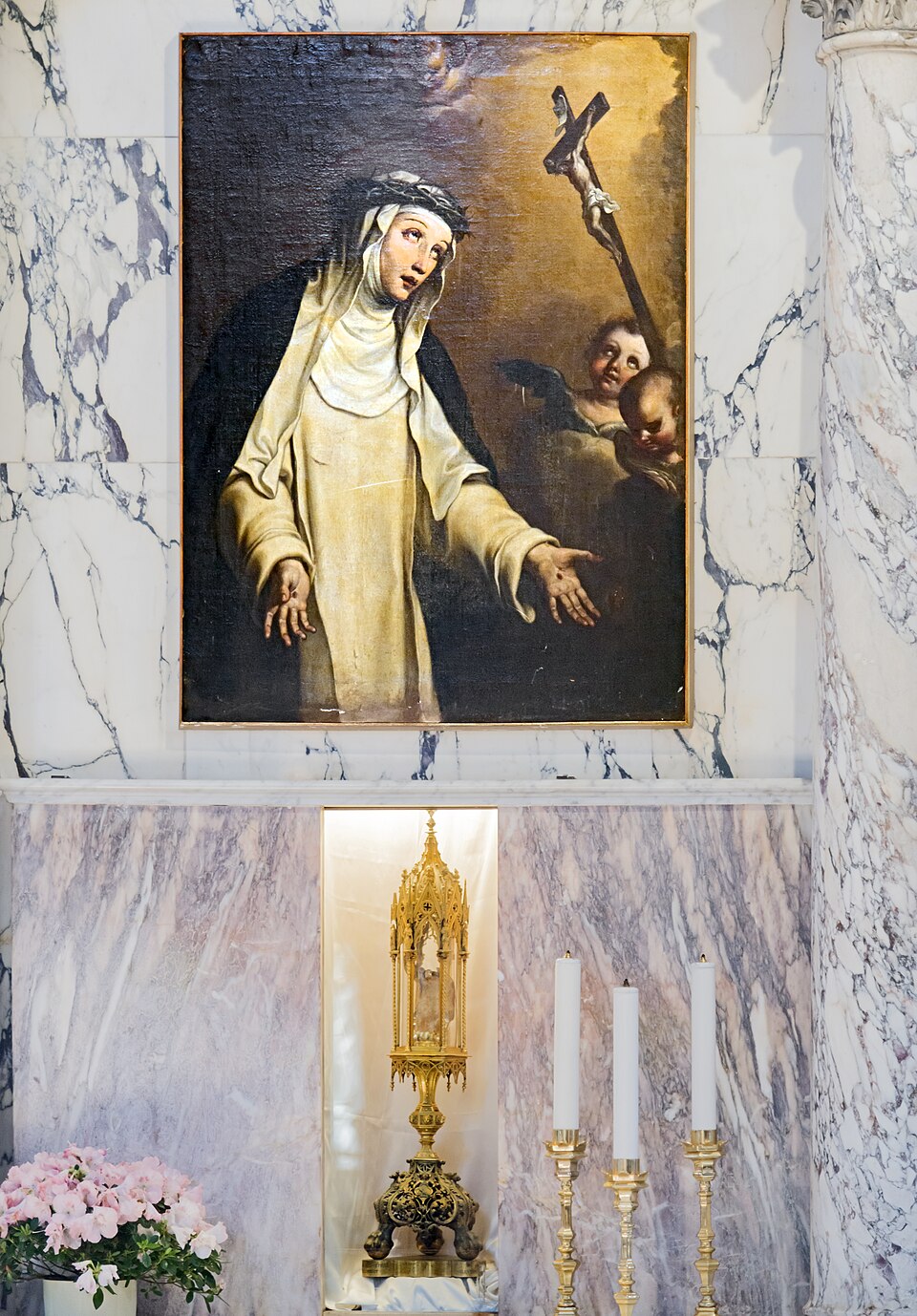
It was in the little church of Santa Cristina in Pisa, before a crucifix. While I prayed, it seemed that five rays of light descended toward my hands, my feet, my side, piercing me like fiery nails. The pain was so sharp I thought I would die. But I begged the Lord that these marks not appear outwardly: I did not want to be pointed at, made a curiosity. Vanity is a more subtle poison than suffering. So the stigmata remained invisible to all, burning within me alone. What God gives in secret should not be flaunted in the public square.
Vanity is a more subtle poison than suffering.
—You left behind an immense body of work, yet they say you could not write. How do you explain that?
It is the pure truth, and I still smile at it. For a long time I could neither trace a letter nor decipher a psalter; I prayed from memory, like the poor. Then one day grace opened my eyes and I could read, without a teacher — I took it as a gift from Heaven. But writing with my own hand came much later. So I dictated. I had around me my spiritual sons, my famiglia, pen in hand, and I spoke, I spoke until they could no longer keep up. Thus were born my hundreds of letters, sealed with wax to travel to kings and popes. A dyer's daughter needed no school: it was enough to have a heart overflowing and faithful hands to gather the word.
—Tell us about this book you call the Dialogue. Under what conditions did you compose it?
I did not compose it like a scholar assembles his reasons in his study. In the year 1378, rapt out of my senses for several days, I spoke and my secretaries wrote. It was a conversation between my soul and the Eternal: I questioned, and He answered. The title I give it, The Dialogue of Divine Providence, says it well. The Lord said to me: “Open the eyes of your intellect and gaze into me, and you will see the dignity and beauty of my rational creature.” I only lent my mouth. When I came back to myself, they read me the pages and I wept, for it was not the voice of an illiterate woman that I recognized, but that of my sweet Truth.
I only lent my mouth.
—In 1376, you left for Avignon. What were you seeking from the pope?
I went to find the shepherd and bring him back to his sheepfold. For nearly seventy years, the popes had lived in Avignon, under the shadow of the kings of France, far from Peter's tomb — that long captivity dishonored the Church. I, a little Sienese woman without a name, crossed the mountains to stand before Gregory XI. They looked at me as an insolent creature: what was this woman of the Mantellate, in her black mantle, doing talking about government to cardinals? But I feared neither the purple nor the palaces. I told him that Rome awaited him, that Christendom bled from his absence, and that a father could not abandon his children for fear of men. I pleaded until I was exhausted, for I knew that God this time would use a contemptible mouth to be heard by the great.
—How did you dare write to the sovereign pontiff with such frankness?
Because love has no fear. I called him my sweet Father, my “sweet Christ on earth,” and in the same breath I urged him to stop being timid and cowardly. In one of my letters I wrote: “I beg you, I beg you, sweet Father, in the name of Christ crucified, do not be afraid; but come, come fight the enemies of God. Be courageous, and not cowardly.” They marvel that a craftswoman speaks thus to a pope! But I did not speak in my own name: I served Truth, and Truth knows no courtly reverences. A son who loves his father tells him his faults to his face rather than flattering him over the precipice. Flattery damns princes; frankness can save them.
Flattery damns princes; frankness can save them.
—What did the return of the papacy to Rome in 1377 mean to you?
A joy I dare not compare to any other in my life. When Gregory XI finally took the road back to Rome in 1377, ending those decades on the banks of the Rhône, it seemed to me that the body of the Church had found its head again. It was not my victory — I claim none — but that of prayer and obstinate truth. Yet I knew the hardest part remained: bringing the pope back was not enough if hearts remained divided, if the cities of Italy went on tearing each other apart and hiring their condottieri to ravage the land. I thanked God on my knees, then took up my pen again, for a work begun is never left halfway.
—People marvel at the way you eat. What do you actually eat?
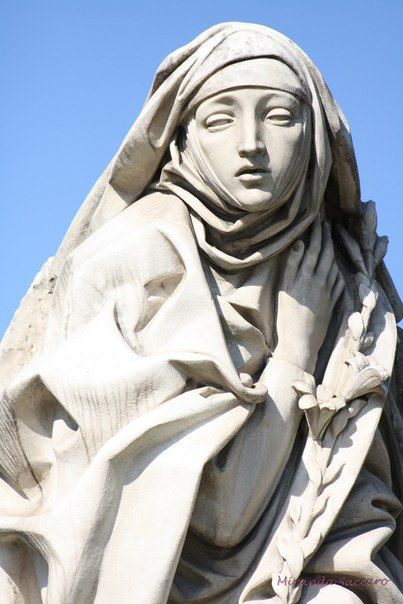
Almost nothing, and I know it scandalizes as much as it amazes. For years my body has no longer tolerated human food: a few bitter herbs that I chew and spit out, a little water — that is my ordinary fare. My true table is the consecrated host — the Eucharist keeps me standing when bread turns my stomach. Many think me ill or proud; my own confessors ordered me to eat, and I obeyed, but my stomach refuses. I do not recommend this path to anyone: it is not a feat I perform, but a chain I bear. The Lord has weaned me from every other taste so that I hunger only for Him. Under my mantle, an iron hairshirt reminds me each day that this body is but a poor servant.
—Doesn't this asceticism consume you?
It consumes me, yes, and I know it. I sleep two hours on a plank, I keep vigil before dawn for prayer and meditation, in the afternoon I go to the sick at Santa Maria della Scala, to the lepers, to the condemned whom I want to accompany to the scaffold. In the evening I still dictate my letters, late, when my sons are dropping with sleep. This body wears out like a garment too often worn, and I feel it will not serve me much longer. But I do not weep over that. A candle is made to burn; if it keeps its wax, it lights no one. I would rather be entirely consumed in the service of the Bride of Christ than keep myself intact and useless.
A candle is made to burn; if it keeps its wax, it lights no one.
—Since 1378, two men have claimed to be pope at the same time. How do you experience this division?
Like an open wound in my own side. After Gregory's death, they elected Urban VI in Rome, then cardinals recanted and set up another pretended pope against him — that is the Great Schism, Christ's robe torn in two before all peoples. I stand with all my strength on the side of Urban, the Roman pope, and I write to him, urging him to be firm but gentle, for his harshness drives away those he should bring back. I beg kings and cardinals to return to unity. That Christendom, already tried by the plague that carried off half my city, should thus divide itself, hurts me more than all my fasts.
—You are spending your last months in Rome, exhausted. What do you still hope for?
I lodge near Santa Maria sopra Minerva, with my famiglia, and I have little left to give but my life itself. Each morning I drag myself to St. Peter's to bear, as I say, the weight of the barque of the Church on my poor shoulders; I come back broken. I am not yet thirty-four and I feel I will not see the end of this division. So I offer what remains: my blood, my vigils, this body that swallows nothing more. If God wills that my death serve to sew back together what is torn, let Him take it. I have never asked anything for myself; I ask only that the Bride of Christ become one again, and that Rome keep its shepherd.
This imaginary interview was generated by artificial intelligence from sources documented in Catherine of Siena's profile. It dramatises what the figure might have said based on what we know about them, but does not constitute attested historical testimony. For primary sources and factual documentation, refer to the full profile.