Imaginary interview with Chika Kuroda
by Charactorium · Chika Kuroda (1884 — 1968) · Sciences · 5 min read
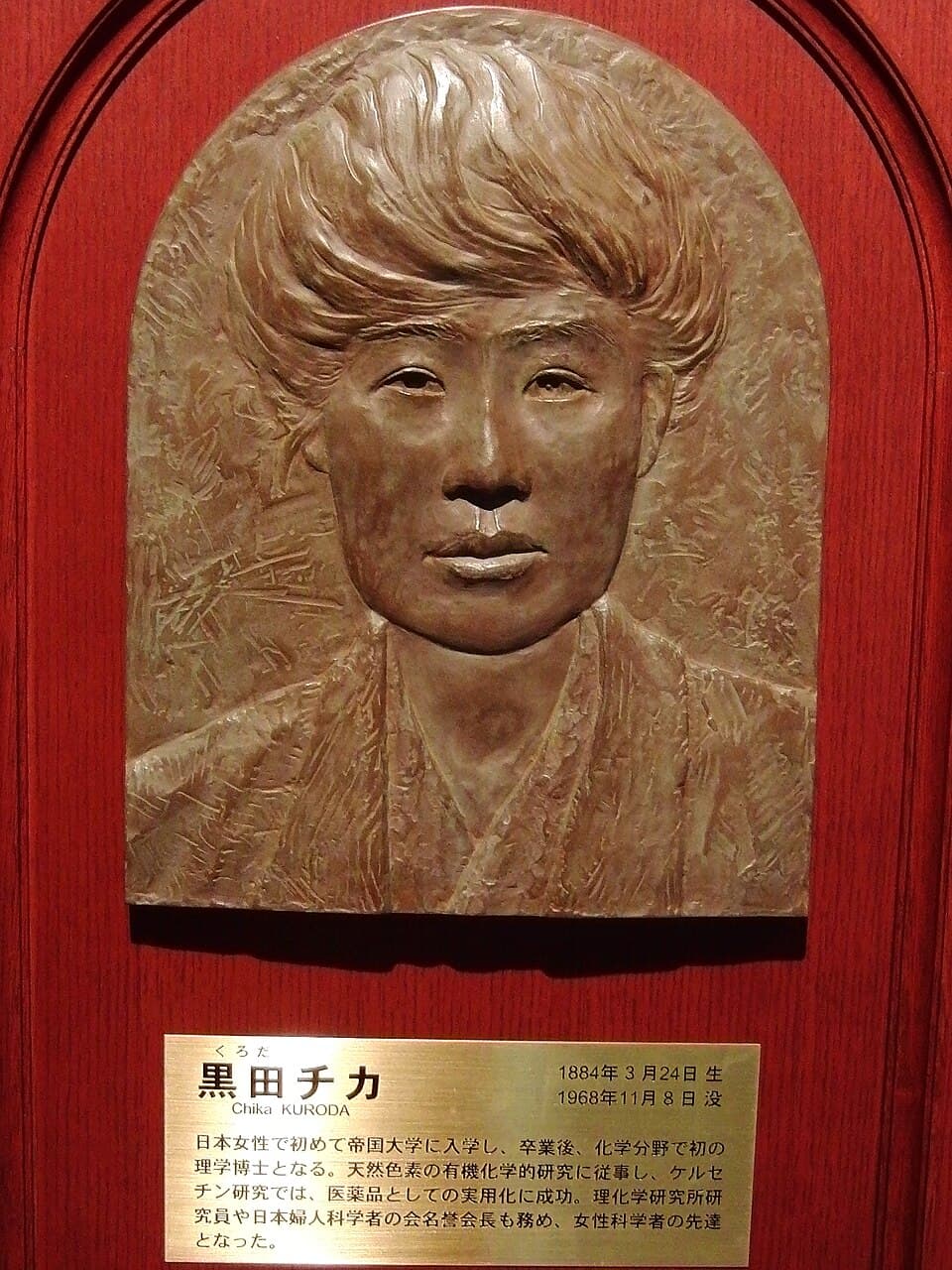
Tokyo, a winter afternoon in the late 1950s. In a study with sliding paper doors and tatami mats, Chika Kuroda receives a visitor calmly, a steaming cup of green tea beside a notebook covered in formulas. Her voice is measured, precise as a weighing; she speaks of colors as others speak of numbers.
—What happened to you in 1913, in Sendai?
In 1913, Tohoku Imperial University did what no national university had dared: it enrolled three women. I was one of them, along with Kono Yasui and Raku Makita. I remember the strangeness of the moment: we were not expected, yet the doors were opening. The Ministry of Education, however, was quite astonished; a letter arrived demanding an explanation of how women had been admitted to a hall reserved for men. Studying chemistry was not, in their eyes, a proper occupation for us. I did not argue: I simply took my place in the laboratory, with my solutions and my balance, and worked. That, I believe, was the only worthwhile answer.
We were not expected, yet the doors were opening.
—How did you experience the way these first female students were regarded?
Before Sendai, my path went through the Tokyo Women's Higher Normal School, from which I graduated in 1907. It was one of the few avenues open to women who wanted to learn: we were trained to teach, rarely to research. So entering university was almost an irregularity. Some professors watched us as one watches a reagent whose reaction is unknown. I never felt like a glorious exception; rather, I was a proof to be administered, patiently, experiment after experiment. A woman could hold a pipette, read a spectrum, defend a demonstration. That had to become ordinary. Each year that other young girls crossed those doors in turn seemed more precious to me than any personal distinction.
I never felt like a glorious exception; rather, I was a proof to be administered.
—Why did you devote so many years to the purple pigment of murasaki?
The purple of murasaki, that gromwell from which shikonin is extracted, always seemed to me a double-layered enigma. In ancient Japan, this dye was so difficult to obtain that it was reserved for the highest-ranking nobles; wearing that purple was to display one's lineage. So I wondered: what molecule lies behind such prestige? I spent entire seasons extracting the root, purifying, decomposing its light with the spectroscope, each color band revealing a clue to its structure. In 1929, I finally established the structure of this compound. There was something moving about it: reducing an emperor's color to an arrangement of atoms, and discovering that prestige changed nothing about the rigor of bonds.
Reducing an emperor's color to an arrangement of atoms.
—What did that doctorate obtained in 1929 represent?
My thesis was on the structure of shikonin, and it earned me the title of rigaku hakushi, Doctor of Science. I was, they say, one of the very first Japanese women to obtain it, and the first in chemistry. Two years earlier, in 1927, Kono Yasui had paved the way in botany; I was walking in a still-fresh track. I do not hide a certain pride, but it is sober, commensurate with the work: a doctorate is not a crown; it is the honest account of many nights spent restarting a purification that was failing. What touched me more was thinking that this title, once deemed unthinkable for a woman, would one day become an ordinary thing.
A doctorate is not a crown; it is the honest account of many nights.
—Do you remember your departure for Oxford in 1921?
Crossing half the globe to join Oxford University was, for a woman of my generation, a considerable leap. I stayed there from 1921 to 1923, with William Henry Perkin Jr., one of the masters of organic chemistry. There I learned to conduct dye analysis with a new rigor, in laboratories where my persistence was hardly surprising. There was an irony in this encounter that amused me: my host's father had, as a young man, invented mauveine, the very first artificial dye, wrested from coal tar. And I, at his table, persisted in understanding the pigments that plants have always made. The son of the synthetic welcomed the daughter of the natural.
The son of the synthetic welcomed the daughter of the natural.

—What did you bring back from your stay in England?
I returned with methods, and above all a way of thinking. At Oxford, I saw how important it was not to assert a structure without establishing it through several converging paths. In my luggage, I had notebooks filled with English protocols, which I later patiently replayed in my own laboratories. I must say that in 1923, when I returned, the great Kantō earthquake had devastated Tokyo; resuming work in a wounded city required tenacity. But the rigor learned there never left me: weigh again, check again, compare the obtained spectrum with the expected one. In those years, I often wore a mix of kimono and Western clothes, as if my wardrobe summed up this back-and-forth between two worlds.
—How did you come to study the red of safflower?
After purple, red presented itself almost naturally. Carthamine, extracted from the flowers of benibana, safflower, had dyed fabrics for centuries and was used to make our grandmothers' lipstick. I loved the idea that a cosmetic, a coquettish object, concealed a complex molecule waiting to be deciphered. In the 1920s and 1930s, I isolated this pigment, purified its extracts, sought to grasp its composition. There was a thread I kept following: showing that traditional Japanese arts — dyeing, makeup, the fabric of a kimono — rested on a real chemistry, as rigorous as that of European laboratories. Ancient beauty and modern science were not two separate realms.
A cosmetic, a coquettish object, concealed a complex molecule.
—What did you find so fascinating about these everyday dyes?
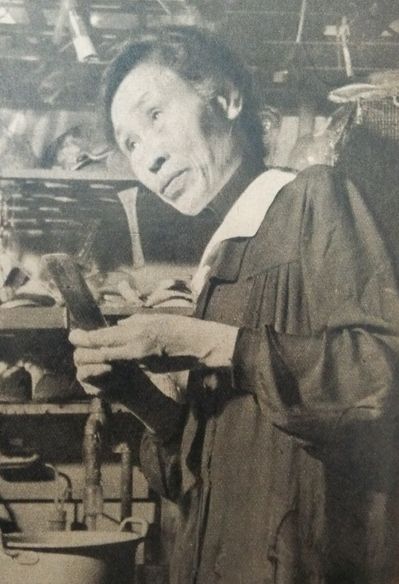
What held me was that these colors were not abstractions: they lived in clothes, on faces, in ordinary gestures. The red of benibana adorned lips, the purple of murasaki signaled rank. By analyzing them, I felt I was translating a long craft memory into the language of organic chemistry. On my bench stood the same tools: glassware, precision balance, spectroscope. But the raw material came from fields and gardens, not a factory. I saw a lesson in humility: nature had preceded our syntheses by several millennia, and we were just beginning to spell out what it knew how to do with its eyes closed.
Nature had preceded our syntheses by several millennia.
—What kept you in teaching for so long?
For decades, from 1920 to the 1950s, I taught chemistry at the Tokyo Women's Higher Normal School, the very school where I had once been a student. My afternoons were split between analyses and lessons: I would decompose a plant extract in the morning, and in the afternoon I would show my students how to hold a flask, read a result, distrust their own conclusions. Training these young women mattered to me as much as my research. Each one who left capable of conducting an experiment alone widened the path opened in 1913. I have always thought that a laboratory without transmission is just a closed room; the colors I studied had to keep speaking in hands other than mine.
A laboratory without transmission is just a closed room.
—How did you feel seeing that school become a university in 1949?
In 1949, the institution where I had taught so long became Ochanomizu University. Seeing this girls' school attain the rank of a true university moved me deeply. Consider the journey: born under the Meiji era, in 1884, in Saga Prefecture, I had grown up in a country where higher sciences were closed to women. And now, at the end of my life, they could study there by full right, in an institution bearing that name. I do not flatter myself that I was the cause; I only contributed, one student after another, one color after another. If I am read in a century, I would like people to remember less my titles than this slow opening of doors.
I would like people to remember less my titles than this slow opening of doors.
This imaginary interview was generated by artificial intelligence from sources documented in Chika Kuroda's profile. It dramatises what the figure might have said based on what we know about them, but does not constitute attested historical testimony. For primary sources and factual documentation, refer to the full profile.