Imaginary interview with Ching Shih
by Charactorium · Ching Shih (1775 — 1844) · Military · Economics · 6 min read

Canton, a winter monsoon night, around 1840. In the back room of a gambling house where dice clatter against lacquered wood, a woman in her sixties has tea served without taking her eyes off the door — an old habit of one who long slept with a hand on her sword. She was known under the red flag; tonight, she is willing to talk about the sea.
—Do you remember the moment when the pirate Zheng Yi entered your life?
I was working on a floating house in Canton, moored in the clutter of junks and sampans that clog the Pearl River. I had been sold there as a child; I expected nothing from anyone. When Zheng Yi came to ask for my hand in 1801, other girls would have lowered their eyes and thanked heaven. I set a condition: an equal share in the command of his fleet, written down, not whispered in the ear. He laughed, then he signed. That day I didn't gain a husband, I gained a contract. Many thought they were marrying a wretch from the flower boats; they had before them a partner. The difference lies entirely in a piece of paper — and in having dared to demand it.
That day I didn't gain a husband, I gained a contract.
—How did a woman born into such poverty impose her authority on men of war?
People imagine that the sea is taken by the sword. It is first taken by accounts. From my entry into Zheng Yi's household, I wanted to know where every tael of silver went, which junk paid what, which captain kept for himself. In 1804, when six great fleets united under our banner, it was not fear that bound them, but well-kept interest: each knew his share and knew that I knew it better than he. Men follow those who feed them and do not steal from them. I started at the bottom of the ladder, from a flower-boat berth; I learned early that one survives only by counting correctly. That arithmetic, none of my captains had in their blood like I did.
People imagine that the sea is taken by the sword. It is first taken by accounts.
—After Zheng Yi's death in 1807, how did you alone hold together an army of eighty thousand men?
Through law, and through the blade. I had a code proclaimed on every junk, from the largest ship to the smallest sampan. Looting a village that paid us tribute: the head fell. Touching a captive woman without her consent: death, without exception, and I maintain that this earned me the loyalty of many. Deserting: they cut off your ear, and sent you back to live marked among your own. Eighty thousand men do not love each other; they obey or they sink. The dàdāo hanging from my belt was not an ornament. But one is mistaken if one believes I ruled by blood alone: blood is shown once, so as not to have to shed it again. The rest is the certainty that the rule applies to all.
Blood is shown once, so as not to have to shed it again.
—Was that severity toward those who mistreated captives calculation or conviction?
The two are not opposed. I had been one of those who are bought and brushed aside with a backhand; I knew what a woman was worth in the eyes of a crew let loose without law. So I wrote in my Code that any non-consensual violence would be punished by death. My lieutenants grumbled — they saw it as a whim. It was a framework. A village that knows my men will touch neither its daughters nor its granaries does not defend itself: it pays and sleeps soundly. Discipline on this point brought me more open ports than ten battles. Convictions and interests end up taking the same course when you look far ahead; it is the beginner who thinks them enemies.
Convictions and interests end up taking the same course when you look far ahead.
—In 1809, three navies allied against you. What remains of those months in your memory?
The noise, above all. The cast iron cannons of the junks answering the Portuguese broadsides, the smoke clinging to the water for days on end. The court in Peking had allied with the Portuguese ships of Macao and those of the English East India Company — three flags to vanquish a single one, the red. They thought to surprise us near Lantau Island. They found a fleet that knew every cove, every shift of monsoon. We blockaded the port of Macao until the Portuguese preferred to talk rather than fight. Repelling one navy is done; repelling three allied ones, no admiral of the Empire dared boast of that. I had no emperor behind me — only the wind and men who knew that fleeing cost an ear.
Three flags to vanquish a single one, the red.
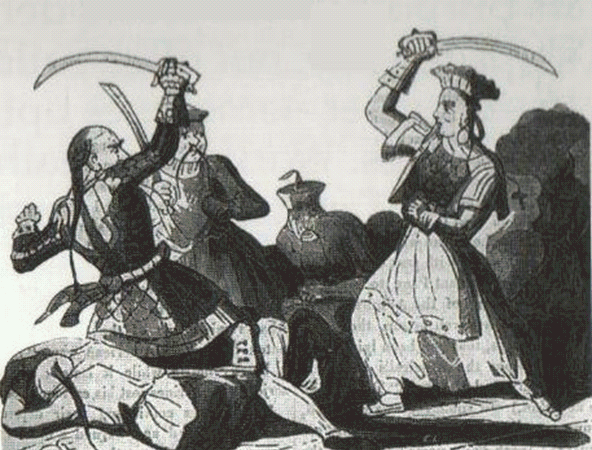
—What, in your way of waging war, always eluded your adversaries?
They sailed against us; we sailed with the sea. All my strategy rested on the winds: the southwest monsoon in summer to go up, the northeast in winter to come down. An imperial admiral waited for orders from Peking; I waited for the wind, which never betrays. And I had the Pearl River Delta, that labyrinth of waterways and islands where a heavy fleet gets lost and breaks up. Our war junks, more than eighteen hundred, slipped through it as if at home and emerged where they were not expected. You do not defeat a force that chooses both the place and the time. Powers count their ships; we read the sky.
They sailed against us; we sailed with the sea.
—In 1810, you could have fought on. Why did you choose to surrender?
Because you leave a gambling table when you have the biggest pile in front of you, not when you have lost everything. In 1810, my fleet still held the seas; it is precisely for that reason that I could dictate my terms. I went myself to find the Governor-General of Guangdong — not an emissary, me. I demanded amnesty for all my men, the freedom to keep part of my fortune and a few ships. Everything was granted. I learned later that his report to the Throne advised yielding: my forces exceeded what the Empire could raise at that moment. An outlaw who imposes peace on the Middle Kingdom — that had hardly been seen. Surrendering at the right time is still victory.
You leave a gambling table when you have the biggest pile in front of you.
—Many saw it as a capitulation. What would you call that agreement, you who negotiated it?
A treaty, not a surrender. The word matters. Surrendering arms is offering your wrists for irons; I laid down terms and obtained an imperial amnesty, what is called dàshè — the great pardon that the emperor usually reserves for those who have begged him. I was not begging: I offered peace on the southern coasts in exchange for my own. My men, instead of the block, had the choice to join the imperial navy or return home. I kept gold and a reduced fleet. I was not hanged, I was bought — that is the truth of that paper. And an adversary who buys you has admitted, without saying it, that he could not defeat you.
I was not hanged, I was bought.
—It has been said that your confederation resembled a real state. Is that an exaggeration?
Look at what a state does: it levies taxes, it protects, it punishes. We did all three. Every coastal village, every merchant, even some corrupt mandarins, paid its tribute — what our ancients called cháogòng, the homage paid to one stronger than oneself. In return, their junks passed without fear through my waters, from Guangdong to Fujian. Everything was recorded in the account books, the zhàngbù, tax by tax, route by route. I did not plunder at random: plunder starves the plunderer, because a drained country no longer pays. I preferred a gentle, regular bleeding. Call it banditry if you will; the officials in Peking did exactly the same — with an imperial seal for all difference.
Plunder starves the plunderer, because a drained country no longer pays.
—After the sea, you ran a gambling house and salt trade in Canton. Was commerce so much like piracy?
Far more than is admitted. In Canton, in this house where we speak, one bets taels on a throw of dice; at sea, I bet lives on a monsoon shift. Same taste for calculated risk, same need to know how to count before the other counts. The salt I smuggled outside the imperial gabelle followed the same secret routes as my former cargoes — and paid the same discreet tolls. I didn't change professions when I left the red flag; I only put away the sword and brought out the ledgers. Smuggling is piracy that has set foot on land and learned good manners. I grew old on that, which no admiral who pursued me would have bet on.
Smuggling is piracy that has set foot on land and learned good manners.


This imaginary interview was generated by artificial intelligence from sources documented in Ching Shih's profile. It dramatises what the figure might have said based on what we know about them, but does not constitute attested historical testimony. For primary sources and factual documentation, refer to the full profile.