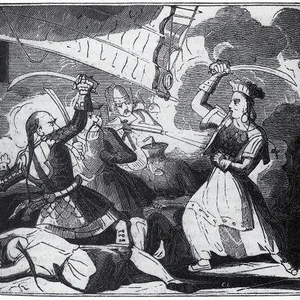

Ching Shih (c. 1775–1844) was a Chinese pirate who became one of the most formidable military commanders in history. She led the Red Flag Fleet, a confederation of over 1,800 ships and 80,000 men, imposing her rule across the South China Sea.
Frequently asked questions
Key Facts
- c. 1775: presumed birth in Guangdong province, China
- 1801: marries Zheng Yi, a pirate chief, and begins co-commanding the fleet
- 1807: upon her husband's death, takes sole command of the Red Flag Fleet
- 1809: her fleet reaches its peak with approximately 1,800 ships and 80,000 men
- 1810: negotiates a favorable surrender with the Qing government, retaining her wealth and authority
Works & Achievements
A set of military and civil regulations that Ching Shih imposed on her fleet after taking command. The code prescribed the death penalty for desertion, unauthorized plunder, and violence against women, maintaining the cohesion of an army of 80,000 men.
A military-commercial organization that Ching Shih brought to its peak: over 1,800 vessels, 80,000 fighters, and a taxation system covering maritime routes from Guangdong to Fujian. It stands as one of the largest non-state naval forces in history.
An unprecedented agreement through which Ching Shih secured amnesty for her men, permission to keep a reduced fleet, and a portion of her fortune. She dictated her terms to the Governor-General of Guangdong, demonstrating her mastery of diplomacy as much as warfare.
After her retirement, Ching Shih ran a well-known gambling establishment and a salt smuggling network in the Canton region. This second career reflects her talent for economic organization well beyond simple maritime banditry.
Anecdotes
Ching Shih, born into poverty around 1775, was working as a prostitute in a floating brothel in Canton when she met the powerful pirate Zheng Yi in 1801. Rather than passively accepting his marriage proposal, she negotiated the terms: she demanded an equal share of command over the fleet. This unprecedented arrangement made her, from the very start, a full partner rather than merely a wife.
After her husband's accidental death in 1807, Ching Shih took sole command of the Red Flag Fleet. She enforced a strict code of laws: any sailor who looted an allied village was beheaded, any non-consensual act against a captured woman was punishable by death, and desertion meant having one's ears cut off. These harsh rules maintained discipline across an army of 80,000 men.
In 1809, a coalition of the Chinese imperial navy, the Portuguese fleet, and ships from the British East India Company attempted to destroy Ching Shih. She defeated each of these forces in turn: several Portuguese vessels were captured, and the Qing admiral was forced to retreat. It is one of the rare moments in history when a pirate fleet repelled the combined navies of three powers.
In 1810, Ching Shih personally negotiated her surrender with the Governor-General of Guangdong. She secured exceptional terms: her men were granted amnesty, she kept a large portion of her fortune, and she was permitted to retain a reduced fleet. She then retired to Canton, where she ran a gambling house and a salt-smuggling network until her death in 1844, at nearly 70 years old.
Ching Shih was one of the first women in world history to lead a criminal and military organization of this scale. Her system of taxing coastal villages, merchants, and even corrupt officials was so effective that it resembled a true parallel state. She collected passage fees from merchant junks, funding her army without resorting to the kind of systematic plundering that would have turned the local population against her.
Primary Sources
The wife of Zheng Yi commanded the red flag vessels with uncontested authority. She reorganized the fleet and imposed strict regulations, punishing any disobedience with death. Merchants and fishermen paid her tribute across all waters from Macao to Fujian.
Their numbers amounted to from forty to fifty thousand men, their vessels of all sizes to upwards of eight hundred. They were perfectly well organised, each division having its own flag and commander, all under the supreme authority of the chief's widow.
The pirate known as the Widow of Zheng has accepted the terms of submission proposed. Her forces exceed in number those we could mobilize in the immediate term. It is recommended that a general amnesty be granted in order to restore peace along the southern coasts.
She managed with great address the affairs of her extensive and turbulent family, consisting of near two thousand vessels of different sizes and above twenty thousand fighting men. No vessel could move safely without having paid the stipulated contribution.
Key Places
The main port city of southern China and the only port officially open to foreign trade under the Qing dynasty. This is where Ching Shih was born, worked in a floating brothel, met Zheng Yi, and retired after her surrender to run a gambling house.
A vast expanse of water between Vietnam, the Philippines, Borneo, and China, which served as the main theater of operations for the Red Flag Fleet. Between 1807 and 1810, Ching Shih exercised near-total control over the trade routes that crossed it.
A network of river branches, islands, and canals surrounding Canton that Ching Shih used as a logistical base and refuge for her fleet. This labyrinthine geography made naval pursuit extremely difficult for imperial forces.
A Portuguese colonial enclave at the mouth of the Pearl River, which Ching Shih targeted in 1809 after the Portuguese joined the coalition against her. Her ships blockaded the port of Macau, forcing the Portuguese authorities to negotiate.
A large island off the Cantonese coast that served as an anchorage for pirate junks. It was in these waters that the naval coalition of 1809 launched its decisive offensive against Ching Shih's fleet — without success.
Liens externes & ressources
Références
Œuvres
Code de lois de la Confédération des pavillons rouges
vers 1807-1810
Confédération des pavillons rouges (紅旗幫, Hóngqí Bāng)
1801-1810
Traité de reddition négocié avec le gouvernement Qing
1810
Maison de jeu et commerce de sel à Canton
1810-1844