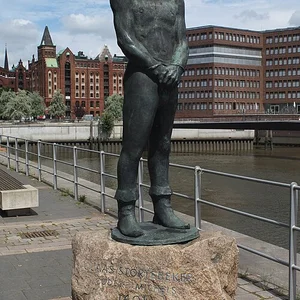

Klaus Störtebeker was a German pirate of the late 14th century, a leading figure of the Vitalienbrüder (Victual Brothers). He raided the North Sea and the Baltic Sea, preying on ships of the Hanseatic League, before being captured and beheaded in Hamburg around 1401.
Klaus Störtebeker(1360 — 1401)
Klaus Störtebeker
Saint-Empire romain germanique
7 min read
Frequently asked questions
Key Facts
- Member of the Vitalienbrüder, privateers who resupplied the besieged city of Stockholm (around 1392–1394)
- Became a figure of the Likedeeler, the “equal sharers,” after 1394
- Plundered the merchant ships of the Hanseatic League in the North Sea and the Baltic
- Captured by a Hamburg fleet during a naval battle off Heligoland in 1401
- Beheaded with his companions on the Grasbrook in Hamburg around October 1401
Works & Achievements
Leading the Victual Brothers on behalf of Mecklenburg, he took part in running the Danish blockade to supply the city, a feat that established the group's reputation.
The principle of sharing the loot equally among all members of the crew became the hallmark of the “equal sharers”, a famous and rare way of operating for the time.
Plundering of Hanseatic ships and trading posts (including Bergen in 1393) that made him one of the most feared pirates in Northern Europe.
After being driven out of Gotland, settling in Frisia (Marienhafe and its surroundings) allowed him to keep threatening the Hanseatic League's sea routes.
Having become a German folk hero, he inspires statues, novels, and the great open-air festival of Ralswiek on the island of Rügen, a symbol of the rebel who stands up to the powerful.
Anecdotes
Klaus Störtebeker was one of the leaders of the Vitalienbrüder, the "Victual Brothers." This nickname comes from the early days of their story: around 1389-1392, dukes of Mecklenburg hired them as privateers to supply provisions (victualia in Latin) to the city of Stockholm, which was besieged by Queen Margaret I of Denmark.
After the war, many of these privateers became true pirates and called themselves Likedeeler, which means "those who share in equal parts" in Low German. According to tradition, they divided the loot fairly among all the crew members, a very unusual arrangement for the time.
The name "Störtebeker" is explained by a popular legend: in Low German
stürz den Becher" means "empty the tankard." It is said that he could down a huge cup of beer holding several litres in a single gulp. This etymology is delightful, but it remains a tradition rather than a proven fact.
In 1401, a fleet armed by the city of Hamburg captured Störtebeker near the island of Heligoland in the North Sea. He was taken to Hamburg and beheaded, along with many of his companions, on the Grasbrook, the city's execution site. Legend claims that, after his head was struck off, his body kept walking past several of his men to save them — but this is a fanciful tale added later.
A skull pierced by a nail, long presented as his, was displayed at the Museum of Hamburg History. It was stolen in 2010 and recovered shortly afterward. Analyses show that it does date from the right period, though no one can confirm that it truly belongs to Störtebeker.
Primary Sources
The chronicle reports that certain sailors were given the name “Victual Brothers” because they brought provisions to besieged Stockholm, and then began to plunder ships and merchants indiscriminately in the Baltic Sea.
The Lübeck chronicler describes the Victual Brothers as a scourge of the North Sea and the Baltic, and mentions the capture and execution in Hamburg of their pirate leaders in the early 15th century.
The city's accounting records note the expenses incurred to arm a fleet and fight the North Sea pirates in 1400-1401, attesting to the military effort that led to the capture of the Victual Brothers.
The minutes of the Hanseatic assemblies repeatedly mention the threat posed by the Vitalienbrüder to trade and the need for joint action by the cities to protect shipping.
Key Places
A Baltic port town often cited as the presumed birthplace of Störtebeker, in the region from which many of the Victual Brothers came. His birth, however, remains uncertain.
A strategic Baltic island and port that served as a base for the Victual Brothers' raids, until they were driven out by the Teutonic Order in 1398.
A Swedish city besieged by Margaret I of Denmark; it was by resupplying it that the privateers earned their name, the “Victual Brothers.”
A North Sea coastal town where Störtebeker is said to have found refuge after 1398; a tower of the church there still bears his name in local tradition.
A rocky North Sea island near which the fleet of Hamburg captured Störtebeker in 1401.
The execution ground of the Hanseatic city, on the bank of the Elbe, where Störtebeker and his companions were beheaded in 1401.
Typical Objects

A round-hulled ship with a single square sail, sturdy, used both for trade and for war in the Hanseatic League. Pirates and merchants used the same type of vessel in the North Sea and the Baltic.

A short, solid bladed weapon, easy to wield in the close-quarters scramble of a ship's deck. It was the weapon of choice during assaults on Hanseatic vessels.

A powerful and accurate ranged weapon, widely used in medieval naval combat to shoot at the enemy crew before boarding.

An iron hook thrown on a rope to catch the enemy ship and pull it closer. It allowed pirates to storm aboard the captured vessel.

A wooden cask holding salted herring, meat, biscuit or beer — the famous supplies that gave the “Victual Brothers” their name. It was also a coveted cargo during raids.

A large metal or wooden drinking vessel, tied to the legend behind the nickname “Störtebeker,” the one who “empties the tankard” in a single gulp.
School Curriculum
Vocabulary & Tags
Key Vocabulary
Daily Life
Morning
Aboard the cog, the day began with changing the watch shifts and scanning the sea. They searched the horizon for a Hanseatic merchant sail, guiding themselves along the coasts and by the sun.
Afternoon
The afternoon was spent maneuvering the ship with the wind, maintaining the rigging, and practicing with weapons. When a target came into view, the boarding began: grappling hooks, crossbows, and cutlasses then sprang into action.
Evening
In the evening, sheltered in a cove or in a friendly port, the loot was shared in equal parts according to the rule of the Likedeelers. Meals stretched on with songs and great gulps of beer.
Food
Their diet relied on salted herring, dried fish, preserved meat, and ship's biscuit, all washed down with beer, which was safer than water. These provisions, carried in barrels, were precisely what had given the group its name.
Clothing
The sailors wore simple, warm clothing: a woolen tunic and hose, a hood, a leather belt, and sturdy boots to withstand the sea spray and the cold of the North Sea.
Housing
They lived mostly on board, in the cramped space of the ship. On land, the pirates took refuge in fortified bases such as Visby or the coastal towers of East Frisia.
Historical Timeline
Period Vocabulary
Liens externes & ressources
Références
Œuvres
Ravitaillement de Stockholm assiégée
vers 1389-1392
Organisation des Likedeeler
années 1390
Campagne de raids en mer du Nord et Baltique
1393-1401
Repaire de la Frise orientale
après 1398
Postérité culturelle de Störtebeker
XXe-XXIe siècle