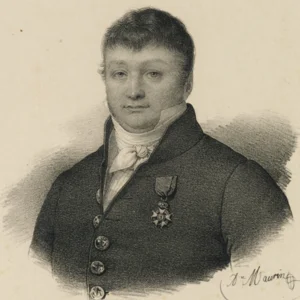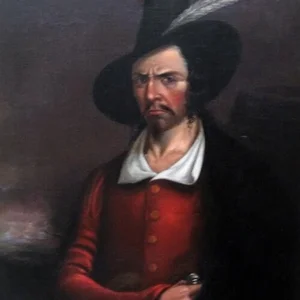

French privateer and smuggler based in the Gulf of Mexico in the early 19th century. As leader of the buccaneer community of Barataria, near New Orleans, he came to the aid of the Americans at the Battle of New Orleans in 1815.
Jean Lafitte(1776 — 1826)
Jean Lafitte
États-Unis
6 min read
Frequently asked questions
Key Facts
- Around 1810, he led the community of smugglers and buccaneers of Barataria, south of New Orleans
- In 1814, he refused the British offer and offered his services to the Americans
- In January 1815, his men helped secure Andrew Jackson's victory at the Battle of New Orleans
- Around 1817, he founded a new buccaneer settlement at Galveston (Campeche), in Texas
- He vanished around 1823, under uncertain circumstances, in the Caribbean Sea
Works & Achievements
Organization of a vast community of privateers and a goods-trafficking operation that secretly supplied the entire New Orleans region.
Rejection of the British offer and the provision of men, cannons, gunpowder, and gunflints to General Jackson.
The Baratarians manned the artillery during a victory that marked the end of the War of 1812 and Lafitte's entry into American legend.
Establishment of a semi-autonomous privateer base on the Texas coast, operating under letters of marque against Spanish ships.
Anecdotes
In September 1814, British officers landed at Barataria and offered Lafitte $30,000 and the rank of captain in the Royal Navy if he would help them seize New Orleans. Rather than accept, he dragged out the negotiations, then handed the British documents over to the American authorities, offering his services in exchange for amnesty for his men.
Just days after the British offer, Commodore Daniel Patterson's American navy launched a surprise attack on the Barataria base, seizing ships and smuggled goods. The irony of history: Lafitte would soon fight alongside the very men who had just ruined him.
During the Battle of New Orleans, on January 8, 1815, the Baratarian gunners manned several cannon batteries with formidable accuracy. General **Andrew Jackson**, who had at first dismissed them as “bandits,” later praised their bravery and secured a pardon for them from President Madison.
Governor Claiborne had put a price of $500 on Lafitte's head. According to a persistent tradition, the smuggler hit back by having posters put up promising $1,500 to anyone who would deliver to him… the governor himself — a delicious anecdote whose authenticity historians still debate.
After the war, Lafitte founded a colony of privateers at Galveston, which he renamed Campeche. It has since been established that he and his brother Pierre were also paid informants for Spain, passing along intelligence under an encrypted code name.
Primary Sources
I am the stray child who longs to return to the fold. I offer to defend Louisiana if my past faults will be forgiven.
In consideration of the services rendered to the defense of New Orleans, I grant a full and complete pardon to those who took up arms for their country.
The men of Barataria, skilled in serving the artillery, contributed mightily to the success of our batteries during the defense of the city.
The Baratarians, once pursued by the law, have conducted themselves as brave men and have earned the gratitude of their adopted country.
Key Places
Hideout of Lafitte's buccaneers, deep in the bayous and lagoons south of New Orleans. A watery maze perfect for concealing ships and goods.
The great port of Louisiana and outlet for Barataria's smuggled goods, defended by Lafitte and Jackson in 1815.
The plain downstream from the city where the Battle of New Orleans was fought on January 8, 1815, with the decisive participation of the Barataria gunners.
Island off the Texas coast where Lafitte founded a new colony of privateers around 1817, abandoned and burned down in 1821 under American pressure.
Area of the western Caribbean where Lafitte is said to have met his death in a naval battle around 1823, according to the most widely accepted sources.
Typical Objects

Official document issued by a state (here Cartagena) authorizing a captain to attack enemy ships. In theory, it distinguished the privateer from the outlaw pirate.

Light, fast two-masted sailing ship, prized by privateers for its maneuverability in the shallow waters of the Gulf of Mexico.

Artillery piece manned by the Baratarian gunners during the Battle of New Orleans. Their skill with the cannon made a strong impression.

Small chip of flint essential for firing flintlock muskets. Lafitte supplied thousands of them to the American army, which was then desperately short of ammunition.

Short, sturdy single-edged blade designed for close combat on a ship's crowded deck.

Flag of the young Republic of Cartagena (present-day Colombia) flown by Lafitte's ships to give a legal framework to their captures against Spain.

Casks and crates of goods (textiles, wines, coffee) sold illegally to evade customs duties, the foundation of the Baratarian fortune.
School Curriculum
Vocabulary & Tags
Key Vocabulary
Tags
Daily Life
Morning
At Barataria, the day began early, in rhythm with the tides. Lafitte inspected the ships at anchor, received captains and sailors, and organized the sorting of the loot brought back from the latest raids.
Afternoon
The afternoon was often spent negotiating: the discreet sale of smuggled goods to merchants from New Orleans, settling the men's shares, and maintaining networks of informants and accomplices.
Evening
In the evening, the buccaneers gathered around lively tables, with games and songs. Lafitte, known for being courteous and well-groomed, also knew how to cultivate relationships in the city's salons when he visited.
Food
Their diet made the most of the gulf: fish, shrimp, oysters, and game from the bayous, supplemented by rice, fruit, and coffee obtained through trade. Wine and rum, often smuggled, accompanied their meals.
Clothing
Unlike the ragged pirate of legend, Lafitte took care with his appearance: a dark frock coat, a linen shirt, boots, and a hat, in the fashion of the notables of the early 19th century, which made it easier for him to enter the city.
Housing
At Barataria, people lived in wooden cabins and warehouses built on the low, marshy islands. In New Orleans, the Lafitte brothers kept pieds-à-terre, including a blacksmith's forge said to serve as a cover for their dealings.
Historical Timeline
Period Vocabulary
Liens externes & ressources
Références
Œuvres
Réseau de contrebande de Barataria
vers 1810-1814
Ralliement à la défense de La Nouvelle-Orléans
1814-1815
Participation à la bataille de La Nouvelle-Orléans
8 janvier 1815