Kids interview Ching Shih
by Charactorium · Ching Shih (1775 — 1844) · Military · Economics · 5 min read

That morning, a school trip visits an old port in southern China. Two twelve-year-old visitors sit down across from a woman with a calm gaze, seated near a red-sailed junk. She was called Ching Shih, the pirate queen.
—Is it true that you set conditions before agreeing to marry?
Yes, my child, it is quite true. I was barely twenty-five, in 1801, and I worked in a floating house in Canton. Picture a large wooden boat moored by the water, where sailors were received. One day, a powerful pirate chief, Zheng Yi, wanted to marry me. Many girls would have said yes with heads bowed. I said: fine, but I want to command the fleet with you, on equal terms. He agreed. You see, from the very first day, I did not become a wife. I became a partner.
I did not become a wife, I became a partner.
—What was it like to be a poor little girl and end up the chief of all that?
Ah, that is a strange life. I was born in poverty around 1775, with nothing. In the morning, I did not always know what I would eat at night. And yet, a few years later, I slept in a silk-lined stern cabin with red paper lanterns hanging from the ceiling. Imagine going from a leaky boat to a ship where everyone obeys you. I will tell you one thing: it was not wealth that changed me. It was understanding that I could command as well as any man. The rest followed.
It was not wealth that changed me, it was understanding that I could command.
—Did you really have rules where people got their heads cut off?
Yes, and I will not lie to you, it was harsh. After my husband's death in 1807, I took sole command of the Red Flag Fleet Confederation: eighty thousand men. Imagine an entire city of armed men, floating on water. Without rules, it is chaos. So I wrote a legal code. Steal from a friendly village: death. Desert: you had your ears cut off. And harm a captured woman: death as well. It may seem terrible to you, I know. But without discipline, my men would have become beasts. Severity, sometimes, protects the weak.
Without discipline, my men would have become beasts.
—Why did you protect female prisoners so much, if you were a pirate?
Because I knew where I came from, my child. I had grown up in a floating house; I knew the fear of defenseless women. In my legal code, written around 1807, harming a captive was punishable by death, without pardon. Many found that strange among pirates. But a leader is not just someone who inspires fear. It is someone who decides what is just in his own world. Imagine a fleet of eighteen hundred ships: if no one sets limits, cruelty overflows everywhere. I set a limit, and I enforced it with the sword.
A leader is not just someone who inspires fear.
—Is it true that three enemy navies attacked at once and you won?
Absolutely true! In 1809, they all allied against me. The navy of the Qing emperor, the Portuguese ships from Macao, and even great vessels from the English. Three powers against a woman pirate! Imagine finding yourself alone in a schoolyard with three gangs charging at you at once. Well, I repelled them, one by one. I even blocked the port of Macao with my junks, until the Portuguese preferred to negotiate. Near Lantau Island, their great attack failed. That day, they understood that the sea here belonged to me.
Three powers against a woman pirate, and I was the one left standing.
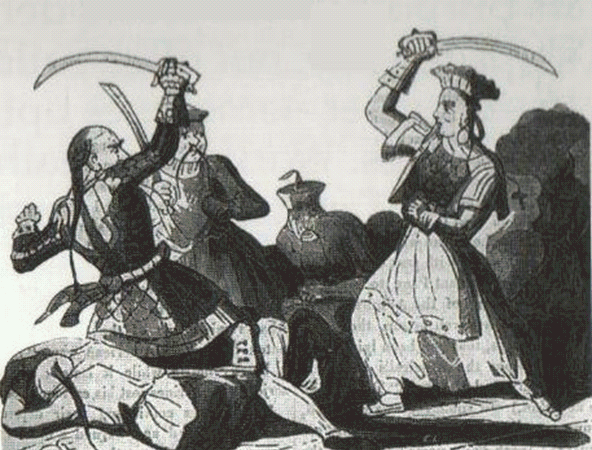
—Were you afraid during battles, or were you calm?
Fear, you always have a little, my child. Whoever tells you otherwise lies. But I will tell you my secret: I prepared everything beforehand. I knew the winds. In the China Sea, there is the monsoon, those great winds that change with the seasons: one blows north in summer, the other south in winter. I chose my attacks according to them. Imagine playing a game where you know the wind direction before your opponent. Then fear becomes very small. It is not courage that wins battles. It is preparation, and a bit of cunning.
It is not courage that wins battles, it is preparation.
—How do you surrender and still get something?
Ah, now that is a chief's question! In 1810, I realized we could not fight forever. So I went to see the governor of Canton, the most powerful man in the region. But I did not go as a supplicant. I went as a negotiator. I said: my men will be pardoned, I keep part of my fortune, and even a few ships. And he agreed! Imagine losing a battle, but managing to decide yourself how you lose it. Surrendering on your knees is losing. Surrendering standing up, dictating your terms—that is still a victory.
Surrendering standing up, dictating your terms, is still a victory.
—Were you afraid of the governor, or was he afraid of you?
Between us? He was a bit afraid of me. You know, in his report to the emperor, he wrote that my forces outnumbered those he could gather immediately. Imagine a powerful official, with his beautiful official seal to sign his orders, forced to admit that a pirate was stronger than him! That is why he advised a general pardon. He was not doing me a favor: he had no choice. I had learned one thing about the powerful. They mostly respect those they cannot crush.
The powerful mostly respect those they cannot crush.
—How did you make money if you weren't always looting?
Very good question, you have a practical mind! Looting burns everything and ends quickly. I did better: I made them pay a tribute. That is an old word: it means a regular sum paid for peace. Villages, merchants, even some corrupt officials paid me to sail safely. I noted everything in my account book, page after page. Imagine a toll on the sea, where every boat must pay to pass. It was run like a real government. A pirate steals once. A well-organized chief gets paid every year.
A pirate steals once; a well-organized chief gets paid every year.
—What did you do with your life after you stopped pirating?
I did not spend my old age twiddling my thumbs, believe me! After 1810, I settled in Canton, and I ran a gambling house and a salt trade. Salt, in my time, was precious; it was smuggled like treasure. I kept the same talent: organize, count, command. Imagine going from the sea to city business without ever ceasing to be the boss. I died old, around 1844, nearly seventy, in my bed. For a poor little girl who became a pirate queen, that is a fine end, don't you think?
For a poor little girl who became a pirate queen, dying old in her bed is a victory.

This imaginary interview was generated by artificial intelligence from sources documented in Ching Shih's profile. It dramatises what the figure might have said based on what we know about them, but does not constitute attested historical testimony. For primary sources and factual documentation, refer to the full profile.