Imaginary interview with Clare of Assisi
by Charactorium · Clare of Assisi (1194 — 1253) · Spirituality · Philosophy · 6 min read
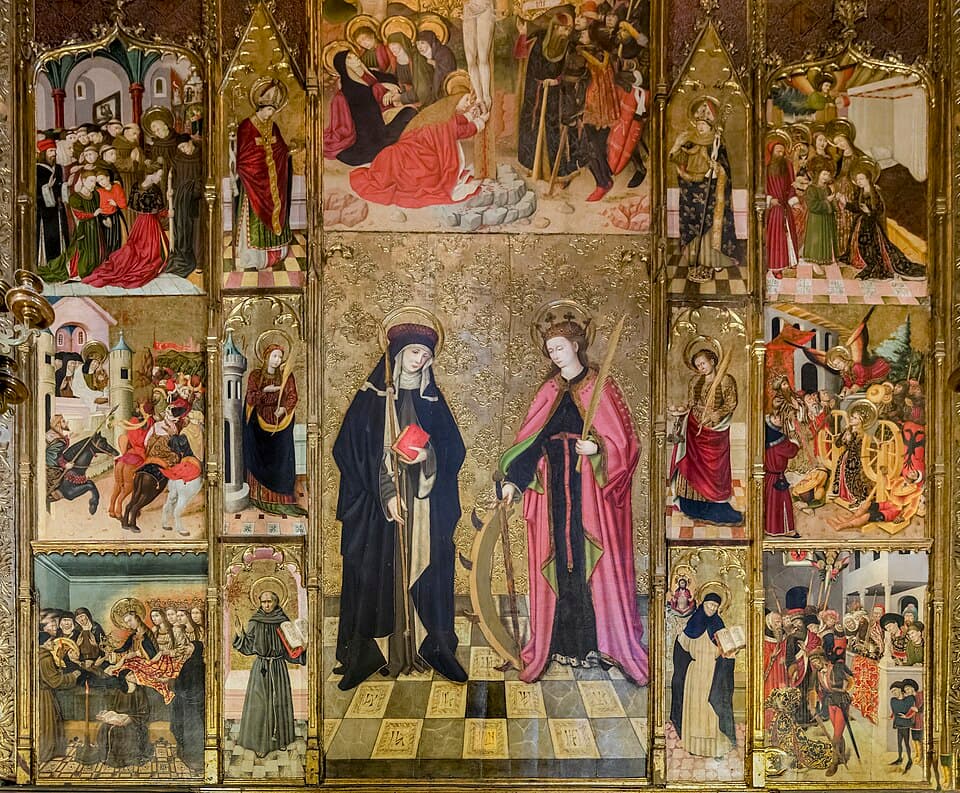
San Damiano, one morning in the year 1252. In the freezing parlor of the convent, a woman with a face hollowed by twenty-eight years of illness receives her visitor, seated on a simple straw mat. Her voice is low but her eye is bright, and behind her, a needle and thread rest on a half-embroidered altar cloth.
—How would you describe the night you left your father's house?
It was the night of March 18-19, 1212, Palm Sunday night. I was eighteen years old, my heart pounding like that of a hunted animal. I forced open a small walled-up door that was never opened — the one reserved for carrying out the dead — and ran through the dark to the Portiuncula. Francis and his brothers were waiting for me, torches in hand. There, before the altar of the Virgin, he took scissors and cut my hair — that hair my family planned to sell to the highest bidder among the lords of Assisi. When my braids fell on the stone floor, I knew that Offreduccio's daughter no longer existed. Only a servant of the poor remained, in a rough wool tunic.
When my braids fell on the stone floor, I knew that Offreduccio's daughter no longer existed.
—Your family did not accept this departure. What happened next?
I was first taken to the monastery of Sant'Angelo in Panzo, with some nuns, to let the family storm calm down. It did not calm down. My uncles came armed, determined to drag me back home to marry me off, like returning merchandise to its owner. I clung to the altar with all my strength, my veil torn off, and showed them my shorn head. Faced with that bare skull, they backed away: you don't marry a consecrated woman. A few days later, my young sister Agnes joined me, and my uncles came back to beat her — but her body, it is said, became so heavy they could not lift her from the ground. Heaven, that day, weighed on our side.
—It is said that even the pope tried to turn you from your vow of poverty. What did you say to him?
Pope Gregory IX came to find me right here, full of paternal concern. He feared that cloistered women, without lands or income, would starve in the first winter. He offered to release me from my vow, like loosening a too-tight rope. I told him I begged him to absolve me of my sins, but that I never wanted to be released from following Christ. Understand: poverty was not a deprivation for me, but a spouse. One does not ask a wife to renounce the one she loves on the pretext that he is destitute. The Son of God was born in a manger and died naked on wood; I wanted to possess nothing that He had not possessed.
Poverty was not a deprivation for me, but a spouse.
—That famous 'privilege of poverty' you obtained — why did you hold it so dear?
The Privilegium paupertatis is an unheard-of thing: a bull by which Rome grants us the right to own nothing, neither individually nor collectively. The whole world demands privileges to have more; I asked for only one, the privilege of having less than nothing. Innocent III granted it to us at our beginnings, and Gregory IX had to renew it. Later, Pope Innocent IV wanted to impose a softened rule on us, with common property for our security. I refused that sweetness like poison. A Poor Clare who hoards is nothing but an ordinary lady behind grates. Our only dowry is open hands and trust that the bread will come — and it always has.
—You are the first woman to have written a religious rule approved by the Church. How did you carry this text?
For forty years, we were made to live under rules thought up by men — Saint Benedict's rule, which was imposed on us like an oversized habit. I wanted our sisters to finally live by the words of one of their own. I wrote, line by line: 'I, Sister Clare, servant of the poor ladies of the monastery of San Damiano in Assisi... promise obedience and reverence to the lord Pope Innocent and his successors.' See how I begin with my name and the word 'servant' — because this rule is not a throne, it is an apron. Cardinal Raynaldus approved it in 1252, and the bull Solet annuere reached me two days before my death. I was able to press the sealed parchment to my lips before I left.
This rule is not a throne, it is an apron.
—What did you hope to convey through your writings to those who would read you?
Besides the rule, I left a Testament, dictated by a weak hand, and letters to Agnes of Bohemia, that princess who abdicated a throne to take the veil in Prague. To her, I wrote that she was the bride of a king greater than all emperors, and I called her to gaze into the mirror of the poor Christ. I wanted my sisters, after me, not to be softened by those who, in the name of prudence, would come to trim our destitution. The Son of God made himself our way, and Francis showed it to us by his word and example. If my poor lines could keep my daughters standing on that path when I was no longer there, I would not have written in vain.
—The attack of the mercenaries in 1240 remains famous. Do you remember that day?
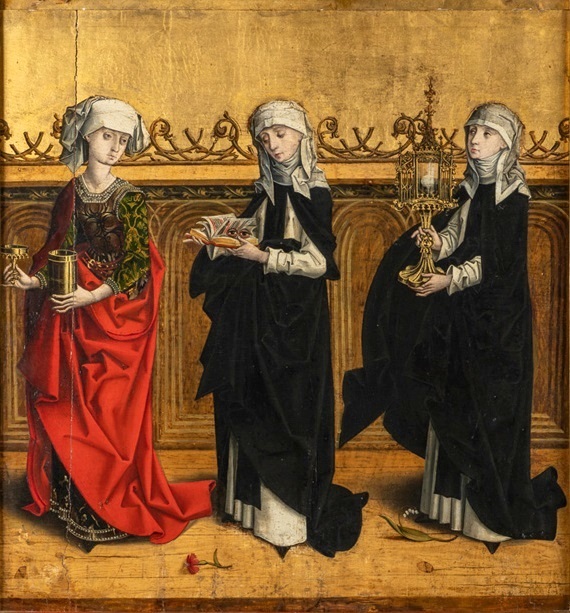
In 1240, the Saracen soldiers in the pay of Emperor Frederick II were ravaging the Spoleto valley. One morning, they were seen scaling the wall of our enclosure at San Damiano, where no man enters. I was so ill I could no longer stand; I asked to be carried to the refectory, and before me the small silver casket where the Blessed Sacrament rested. I prostrated myself and begged the Lord to keep his servants, whom I could not protect with my own hands. A voice within me assured me that He would keep us. The attackers, it is said, were seized with trembling and climbed back down the wall as if fleeing a fire. That is why painters depict me with the raised monstrance — I who never brandished it as a weapon, but held it as a prayer.
I never brandished it as a weapon, but held it as a prayer.
—That monstrance has become your attribute. What does it represent to you?
The world remembers the spectacular image: the sick nun routing an army. But the monstrance, that vessel in which the host is exposed, does not speak of my strength — it speaks of my happy powerlessness. I had no sword, no solid wall, no man's arm to defend San Damiano. I had only the Bread. My whole life is summed up in that gesture: to oppose nothing to the violent except the unarmed presence of Christ. Frederick II ruled half of Christendom with his armies and fortresses; I ruled a few damp cells with a host. And yet it was his soldiers who fled. Heaven does not love big battalions — it loves empty hands that know how to pray.
—You were bedridden for nearly thirty years. How did you fill those long days of immobility?
Twenty-eight years nailed to my pallet, yes — and not a day of idleness. They propped my back with cushions and I embroidered corporals, those white linen cloths on which the chalice is placed during Mass. My fingers, when the fever left them alone, pulled the needle and thread for hours on end. Then I sent these cloths to the poor little churches on the hills of Assisi, those that could not afford to cover their altar decently. I could no longer run to the poor as in my youth, so I sewed for them from my bed. Suffering is only fruitful if it produces something between your hands; mine turned into linen thread.
I could no longer run to the poor, so I sewed for them from my bed.
—What was an ordinary day like in the convent of San Damiano?
We rose before dawn to sing Matins and Lauds in the chapel, without fire or brazier, on bare boards. The afternoon was given to manual work and reading of Scripture; I myself cared for the sick sisters, washed their feet and changed the straw in their beds — because an abbess who does not serve is only a mistress in disguise. Our food was barley bread, boiled vegetables, a little water. I fasted so much that Francis, while he was alive, had to order me under obedience to eat a piece of bread each day, for fear I would kill myself with austerity. In the evening, after Compline, silence fell upon us like a cloak, and I often kept vigil alone until late hours.
This imaginary interview was generated by artificial intelligence from sources documented in Clare of Assisi's profile. It dramatises what the figure might have said based on what we know about them, but does not constitute attested historical testimony. For primary sources and factual documentation, refer to the full profile.