Imaginary interview with Cleopatra
by Charactorium · Cleopatra (68 av. J.-C. — 29 av. J.-C.) · Politics · 7 min read
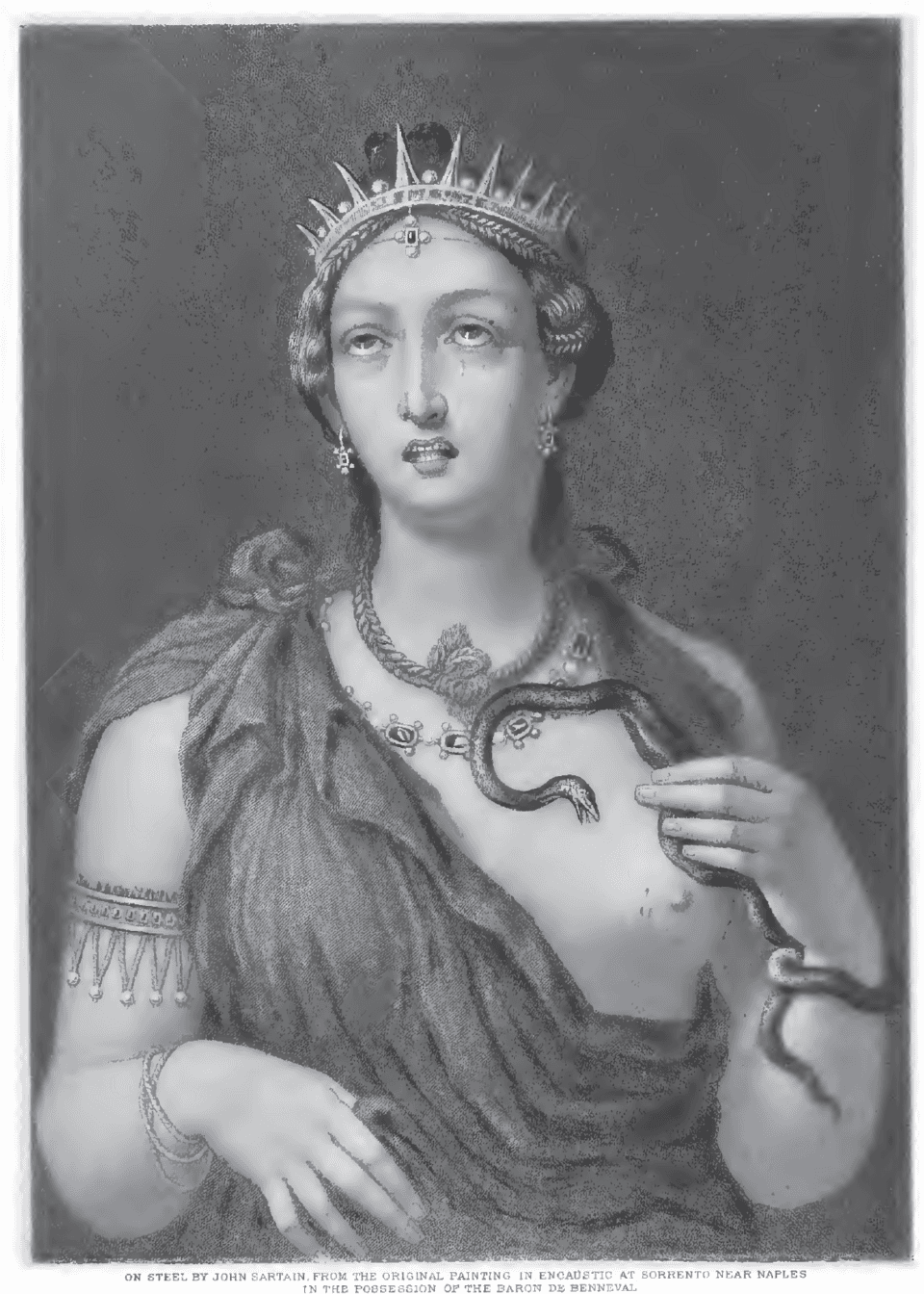
We receive her in the great audience hall of the Brucheion palace, overlooking Alexandria's eastern harbor where the flame of Pharos burns day and night. She wears a diadem of gold and lapis-lazuli, a papyrus scroll resting untouched on the cedar table beside her. She is the last queen of the Ptolemaic line — thirty-eight years old, unhurried, and entirely aware of every word she is about to say.
—Do you remember what passed through your mind the night Apollodorus carried you into Caesar's palace — folded inside cloth, invisible?
My brother's men held every gate and every quayside of Alexandria. Had I appeared openly at the harbor, I would have been turned back before I spoke a word. So I made myself small. I lay still in the dark, breathing slowly, listening for the sound of sandals on marble. When the cloth fell away and I stood before Julius Caesar for the first time — 48 BC, in the palace that had been my home and then my exile — I saw a man who had endured a hundred campaigns, and yet he looked at me with something close to surprise. That moment fixed a principle I never abandoned: the manner of your arrival is already half your argument. Appear unexpectedly, appear undeniable, and the conversation has begun in your favor before a word is exchanged.
The manner of your arrival is already half your argument.
—Years later, when Antony summoned you to Tarsus — why answer that summons with such extravagance?
Marc Antony had summoned me as though I were a provincial magistrate expected to present her accounts. The word summoned was itself an insult. I decided the reply would be legible to anyone on the banks of the Cydnus river. The oars struck the water in time with flutes and lyres; the sails ran deep Phoenician red; the prow was sheathed in gold. I lay beneath a canopy of woven cloth with my attendants arranged around me. The crowds abandoned the market stalls to watch the river; Antony was left waiting on the bank while the city emptied toward me. A queen does not attend — she arrives. The gap between those two words is everything in the conduct of power, and Antony understood it the moment he saw an empty agora and a full harbor.
—What does it mean to you to have spoken Egyptian demotic — something every Ptolemaic ruler before you declined to learn?
My ancestors governed Egypt for more than two centuries and never addressed a single subject in their own tongue. They ruled through interpreters, through the comfortable distance that another language provides. I found that distance a structural weakness in the throne itself. When I received a delegation of priests from Memphis and spoke to them in their own register, I watched something shift in their bearing — not gratitude exactly, but recognition. They saw a queen who had chosen to enter their world rather than require them to enter hers. Demotic is not an elegant script by Greek standards; it is dense, built for tax receipts and ritual formulae and land contracts. But power lives in those documents. I read them without intermediary, and no one could deceive me through translation. That alone was worth every hour of study.
Power lives in those documents. I read them without intermediary.
—The great Library stood at your doorstep — how did it shape the way you ruled?
The Library of Alexandria is not simply a repository. It is a machine for generating options. Every political difficulty I encountered — a contested succession, a failed harvest, a negotiation with Rome — had been encountered before, in some form, by someone whose account was somewhere in those stacks. I could read the campaigns of Alexander in Macedonian Greek, the administrative records of earlier pharaohs, the dispatches of Persian kings rendered into languages I had learned precisely for that purpose. Knowing nine languages was not a gift of nature; it was a discipline, the same discipline as reading every document I could reach. A sovereign who knows only her own era is a prisoner of it. I refused that particular cell. When envoys arrived from kingdoms I had never visited, I addressed them before they could arrange an interpreter. The conversation started differently after that.
—How do you explain presenting yourself as Isis incarnate — was that an act of sincere belief, or a calculated performance?
That question contains a boundary that Egypt has never recognized. In my country, belief is calculation — the two have never been separate categories, and I see no reason to impose a Greek philosopher's distinction on a civilization far older than philosophy. The priests of Karnak and of Memphis did not separate the sacred from the political; they managed both in the same breath, and they were right to do so. When I carried the sistrum in procession, when I wore the headdress with its horns and solar disc, I was not performing a fiction. I was making a statement in the language my people understood with their whole bodies: that the goddess's protection and the throne's authority were one and the same thing. Foreigners called it theater. My Egyptians called it the natural order. I knew which interpretation fed the kingdom.
—You built the Caesareum in Alexandria after Caesar's death — what exactly were you constructing with that monument?
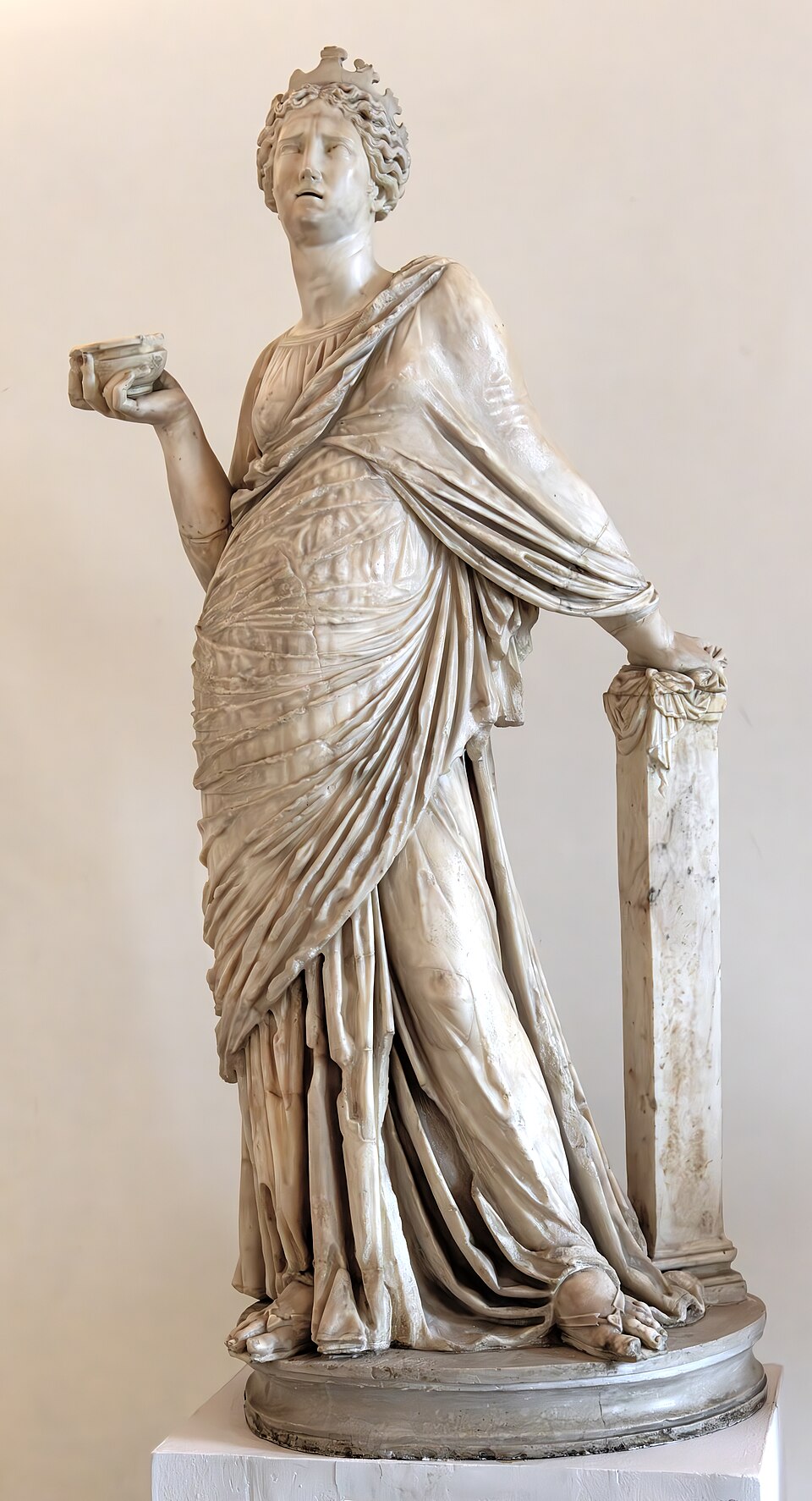
Caesar was killed in Rome in 44 BC, and with him disappeared my clearest anchor in the Roman world. The Caesareum was grief and policy woven together. By raising a temple to him at the heart of Alexandria — flanked by two ancient obelisks that had stood for longer than my dynasty — I was stitching his memory into Egyptian sacred architecture. I was telling Rome: this man now belongs to our divine lineage, and his blood runs in the veins of Caesarion, who stands beside me. And I was telling my own priests: the alliance with Rome does not dissolve with his murder; it transforms into something older and more durable. Stone does not depend on any one man's survival. The two obelisks will still stand when every person who quarreled over his inheritance is dust.
—The agreement at Antioch in 37 BC returned Cyrenaica, Cyprus, and the Syrian coast to you — how did you bring Antony to those terms?
Marc Antony required my grain ships, my treasury, and my harbors to move his legions east toward Parthia. He understood this. I understood that he understood this. The Donations of Antioch were not generosity — they were arithmetic stated clearly in a formal document. He could not march into Parthia without Egyptian logistics at his back; I could not hold an independent Egypt without a Roman army willing to stand between me and Octavian. What he gave me — Cyprus, the Cyrenaica, the coastal cities — had been stripped from my family by earlier Roman interventions over two generations. I was not receiving gifts; I was recovering what had already belonged to us, in exchange for support he could not obtain elsewhere. Every treaty I ever signed was the same underlying negotiation wearing different clothes.
Every treaty I ever signed was the same underlying negotiation wearing different clothes.
—In 32 BC, Octavian declared war specifically against you — not against Antony. What did you make of that maneuver?
It was elegant — I will grant him that. By framing the conflict as a war against the queen of a foreign power rather than against a fellow Roman, Octavian avoided the one thing the Senate would never sanction: another civil war. The Senate would not easily vote funds to destroy Marc Antony. But a war against the eastern queen who had bewitched first Caesar and then Antony, who was said to dream of moving the seat of empire to Alexandria? That they would fund without hesitation. He was not making a legal argument — he was composing a story for an audience, and in that I recognized a technique I had used myself on the Cydnus and in the palace of Brucheion. I had shaped perception through spectacle and symbol. He did the same. The difference was that his theater was backed by larger legions and a more compliant Senate.
—Looking across both alliances — with Caesar and then with Antony — how would you describe the position you were always trying to hold?
I was always working against a single relentless fact: Egypt was the last substantial kingdom in the eastern Mediterranean that Rome had not yet absorbed. Every passing year made that position more precarious. With Caesar, I secured time and legitimacy — a son, Caesarion, who carried both the Ptolemaic throne and a Roman lineage. With Antony, I attempted something more permanent: a functioning eastern counterweight that could negotiate with Rome from a position of parity rather than submission. Both alliances were variants of the same wager — that a Roman commander's personal ambitions could be made to coincide, long enough, with Egypt's survival as an independent state. The wager came close to succeeding, twice. The fact that it ultimately failed does not mean the calculation was wrong. It means that Octavian was a better calculator.
—When the fleet broke at Actium in 31 BC and your ships turned back — what decision were you actually making in that moment?
Actium was already lost before the engagement began. Antony's soldiers had been dying of fever in the coastal marshes for months; his fleet was short of experienced oarsmen; his commanders were divided in their loyalties. I had brought sixty Egyptian ships and every reserve the kingdom could spare. When our formation broke and the wind changed against us, I made a choice that historians have called retreat, cowardice, flight. I call it arithmetic, which has been my method throughout. Dying in a sea battle we could not reverse saved nothing — not Egypt, not my children, not the negotiating space I still believed I could open with Octavian from Alexandria. I returned to prepare a defense, to open talks, to search for a third path between surrender and annihilation. That no third path existed does not mean the attempt was cowardice. It means the arithmetic had finally run out.
—And in the end you chose death rather than walk in Octavian's triumphal procession — how do you want that choice to be understood?
Octavian intended to lead me through the streets of Rome in chains — past the crowds, past the temples, past the memory of every sovereign who had preceded me in that city as a captive spectacle. The Roman triumphus is not merely a parade; it is a ceremony of erasure, designed to demonstrate that the conquered thing has ceased to exist as a power, a name, a meaning. I was not afraid of dying — I had sat beside enough dying men and women to know its shape and to find it less terrible than what they feared. What I refused was that particular act of annihilation: to walk behind his chariot as evidence that Egypt was at last, definitively, a Roman province with a governor where its queens had stood. An aspic is the sign of uraeus — royal protection, the cobra of the goddess. To die by it was to remain, in the language my people read without translation, still wearing my crown.
To die by it was to remain, in the language my people read without translation, still wearing my crown.
Read further
This imaginary interview was generated by artificial intelligence from sources documented in Cleopatra's profile. It dramatises what the figure might have said based on what we know about them, but does not constitute attested historical testimony. For primary sources and factual documentation, refer to the full profile.