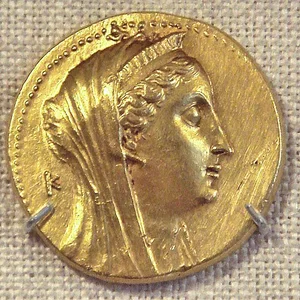

A Macedonian princess born around 316 BCE, daughter of Ptolemy I, she became queen of Ptolemaic Egypt. Co-regent alongside her brother and husband Ptolemy II, she wielded considerable political influence and was deified during her own lifetime.
Arsinoe II(315 av. J.-C. — 269 av. J.-C.)
Arsinoe II
8 min read
Frequently asked questions
Key Facts
- Born around 316 BCE, daughter of Ptolemy I Soter and Berenice I
- Married successively to Lysimachus of Thrace, then to Ptolemy Ceraunus, before marrying her brother Ptolemy II around 276 BCE
- Given the title 'Philadelphus' (meaning 'one who loves their sibling'), a title she shared with her husband
- Deified during her lifetime and identified with Isis and Aphrodite — a cult in her honor was established throughout the kingdom
- Died around 270 BCE; her influence continued to shape Ptolemaic politics long after her death
Works & Achievements
A circular monument in white marble donated by Arsinoe to the sanctuary of the Cabiri at Samothrace, one of the largest circular structures of ancient Greece. It bears witness to her piety and royal munificence.
Arsinoe and Ptolemy II were officially incorporated into Egypt's religious calendar as the "sibling gods" (Theoi Adelphoi). This cult was the first in a long Ptolemaic tradition of deifying living rulers.
The Fayyum region was renamed and extensively developed under her patronage, with irrigation works, Greek colonization, and the founding of new cities. This territorial development project significantly increased Egypt's agricultural resources.
Arsinoe is credited with a decisive influence on Ptolemaic strategy for control of the Aegean Sea, including the building of a powerful fleet and the establishment of protectorates over islands such as Delos and Samos. This policy made Egypt the leading naval power of the eastern Mediterranean.
Arsinoe won victories in chariot and horse races at the great Greek games (Olympic, Pythian, Isthmian, and Nemean) with her own teams, a feat celebrated by the poet Posidippus. Women could not compete in person, but the owner of the horses received the honor.
Anecdotes
Arsinoe II was first married around 300 BCE to Lysimachus, the aging king of Thrace, when she was only about fifteen years old. She established herself as a formidable queen in that rough court, scheming to secure the throne for her own son rather than Lysimachus's eldest son Agathocles, whom she had executed.
After Lysimachus's death at the Battle of Corupedium (281 BCE), Arsinoe found herself without protection. Her half-brother Ptolemy Ceraunus proposed marriage, then once the wedding was celebrated, had her two young sons murdered before her eyes. She escaped miraculously and was forced to flee into exile on Samothrace before eventually returning to Egypt.
Back in Egypt, Arsinoe married her own full brother Ptolemy II — a practice shocking to Greeks but rooted in the tradition of the Egyptian gods Osiris and Isis. This marriage earned her the epithet Philadelphus ('sibling-loving'), a title she shared with her husband. She became a full co-ruler, appearing on coins alongside her brother.
Arsinoe was deified during her own lifetime — an exceptional distinction for a woman in the Greek world. Temples were dedicated to her while she still lived, under the name Philadelphus. After her death in 269 BCE, she was officially venerated as a goddess, and special priestesses called kanephoroi bore her name in official ceremonies throughout Alexandria.
Arsinoe played a decisive role in Ptolemaic naval policy in the Aegean. She is credited with driving the expansion of the fleet and extending Ptolemaic influence over the Greek islands, particularly during the First Syrian War. She also patronized the poets at the Alexandrian court — Callimachus and Theocritus both dedicated celebrated works to her.
Primary Sources
"He honors his noble wife more than any other man has honored his; she too loves him with all her heart, her brother and her husband."
Callimachus describes the apotheosis of Arsinoe, carried to the heavens by the Dioscuri, and evokes the sacred flame that burned upon her funeral pyre.
Several epigrams celebrate Arsinoe as protector of sailors and equestrian games, victorious at Olympia with her horses.
Athenian inscription recording the alliance between Athens and the Ptolemies, in which Arsinoe's role underlies Ptolemaic policy in the Aegean.
Key Places
Capital of the Ptolemaic kingdom where Arsinoe wielded power alongside her brother. The grand royal palace, the Library, and the Museum were at the heart of the political and cultural life she patronized.
A vast agricultural region of Egypt renamed in her honor and intensively settled by the Ptolemies. Numerous papyri discovered in this region document the administration and the cult carried out in her name.
Greek island where Arsinoe sought refuge after the massacre of her children by Ptolemy Keraunos. There she enriched the sanctuary of the Great Gods (the Cabiri) by commissioning a monumental rotunda that is still visible today.
Lysimachus's residence in Macedonia where Arsinoe lived as queen of Thrace. It was here that she schemed to place her son on the throne and had Lysimachus's eldest son executed.
One of the many cities founded or renamed in honor of Arsinoe II throughout the Ptolemaic empire, bearing witness to the extent of her influence over Hellenistic colonization policy.
Typical Objects

An emblematic attribute of Arsinoe II on coins and reliefs, the double cornucopia symbolized her dual Egyptian and Greek divinity. She was one of the first Hellenistic queens to adopt this attribute, which merges royal traditions from both cultures.

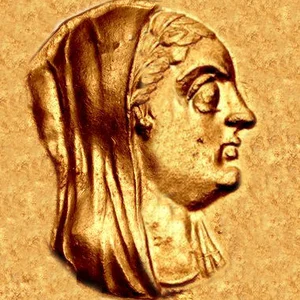
Gold coins struck after her death bear her diademed portrait — an exceptional distinction for a woman in the Greek world. These coins circulated widely across the Mediterranean for many years as a symbol of Ptolemaic power.

The diadem — a white band tied around the forehead — was the symbol of Hellenistic royal power, inherited from Alexander. Arsinoe wore it as a queen in her own right, on equal footing with her brother-husband.

Canopic jars and small faience figurines depicting Arsinoe in the guise of Isis have been found at several Egyptian sites, bearing witness to her syncretism with local deities.

The archives of the Faiyum (ancient Arsinoite nome) contain papyri referencing the management of royal lands under her patronage. These documents attest to her direct involvement in the economic administration of the kingdom.

Rites in honor of the deified Arsinoe required bronze or gold incense burners during sacrifices at her temples. The use of Arabian incense was a luxury reserved for divine and royal cults.
School Curriculum
Vocabulary & Tags
Key Vocabulary
Tags
Daily Life
Morning
Arsinoe began her day with ritual ablutions in her apartments in the royal palace of Alexandria, attended by her Greek and Egyptian chambermaids. She then took part in the morning ceremonies at the dynastic temples, dressed in her royal regalia — diadem, veil, and double cornucopia.
Afternoon
Afternoons were devoted to political audiences and administrative decisions, in consultation with senior Ptolemaic officials. Arsinoe also received the poets and intellectuals of the Museum of Alexandria whom she patronized, and weighed in on the kingdom's military and diplomatic affairs.
Evening
Evenings at the Ptolemaic court unfolded at lavish banquets blending refined Greek cuisine with Egyptian traditions, accompanied by music, poetry, and philosophical discourse. Arsinoe, accustomed since childhood to the courts of the Diadochi kings, held a central place at these gatherings alongside Ptolemy II.
Food
The Ptolemaic royal table combined Egypt's abundant resources — Nile fish, dates, figs, and grain — with imported Mediterranean goods: wine from Chios, Greek olive oil, and Arabian spices. Royal banquets featured roasted meats, honey pastries, and exotic fruits, washed down with the finest Greek wines.
Clothing
Arsinoe wore gowns of white linen or fine silk with delicate pleating in the Greek style, adorned with embroidery and golden belts. In Egyptian contexts, she also wore pharaonic ornaments — the usekh collar, Hathoric headdress — to align herself with local divine tradition. Her jewelry in gold, emerald, and lapis lazuli was of unrivaled splendor.
Housing
Arsinoe resided in the great palace complex of Alexandria, set on a peninsula facing the island of Pharos and surrounded by gardens, fountains, and colonnaded porticoes. The royal apartments blended Greek architecture (Parian marble, mosaics, Ionic columns) with Egyptian decorative elements (hieroglyphs, statues, private temples), reflecting the syncretic character of Ptolemaic monarchy.
Historical Timeline
Period Vocabulary
Visual Style
Portrait helléno-égyptien mêlant réalisme grec et symbolique pharaonique : teintes or, bleu lapis et ivoire sur fond de colonnes de marbre et hiéroglyphes dorés.
Sound Ambience
Ambiance sonore du palais ptolémaïque d'Alexandrie : mélange du monde grec et égyptien, rituels sacrés, vie de cour fastueuse au bord de la Méditerranée.
Liens externes & ressources
Références
Œuvres
Rotonde d'Arsinoé à Samothrace
Vers 288-281 av. J.-C.
Institution du culte royal des Theoi Adelphoi
272 av. J.-C.
Fondation de l'Arsinoïté (nome du Fayyoum)
Vers 275 av. J.-C.
Politique navale en Égée
274-271 av. J.-C.
Victoires équestres aux Jeux panhelléniques
Vers 272 av. J.-C.