Imaginary dialogue between Julius Caesar and Cleopatra
by Charactorium · Cleopatra (68 av. J.-C. — 29 av. J.-C.) · Politics · 7 min read
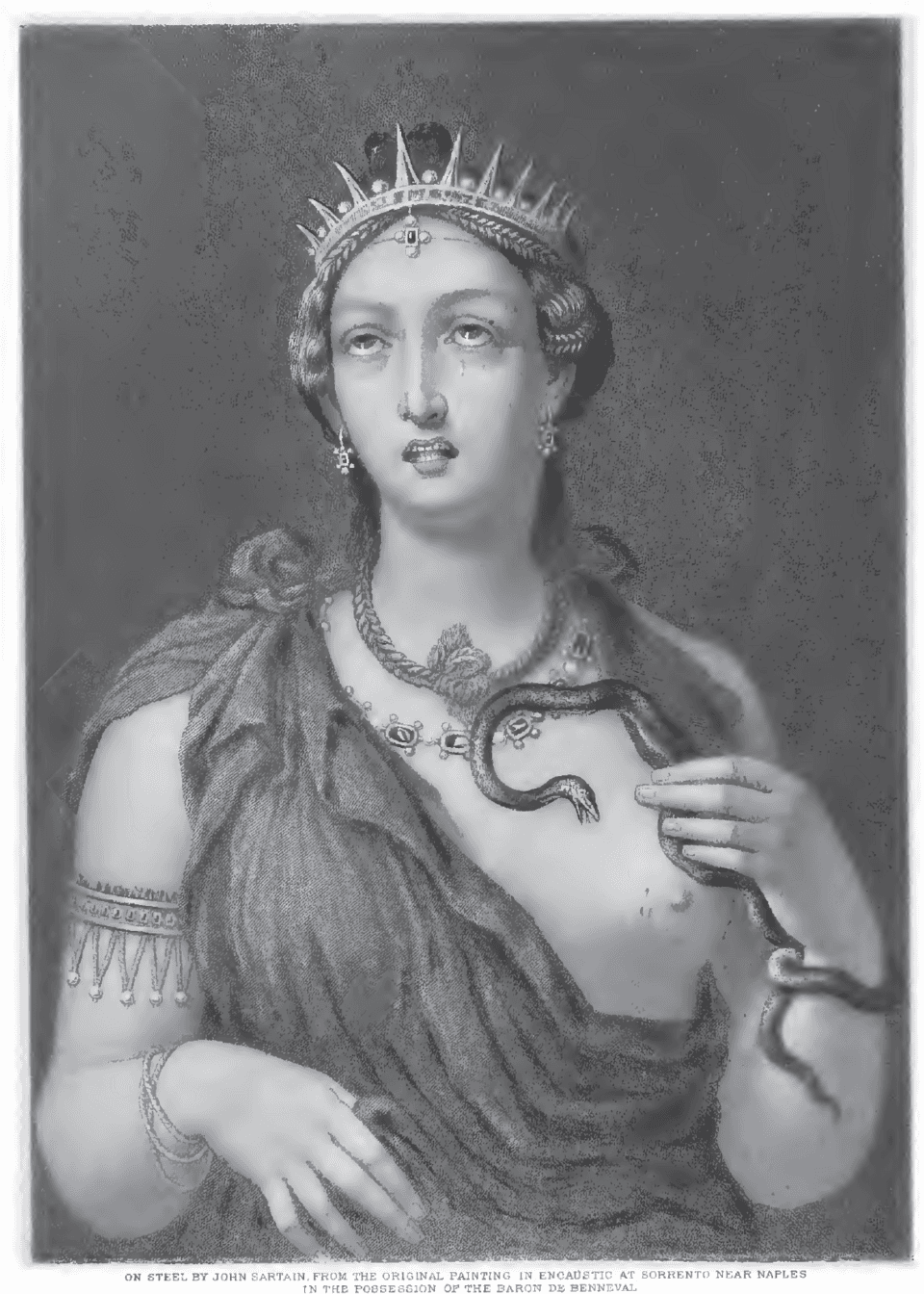
It is the spring of 47 BC, and the royal apartments of the Brucheion palace — overlooking the Great Harbor of Alexandria — carry the scent of kyphi, the temple incense drifting in with the morning sea wind. The Alexandrian War has just ended: Ptolemy XIII is drowned in the Nile after his final defeat, and Cleopatra VII reigns alone for the first time in her life. Julius Caesar, still in the city — longer than a general of his ambitions usually stays anywhere — sits across from her at a table where a half-unrolled scroll of accounts provides a polite pretext; he has questions that no legate's report has yet answered.
—That night in 48 BC, when my guards unrolled the cloth and you stepped out — were you truly not afraid?
I had spent months in a desert encampment, Julius, watching my brother's advisors dismantle everything my father had struggled to preserve. Fear, by then, had been replaced by something more useful: calculation. I had studied enough about your campaigns to know how you moved through ambiguity — a general who crossed the Rubicon with a single legion does not hesitate when a genuine opportunity steps into the room. I needed you to see me as a partner, not as a suppliant begging for Roman arbitration. If I had sent a letter, Pothinus would have intercepted it before nightfall. The cloth was not an indignity — it was the only passage not already guarded by my enemies. What I felt, in the dark, listening for your voice on the other side of the door, was not fear. It was the absolute concentration of someone who knows the next few minutes will determine everything.
—Pothinus pressed for your brother — stability, a manageable king. What made you confident I would choose you instead?
I was not certain. But I calculated that you were too clear-sighted to want what Pothinus was selling. A twelve-year-old king managed by a court eunuch and a general who had just murdered Pompey on a beach: that is not stability — that is a succession of crises waiting to unfold. You needed Egypt functional, wealthy, and capable of sustaining your campaigns for years. I could offer precisely that, because I understood this kingdom in a way no court faction aligned with Rome ever could. I spoke to you directly, in Latin, so that no translator stood between us to soften the argument. I offered you a partnership — as close to one between equals as our circumstances allowed. You had not crossed the eastern Mediterranean to manage a regency council, Julius. I believe you understood that the moment I was standing in your room.
—You spoke to me in Latin that first evening. How many languages do you command, and why does that matter?
Nine, as of today — though Aethiopian still requires concentration. But the number matters less than the principle behind it. Every ambassador who hears me speak his own language — Hebrew for Herod's delegation, Aramaic for the Arabian merchants, Greek for the philosophers — loses, before the meeting has properly begun, his most reliable defense: the claim that something was lost in translation. I see what his face does when I speak his tongue before he expects it. And for internal governance, the logic is identical: a minister who must relay my words to my subjects holds power that rightfully belongs to me, and he knows it. I eliminated that class of intermediaries the moment I chose to learn démotique. Language is not an ornament, Julius — it is the instrument through which a sovereign either governs or is governed.
Language is not an ornament — it is the instrument through which a sovereign either governs or is governed.
—None of your Greek predecessors ever learned démotique. What made you become the first Ptolemaic ruler to speak Egyptian directly?
Because for two hundred and fifty years, every Ptolemaic king heard their own kingdom through a filter — priests, stewards, interpreters who chose which grievances to transmit and which to suppress. The grain farmer disputing his tax levy, the temple scribe recording the flood levels, the craftsman appealing an unjust fine: none of them could reach the throne without passing through a man whose loyalty was, at best, divided. When I address them in démotique, their answer arrives unmediated. I also see something change in their faces — something between relief and disbelief, as if they had not permitted themselves to expect it. Two and a half centuries of distance, undone by a single sentence in their own language. My ancestors chose Greek pride over Egyptian loyalty. I chose differently, Julius — and I govern a kingdom that is more genuinely mine for it.
—I have watched you receive the priests of Isis in full regalia. Is that divine persona genuine belief, or governance dressed as theology?
You ask as though belief and governance were opposites, Julius. In Egypt they are not. Isis holds the throne in her very name — she who reassembles what is broken, who protects what lives. For three thousand years, the people of this kingdom have understood legitimate power through sacred form: the pharaoh who carries the uraeus, the queen who wears the disc and the horns, is not merely a ruler — she is the principle of order made visible. My predecessors governed through Greek bureaucrats who never grasped what held the kingdom together beneath the surface. I chose to stand inside that tradition rather than above it. When I enter the temple wearing her attributes, I am not pretending. I am placing myself within the oldest legitimacy this land knows — one that no Roman legion and no senate decree can simply replace. The priests accept this. The people accept this. That is not nothing.
When I enter the temple wearing her attributes, I am not pretending.
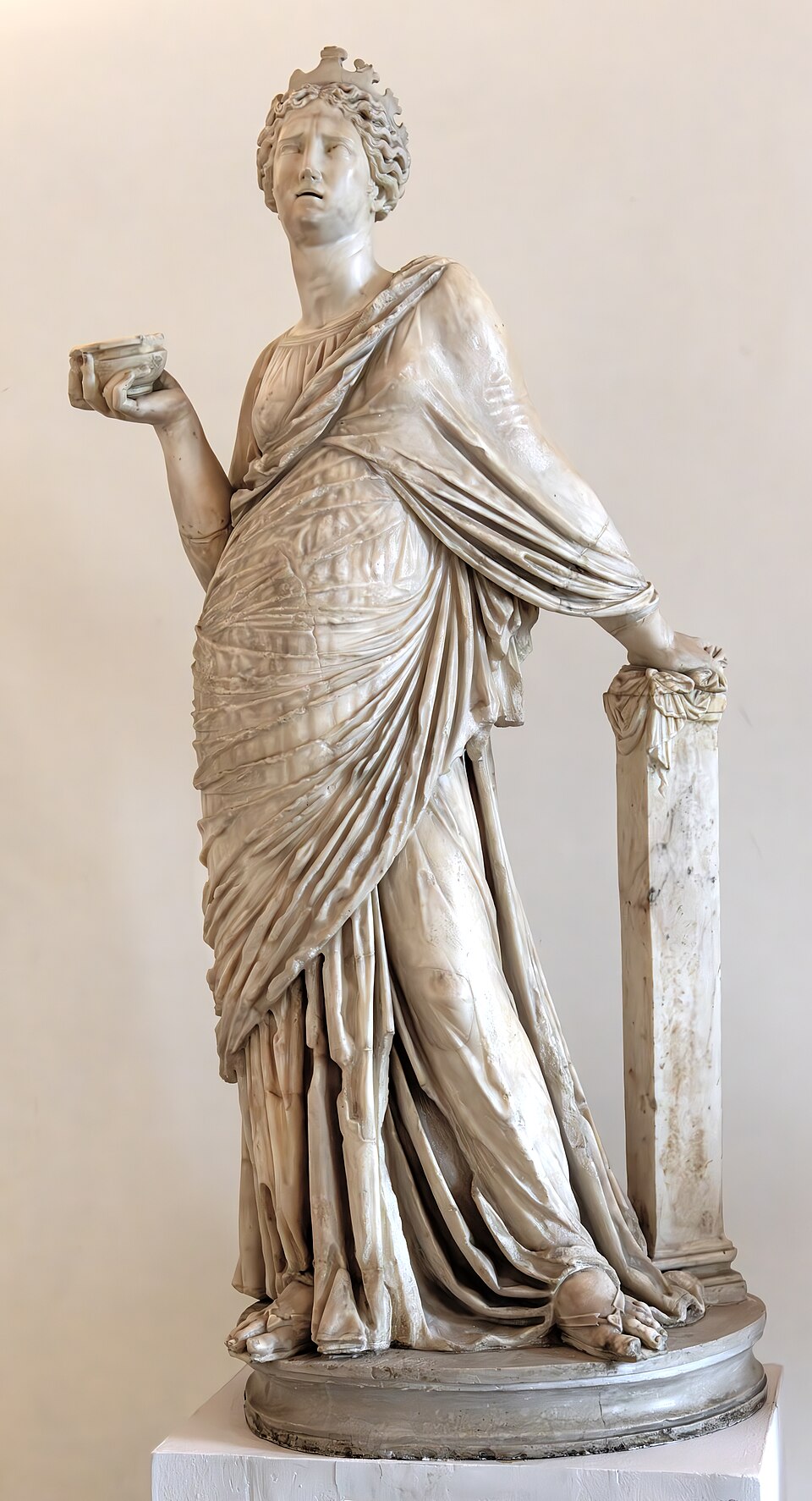
—Your father purchased his throne with Roman loans and paid for it with concessions. How do you govern a kingdom some senators believe they already own?
My father, Ptolemy XII, paid for his throne with debts he could not repay and concessions that hollowed the kingdom from within. I inherited those liabilities — but also a land of extraordinary productive capacity. Egypt is not simply wealthy: it is the mechanism by which wealth moves between East and West. The spice routes of India, the incense of Arabia, the grain of the Nile valley — all pass through Alexandria. My task is to ensure the kingdom captures a share of every transaction rather than merely providing the road. The monopolies on oil and papyrus, the controlled bronze currency, the management of grain levies — these are instruments of sovereignty, not greed. A kingdom with stable finances is one whose merchants do not pray for a change of dynasty. I govern the economy the way a navigator governs a current: not by fighting it, but by knowing exactly where it carries you if you stop paying attention.
—The old empire held Cyprus and Cyrenaica. You speak of alliances rather than armies — what do you truly want for Egypt's eastern borders?
I want what was taken, Julius — but I am patient about the means. Cyrenaica, Cyprus, the coastal cities of Syria: these were Ptolemaic for generations before Roman pressure and internal weakness stripped them away. Egypt's army today cannot recover territory against Rome's wishes, and I have no illusion that it could. But alliances accomplish what armies cannot. If this kingdom demonstrates its indispensable value — as the principal supplier of grain, as the linchpin of eastern Mediterranean trade, as the most reliable partner Rome has in the eastern provinces — then what was lost can eventually be renegotiated. Not as charity, but as recognition of what Egypt genuinely contributes. You understand this logic better than most, Julius: territory is often a question of who needs whom most urgently at a given moment. I am building the kingdom that everyone needs — and learning to wait for the moment when that becomes obvious to everyone else.
—I hear you plan a sanctuary in Alexandria to honor the bonds between our worlds. What are you building, and for whom?
Alexandria has always been a meeting place of traditions — Greek, Egyptian, Jewish, now increasingly Roman. What I am planning is a sanctuary that makes the alliance between our worlds visible in permanent form rather than written in letters on papyrus that can burn. In Egypt, legitimate authority is inseparable from sacred architecture — a building outlasts the politics of any single generation. The Egyptian population understands power through sacred form; Roman visitors understand it through monumental display. A sanctuary that speaks to both does what no treaty text can accomplish: it inscribes the relationship into the landscape of the city itself. I suspect you worry, Julius, that Roman opinion will find this excessive — that I am making public what some senators prefer to regard as a private arrangement. But in Egypt, what is not made sacred tends to be forgotten. And I have no intention of being forgotten.
—If Rome were to turn against you — and I do not say this carelessly — what would you never allow to happen?
I have thought about this more than you might expect, Julius, even in these days of our alliance. The answer requires no deliberation: a Roman triumph is the theater of absolute defeat — the conquered king or queen displayed in chains before a crowd that has come to witness degradation. No Ptolemaios has ever walked in Roman chains, and I will not be the first. I am pharaoh of Egypt, I am the living form of Isis, and I am the last of a royal line that governed this land before Rome was a republic. Whatever Rome may demand of my kingdom — grain, alliance, gold, formal deference — that particular moment will not happen. I have already decided. A queen who allows herself to be paraded as a trophy has already ceased to be a queen — and I would rather cease to exist than cease to reign.
A queen who allows herself to be paraded as a trophy has already ceased to be a queen.
—You speak nine languages, carry two divine identities, rule two civilizations at once. Alone in this palace — who are you?
A question only you would ask, Julius, and only in this room. In any formal setting, I am always pharaoh, always Isis, always Cleopatra of the Ptolemaioi — each role precisely calibrated for its audience. But alone here, in the halls of the Brucheion I have known since childhood, I am someone uncertain where the role ends and the person begins. Perhaps after enough years of speaking nine languages to nine different audiences, the self beneath all of them becomes something difficult to name. What I know is this: I am most fully myself when the kingdom is functioning — when the grain is moving, the accounts balance, the ambassadors leave satisfied, and the Nile rises at the right level. In those moments I feel no distance between what I am and what I do. That, I think, is the closest I have to an answer.
Read further
This imaginary interview was generated by artificial intelligence from sources documented in Cleopatra's profile. It dramatises what the figure might have said based on what we know about them, but does not constitute attested historical testimony. For primary sources and factual documentation, refer to the full profile.