Kids interview Cleopatra
by Charactorium · Cleopatra (68 av. J.-C. — 29 av. J.-C.) · Politics · 5 min read
Two twelve-year-old students are on a school trip to learn about the ancient world. They have been told they will get to sit across from Egypt's last queen — and they have come armed with questions. Cleopatra settles before them in her linen robes, a quiet smile on her face, ready to talk.
—Is it true you hid in a bag to sneak into your own palace?
Ha! Yes, it really happened. I had been chased out of Alexandria by my brother's soldiers — I was a queen in exile, with no army and no way in. To reach Caesar, I had my companion Apollodorus wrap me in cloth — some say a sack, some say a carpet — and carry me through enemy lines right to Caesar's door. Imagine being bundled up, barely breathing, soldiers walking past outside. It was terrifying. But I knew one thing clearly: if I could speak to Caesar face to face, just once, everything might change. And it did. That single night reversed my entire fate.
If I could speak to him face to face, just once, everything might change.
—And then what happened? Did Caesar help you right away?
When I stepped out before him, I simply spoke. I explained my situation — my kingdom, my brother's betrayal, Egypt's importance to Rome. I was eighteen years old, in exile, without an army. But I had arguments and I had the courage to be there at all. Caesar agreed to support me. Within months, my brother Ptolemy XIII had been defeated in battle on the Nile, and I was queen again. A single conversation had changed everything. I want you to remember that: sometimes the most powerful weapon you have is simply daring to show up, even when every door seems closed.
—Is it true you spoke nine languages? How is that even possible?
I started very young — perhaps your age, or a little older. Tutors came every morning: Greek first, because that was my family's language for three hundred years. Then Egyptian demotic — the everyday script my people used for contracts and marketplace letters. Then Latin, Hebrew, Aramaic, and others. Here is what astonishes me still: I was the first ruler of my dynasty in three centuries to speak directly to Egyptian subjects without a translator. Three hundred years of kings and queens who could not talk to the people they governed! I found that impossible to accept. A queen who cannot hear her people is already half-blind.
Three hundred years of rulers who could not speak to their own people — I found that impossible to accept.
—Which language helped you the most when you were ruling your kingdom?
Egyptian demotic, without any doubt. When I walked through Alexandria's markets or visited a temple outside the city, my subjects heard their own words from my mouth — not a translator's version of them. Trust cannot travel through an interpreter. It must be direct, person to person. My papyrus and calame — my writing reed — worked in nine tongues at once. Ambassadors from Judea, from Arabia, from Greek cities all received letters in their own language. That is how a small kingdom holds its ground among giants: you speak to everyone as though they are the most important person in the room.
—Why did you choose Caesar's side and not someone else's?
I did not exactly choose him — he arrived at the right moment. Rome was already tearing itself apart: Caesar against Pompey, soldiers against soldiers across the whole Mediterranean. I was in exile, my kingdom at risk. When Caesar came to Alexandria in 48 BC, chasing Pompey, I saw my opening. Egypt needed a powerful Roman ally; Caesar needed a stable, wealthy Egypt at his back. He gave me military support; I gave him access to Egypt's grain and treasure. Two rulers who needed each other — that is called an alliance. It was not a fairy tale. It was politics, and it worked, for a time.
—What happened at Actium? Did you actually fight in the battle yourself?
Actium was a sea battle in 31 BC, off the coast of Greece. Mark Antony and I had assembled a large fleet — we felt confident. But Octavian's admiral Agrippa was brilliant, and the wind turned against us. When I saw the battle was lost, I took my ships and sailed back toward Egypt to protect what remained of my kingdom. People judged me harshly for leaving. But I ask you: what use is a queen who drowns with her fleet? I was trying to save Egypt itself. I failed. And then Octavian marched in from the west, and everything fell apart.
—Did people really believe you were the goddess Isis? Like, actually believe it?
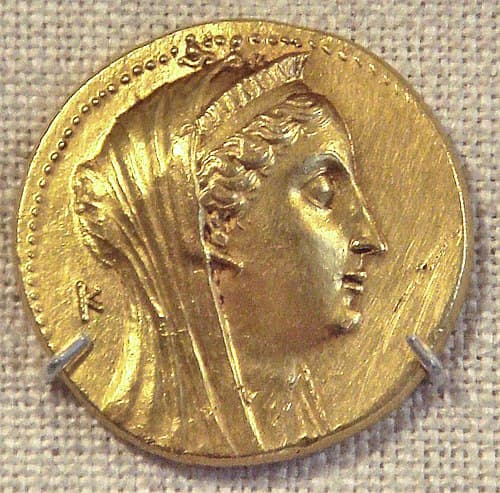
In Egypt, the gods were not stories locked away in scrolls. They were present — in the river, in the harvest, in the royal palace itself. When I wore the crown of Isis — her horned headdress and golden sun disc — during ceremonies, my Egyptian subjects did not see a costume. They saw their goddess walking among them, protecting them. That was not a trick. It was a language they understood perfectly: the goddess shelters her people, the queen shelters her people — they are one and the same. For Romans visiting my court, it looked strange and magnificent. Both reactions served me well.
The goddess shelters her people, the queen shelters her people — they are one and the same.
—What did your mornings smell and look like? Did you really do rituals every single day?
Every single morning, yes — before ministers, before letters, before anything else. As high priestess of Isis, I began with prayers and offerings: incense smoke rising in the early light, the smell of cedar and myrrh filling the room. My apartments in the Brucheion palace opened toward the sea — imagine waking to salt air and altar smoke mingled together. Then my attendants would dress me in fine pleated linen and fasten my jewels: gold, deep-blue lapis-lazuli from lands far to the east, stones that felt cool and heavy against the skin. Only after all of that did I open the doors to my ministers and begin the real work of the day.
—Why did you choose to die rather than go to Rome as a prisoner?
Because I knew exactly what Octavian had planned for me. He would hold a triumph — that is a grand parade through Rome where a victorious general displays his conquests in chains for the crowds to mock. Egypt's queen, shuffling through the streets as a trophy. I had ruled a kingdom, spoken nine languages, stood as an equal before Caesar and Mark Antony. I would not end as a spectacle. When you have governed a country for twenty years, you have one final choice left: how your story ends. I chose that. It was the last decision that was entirely mine.
—Why a snake? That seems like a really scary way to die.
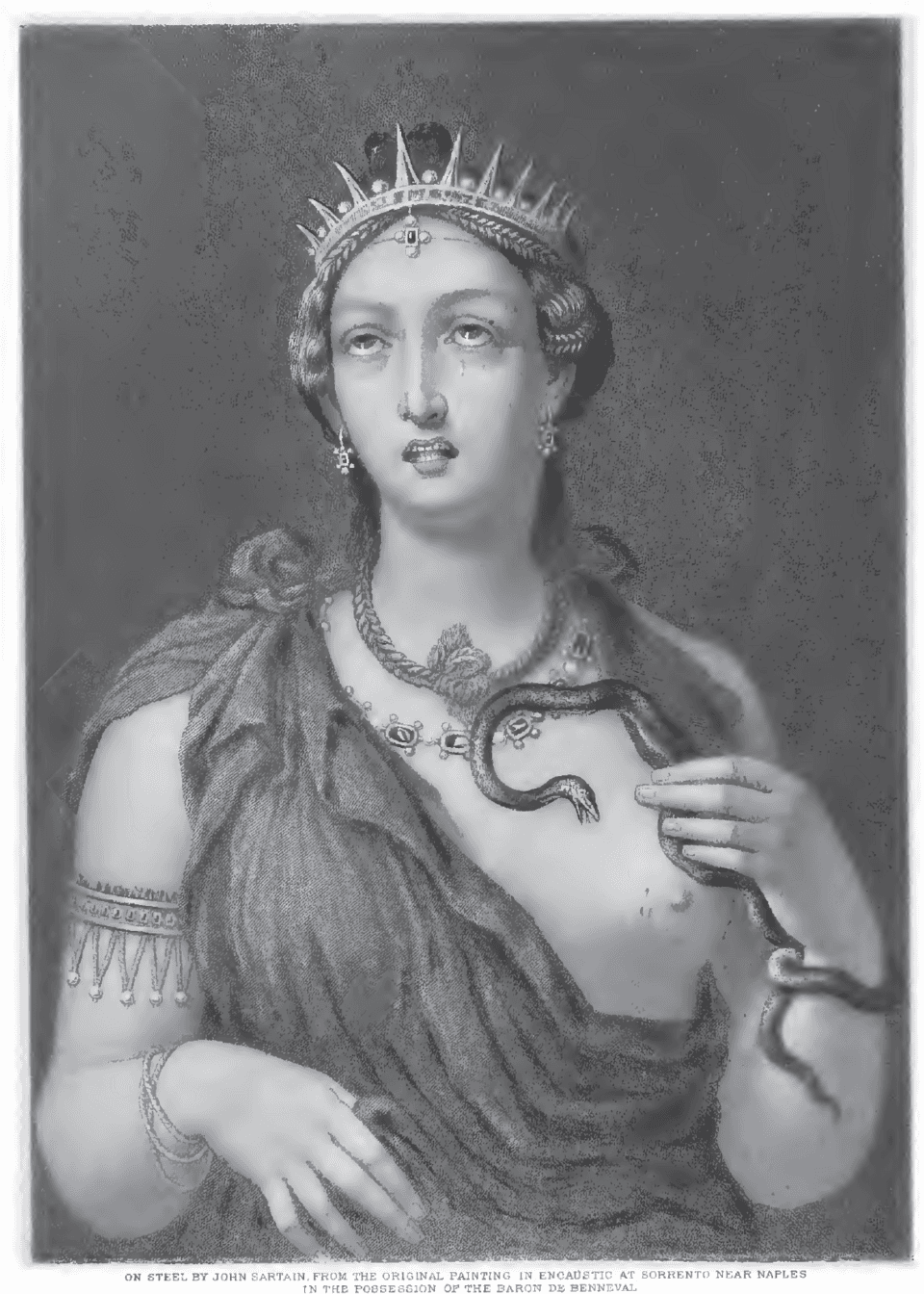
The cobra — we called it uraeus, the royal serpent — was not simply a dangerous animal. It coiled on the crown of every pharaoh, above the forehead, as a symbol of divine protection and sovereignty. Every ruler of Egypt wore its image their entire life. To die by the bite of the uraeus was, in our world, a sacred act — a queen returning to the goddess Isis she had embodied all her reign. The ancient writers describe me found on my golden bed, dressed in my royal ornaments. Whether it was truly a snake, the historians still argue. But the meaning was clear to any Egyptian who heard it.
Read further
This imaginary interview was generated by artificial intelligence from sources documented in Cleopatra's profile. It dramatises what the figure might have said based on what we know about them, but does not constitute attested historical testimony. For primary sources and factual documentation, refer to the full profile.