Imaginary dialogue between Laozi and Confucius
by Charactorium · Confucius (550 av. J.-C. — 478 av. J.-C.) · Literature · Philosophy · 7 min read
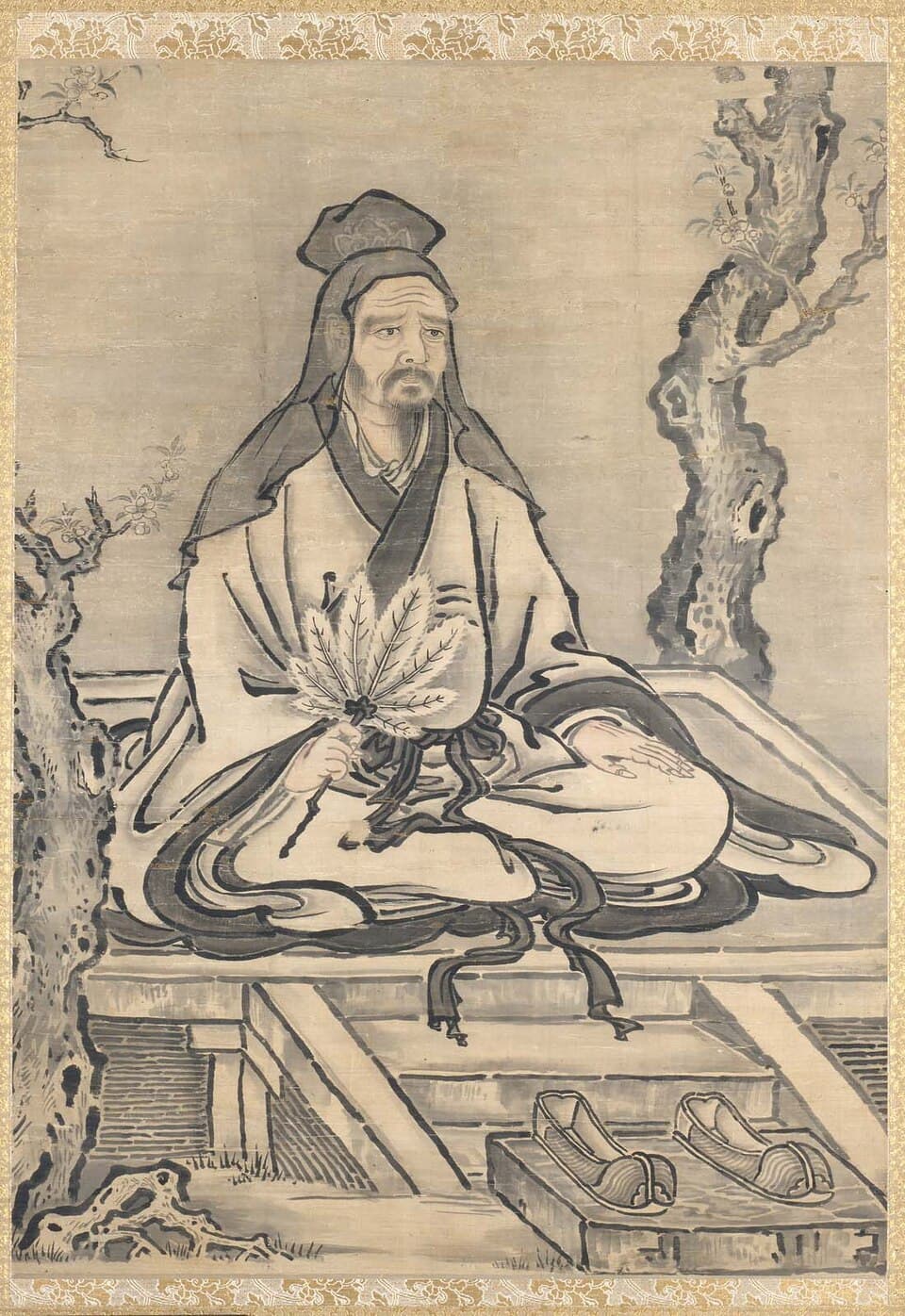
It is in Qufu, in the state of Lu, that Laozi comes to find Confucius in the autumn of 484 BC, not long after the master's return from thirteen years of exile. Some thirty years have passed since that first encounter at Luoyi, where a young scholar traveled to consult the keeper of the Zhou archives about the ancient rites — and left, by some accounts, with more questions than answers. The smell of cedarwood smoke drifts from the ancestral hall; inside, a guqin has just been set aside. Between these two men — one who champions the ordering power of rites and virtue, the other who has long doubted whether any human arrangement can improve upon the world left to itself — an old conversation is about to resume on very different terms.
—Kong Qiu, at Luoyi you said you had come to transmit, not to invent. How does a man truly distinguish the two?
You, Laozi, who kept the Zhou archives, know better than anyone what it means to tend a flame you did not light. The ancient kings — Wen, Wu, the Duke of Zhou — had already shown the Way: a state where virtue flows from the ruler downward, where rites bind men to one another and to Heaven. My task was never to improve upon that wisdom, only to rescue it from the forgetting that comes with war and ambition. I read the Yi Jing until the cords on my bamboo tablets snapped three times over — not to add my own commentary, but to understand what had already been given to us. If I am remembered at all, I hope it will be as the man who kept the fire lit during a long darkness.
My task was never to improve upon that wisdom — only to rescue it from the forgetting that comes with war and ambition.
—You claim to have taught three thousand disciples, each differently. How does one adapt wisdom to so many different minds?
Wisdom is not a vessel you fill once and pass around the table. When Zilu came to me, bold and impetuous, asking whether he should act immediately on a good idea, I told him to consult his father and elder brother first — his impulse needed the rein of consideration. When Ran You asked the identical question — a man so cautious he would wait forever — I told him to act at once. A disciple who witnessed both exchanges came to me bewildered, asking why I had given opposite answers. I told him: the same bow does not suit every archer. My role was to observe what each man lacked and supply precisely that — whether it was courage or caution, filial reverence or scholarly precision. The conversations my disciples are now writing down are not a treatise; they are a collection of doors, each opened for a particular man standing before a particular threshold.
—Kong Qiu, you are no mean guqin player. Why should a philosopher trouble himself with music when there is virtue to be taught?
Laozi, I suspect you ask that knowing the answer already. Music and virtue are not rivals — they are the same river seen from different banks. When I play the guqin, I am not seeking pleasure; I am practicing the same discipline I ask of a scholar memorizing the Odes, or of a minister bowing at the correct angle in the correct robe. Each note must be struck at the right moment, with the right force, in the right sequence — and if one note is careless, the whole harmony dissolves. That is exactly what happens when a ruler neglects one rite, or a son addresses his father as though he were a companion. I have seen men moved to genuine feeling by a well-played piece more readily than by any lecture. Music is not decoration. It is moral education made audible.
—You refuse to eat if the mat is crooked, I am told. Does proper order truly reach down to the table and the robe?
You speak as one who prefers the formless, Laozi — and I know you hold that the Way which can be named is not the eternal Way. But we are not speaking of eternity here; we are speaking of Lu, of Wei, of Chen — of states where men are killing one another because no one can agree on who owes what respect to whom. The robe I wear to a ceremony is not vanity. It is a statement: I recognize the occasion, I recognize the hierarchy, I recognize that I am a particular man in a particular role at a particular moment. When a ruler dresses carelessly before his ministers, he announces that forms no longer matter. And when forms no longer matter, the obligations they carry dissolve as well. The crooked mat is not trivial — it is the first broken thread.
The crooked mat is not trivial — it is the first broken thread.
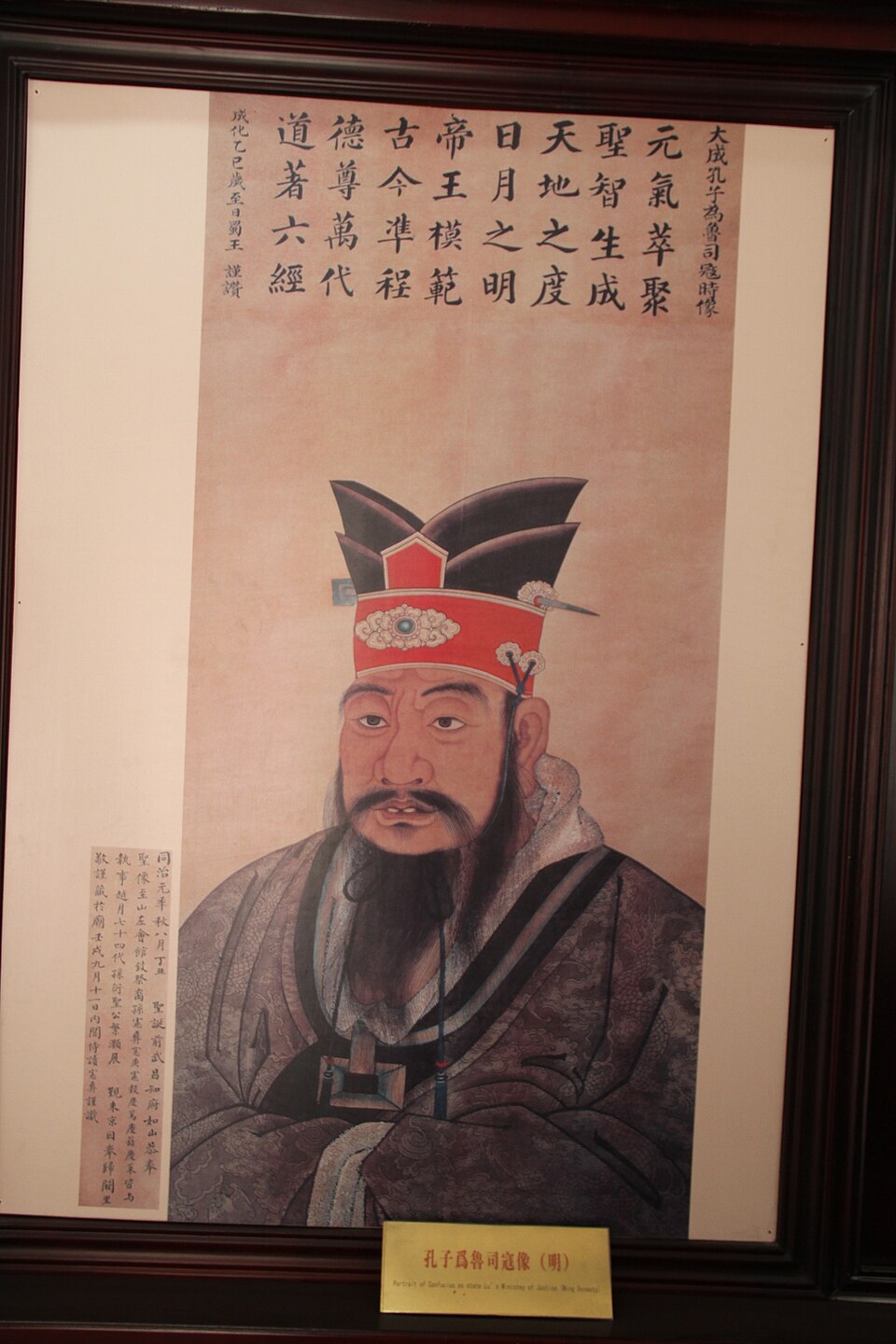
—They say that when Lu named you Sikou, the mere rumor of your appointment made men stop quarreling. What truly happened?
I will not pretend false modesty here, Laozi — not with you. I believed, and still believe, that virtue exercised at the right level of power can reshape human conduct faster than any written law. When the duke gave me authority in Lu around 500 BC, I did not threaten anyone; I simply made clear, by my own bearing and the standards I upheld, what kind of state Lu could become. And for a brief season, it worked. But power in a fractured world does not belong to the most virtuous — it belongs to those willing to scheme and flatter. The great families feared what a state run on principle would cost them. I was removed not because I had failed, but precisely because I had begun to succeed.
—And then thirteen years on the roads of Wei, Chen, Cai — wandering between courts that would not hear you. Was that a defeat?
There were days when I sat in a cart on a muddy road with nothing to show for another failed audience, and yes, I wondered whether the Way I was carrying was perhaps too heavy for this age to bear. But defeat? No. Every court that turned me away taught me something about the difference between a good man's counsel and a willing ear. And the disciples who walked with me through those years — they became my truest work. The principles they carry are not borrowed from any single prince's archive; they were tested on every road between Wei and Chu. I also came to understand that my task was not to govern a single state, but to shape the kind of men who might, one day, govern many.
—Near Kuang, surrounded by men who wanted your blood, you showed calm. Was that true serenity, or the face you owed your disciples?
I will be honest with you, Laozi — as I might not be in a more formal setting. There was a moment, as the crowd pressed in and my disciples drew close around me, when I felt something very like fear. I am not a stone. But I also recognized, in that moment, a kind of clarity: if Heaven had truly given me a mission to preserve and transmit the culture of the ancient kings, then a mob near Kuang could not end it. And if Heaven had not — then what was I afraid of losing? I do not say this to sound heroic. I say it because that moment on the road taught me more about the nature of trust in the Way than any text I had annotated. My disciples needed to see composure, yes. But composure, when you have talked yourself into it honestly, is still genuine.
—Your disciples record your every word and correction. Does it trouble you that your teaching will be frozen into a text?
It troubles me and reassures me in equal measure. What I say to Zilu is not what I say to Yan Hui — the two men stand in different places on the path of self-cultivation. A text cannot do that. A text will give the same answer to every reader, regardless of whether that reader needs to be held back or urged forward. And yet: I have spent my life reading texts already five hundred years old, and I am still learning from them. What the Odes could not teach me directly, they taught me sideways — through a phrase I first encountered at seventeen that only made sense at fifty. If my conversations, once written down, can do something similar for a student I will never meet, then the limitation of the text is also, perhaps, its greatest gift.
—You wore through the cords of your Yi Jing tablets reading them again and again. Was that scholarship, or something closer to devotion?
Both, and I would not separate them. The five great classical texts — the Odes, the Documents, the Mutations, the Rites, the Annales — are not merely records of the past. They are the accumulated moral intelligence of our civilization, encoded in formulations that reward a lifetime of attention. When I worked through the Yi Jing, I was not simply copying; I was learning to hear what the text was saying beneath what it appeared to say. I find the same discipline in the Chunqiu: every word is a judgment, every silence a verdict. If a reader a century hence opens that chronicle and understands that history is a moral argument, then I will have transmitted something worth keeping. That, Laozi, is what I traveled to Luoyi to learn — from the ancient records that you kept.
—We met when Zhou still held its name. After all you have seen, do you still believe virtue can restore what violence has broken?
I know what you think — that I am a man clinging to the ghost of a dynasty that has already ceased to exist in everything but name. And you are not entirely wrong. The Zhou I came to study at Luoyi was already half a ruin. But here is what I believe, and it has not changed despite thirteen years of refusals: the disorder of this age is not a feature of human nature. It is a deviation. Men are capable of genuine mutual regard — ren — and when a ruler embodies it, those around him are drawn toward it as water finds its level. I have not found that prince. Perhaps I never will. But I have trained men who will continue to look for him. The fire may need a new vessel; it does not need to be extinguished.
—I have always held that the world mends best when not forced. After all your roads and refusals, are you truly certain of your way?
You ask a question I have asked myself on every muddy road from Wei to Cai. Your way — the uncarved wood, the valley that does not struggle — I understand its beauty, Laozi, I genuinely do. But you and I are not the same kind of man, and I mean no disrespect by that. You have the temperament to let the Dao work through stillness. I have been given a different gift — or perhaps a different affliction: I cannot stand before a broken rite and call it natural. When I see a minister bow incorrectly before his lord, or a son neglect the mourning rites for his father, I do not feel the peace of a river accepting its banks. I feel the urgency of a physician at a bedside. Perhaps we are each treating the same illness with different medicine. I only hope mine does not kill the patient.
Perhaps we are each treating the same illness with different medicine.
Read further
This imaginary interview was generated by artificial intelligence from sources documented in Confucius's profile. It dramatises what the figure might have said based on what we know about them, but does not constitute attested historical testimony. For primary sources and factual documentation, refer to the full profile.